




A man walks 30 m towards north, then 20 m towards east and in the last \[30\sqrt 2 \,m\], towards south-west. The displacement from origin is
A. 10 m towards west
B. 10 m towards east
C. \[60\sqrt 2 \,m\] towards northwest
D. \[60\sqrt 2 \,m\] towards east north
Answer
 Verified
609.9k+ views
Hint: Use the formula for position vector of a certain point in x-y plane. Calculate the x and y components of south-west displacement of the man. Add the total displacement with respect to its direction.
Formula used:
\[\vec S = x\hat i + y\hat j\]
Here, x is the x-coordinate and y is the y-coordinate.
Complete step by step answer:
The position vector of point P in x-y plane is given as,
\[\vec S = x\hat i + y\hat j\]
Here, x is the x-coordinate and y is the y-coordinate.
The displacement of a man is can be drawn as shown in the figure below,
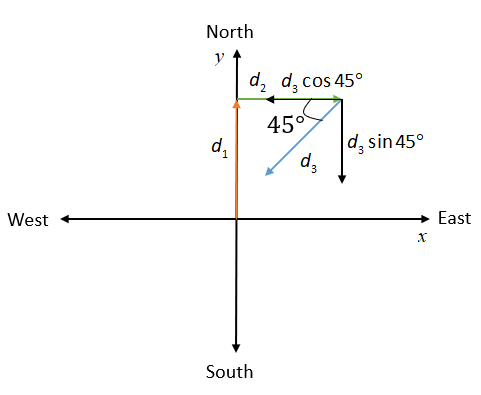
Here, the orange straight-line (\[{d_1}\]) represents the northward displacement, yellow straight-line (\[{d_2}\]) represents eastward displacement and blue straight-line (\[{d_3}\]) represents south-west displacement.
Therefore, the total displacement of a man from origin is,
\[\vec S = \left( {{d_2} - {d_3}\cos 45^\circ } \right)\hat i + \left( {{d_1} - {d_3}\sin 45^\circ } \right)\hat j\]
Here, \[{d_3}\cos 45^\circ \] is the x-component of south-west displacement and \[{d_3}\sin 45^\circ \] is the y-component of south-west displacement,
Substitute 30 m for \[{d_1}\], 20 m for \[{d_2}\] and \[30\sqrt 2 \,m\] for \[{d_3}\] in the above equation.
\[\vec S = \left( {20 - 30\sqrt 2 \cos 45^\circ } \right)\hat i + \left( {30 - 30\sqrt 2 \sin 45^\circ } \right)\hat j\]
\[ \Rightarrow \vec S = \left( {20 - 30} \right)\hat i + 0\hat j\]
\[ \Rightarrow \vec S = - 10\hat i\]
The negative sign implies that the displacement is along the negative direction that is towards west. Therefore, the net displacement from the origin is 10 m towards the west.
So, the correct answer is “Option A”.
Note:
Always specify the direction of the displacement vector.
In this question, we have taken the east and north as positive directions and west and south as negative directions.
Formula used:
\[\vec S = x\hat i + y\hat j\]
Here, x is the x-coordinate and y is the y-coordinate.
Complete step by step answer:
The position vector of point P in x-y plane is given as,
\[\vec S = x\hat i + y\hat j\]
Here, x is the x-coordinate and y is the y-coordinate.
The displacement of a man is can be drawn as shown in the figure below,
Here, the orange straight-line (\[{d_1}\]) represents the northward displacement, yellow straight-line (\[{d_2}\]) represents eastward displacement and blue straight-line (\[{d_3}\]) represents south-west displacement.
Therefore, the total displacement of a man from origin is,
\[\vec S = \left( {{d_2} - {d_3}\cos 45^\circ } \right)\hat i + \left( {{d_1} - {d_3}\sin 45^\circ } \right)\hat j\]
Here, \[{d_3}\cos 45^\circ \] is the x-component of south-west displacement and \[{d_3}\sin 45^\circ \] is the y-component of south-west displacement,
Substitute 30 m for \[{d_1}\], 20 m for \[{d_2}\] and \[30\sqrt 2 \,m\] for \[{d_3}\] in the above equation.
\[\vec S = \left( {20 - 30\sqrt 2 \cos 45^\circ } \right)\hat i + \left( {30 - 30\sqrt 2 \sin 45^\circ } \right)\hat j\]
\[ \Rightarrow \vec S = \left( {20 - 30} \right)\hat i + 0\hat j\]
\[ \Rightarrow \vec S = - 10\hat i\]
The negative sign implies that the displacement is along the negative direction that is towards west. Therefore, the net displacement from the origin is 10 m towards the west.
So, the correct answer is “Option A”.
Note:
Always specify the direction of the displacement vector.
In this question, we have taken the east and north as positive directions and west and south as negative directions.
Recently Updated Pages
Master Class 11 Social Science: Engaging Questions & Answers for Success

Master Class 11 Chemistry: Engaging Questions & Answers for Success
Master Class 12 Business Studies: Engaging Questions & Answers for Success
Master Class 12 Chemistry: Engaging Questions & Answers for Success
Master Class 12 Biology: Engaging Questions & Answers for Success
Class 12 Question and Answer - Your Ultimate Solutions Guide
Trending doubts
One Metric ton is equal to kg A 10000 B 1000 C 100 class 11 physics CBSE
Difference Between Prokaryotic Cells and Eukaryotic Cells
Two of the body parts which do not appear in MRI are class 11 biology CBSE
Explain zero factorial class 11 maths CBSE
10 examples of friction in our daily life
Name the Largest and the Smallest Cell in the Human Body ?