



A man swims across a river with speed of $5km{h^{ - 1}}$(in still water), while a boat goes upstream with speed $12km{h^{ - 1}}$(in still water). How fast and in which direction does the man appear to go to the boatman? Given that the speed of flowing water is$2km{h^{ - 1}}$.
Answer
 Verified
574.5k+ views
Hint: The vector resultant can be used to solve this problem. The direction of the boat is perpendicular to the velocity of the stream and therefore the resultant velocity of the boat will be in the resultant of the velocities of the stream and the boat.
Complete Step by step solution:
It is given in the problem that a man swims across a river with speed of $5km{h^{ - 1}}$(in still water), while a boat goes upstream with speed $12km{h^{ - 1}}$(in still water) and we need to tell in which direction and with what speed the man appears from the boat, if the speed of flowing water is$2km{h^{ - 1}}$.
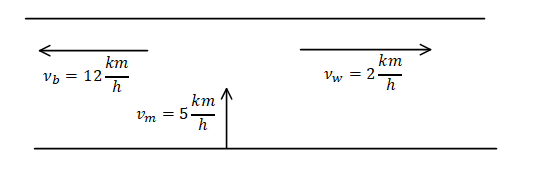
The velocity of the boat with respect to the river is given by,
$ \Rightarrow {v_{b,m}} = \sqrt {{2^2} + {{12}^2}} $
$ \Rightarrow {v_{b,m}} = \sqrt {4 + 144} $
$ \Rightarrow {v_{b,m}} = \sqrt {4 + 144} $
$ \Rightarrow {v_{b,m}} = \sqrt {148} \dfrac{m}{s}$………eq. (1)
The relative velocity of the man with respect to river is given by,
$ \Rightarrow {v_{m,r}} = \sqrt {{2^2} + {5^2}} $
$ \Rightarrow {v_{m,r}} = \sqrt {4 + 25} $
$ \Rightarrow {v_{m,r}} = \sqrt {29} \dfrac{{km}}{h}$……….eq. (2)
The direction in which the man appear to move from the boatman is given by,
$ \Rightarrow \theta = {\cos ^{ - 1}}\left( {\dfrac{{{v_{m,r}}}}{{{v_{b,m}}}}} \right)$
Replacing the values of ${v_b}$ and ${v_m}$ in the above relation from equation (1) and equation (2) we get.
$ \Rightarrow \theta = {\cos ^{ - 1}}\left( {\dfrac{{{v_{m,r}}}}{{{v_{b,m}}}}} \right)$
$ \Rightarrow \theta = {\cos ^{ - 1}}\left( {\dfrac{{\sqrt {29} }}{{\sqrt {148} }}} \right)$
$ \Rightarrow \theta = {\cos ^{ - 1}}\left( {\sqrt {\dfrac{{29}}{{148}}} } \right)$.
$ \Rightarrow \theta = 63 \cdot 72^\circ $
The speed with which the man appears by the boat is given by,
$ \Rightarrow v = \sqrt {148 - 29} $
$ \Rightarrow v = \sqrt {119} \dfrac{{km}}{h}$.
The velocity of the man that appears from the boat is equal to $V = \sqrt {119} \dfrac{m}{s}$ and the direction in which the man appears is equal to$\theta = 63 \cdot 72^\circ $.
Note: The concept of resultant vector is very important and students need to understand and remember this concept. Whenever we cross a river then we cross it the way in which we can cross it in minimum time.
Complete Step by step solution:
It is given in the problem that a man swims across a river with speed of $5km{h^{ - 1}}$(in still water), while a boat goes upstream with speed $12km{h^{ - 1}}$(in still water) and we need to tell in which direction and with what speed the man appears from the boat, if the speed of flowing water is$2km{h^{ - 1}}$.
The velocity of the boat with respect to the river is given by,
$ \Rightarrow {v_{b,m}} = \sqrt {{2^2} + {{12}^2}} $
$ \Rightarrow {v_{b,m}} = \sqrt {4 + 144} $
$ \Rightarrow {v_{b,m}} = \sqrt {4 + 144} $
$ \Rightarrow {v_{b,m}} = \sqrt {148} \dfrac{m}{s}$………eq. (1)
The relative velocity of the man with respect to river is given by,
$ \Rightarrow {v_{m,r}} = \sqrt {{2^2} + {5^2}} $
$ \Rightarrow {v_{m,r}} = \sqrt {4 + 25} $
$ \Rightarrow {v_{m,r}} = \sqrt {29} \dfrac{{km}}{h}$……….eq. (2)
The direction in which the man appear to move from the boatman is given by,
$ \Rightarrow \theta = {\cos ^{ - 1}}\left( {\dfrac{{{v_{m,r}}}}{{{v_{b,m}}}}} \right)$
Replacing the values of ${v_b}$ and ${v_m}$ in the above relation from equation (1) and equation (2) we get.
$ \Rightarrow \theta = {\cos ^{ - 1}}\left( {\dfrac{{{v_{m,r}}}}{{{v_{b,m}}}}} \right)$
$ \Rightarrow \theta = {\cos ^{ - 1}}\left( {\dfrac{{\sqrt {29} }}{{\sqrt {148} }}} \right)$
$ \Rightarrow \theta = {\cos ^{ - 1}}\left( {\sqrt {\dfrac{{29}}{{148}}} } \right)$.
$ \Rightarrow \theta = 63 \cdot 72^\circ $
The speed with which the man appears by the boat is given by,
$ \Rightarrow v = \sqrt {148 - 29} $
$ \Rightarrow v = \sqrt {119} \dfrac{{km}}{h}$.
The velocity of the man that appears from the boat is equal to $V = \sqrt {119} \dfrac{m}{s}$ and the direction in which the man appears is equal to$\theta = 63 \cdot 72^\circ $.
Note: The concept of resultant vector is very important and students need to understand and remember this concept. Whenever we cross a river then we cross it the way in which we can cross it in minimum time.
Recently Updated Pages
Master Class 11 Computer Science: Engaging Questions & Answers for Success

Master Class 11 Business Studies: Engaging Questions & Answers for Success
Master Class 11 Economics: Engaging Questions & Answers for Success
Master Class 11 English: Engaging Questions & Answers for Success
Master Class 11 Maths: Engaging Questions & Answers for Success
Master Class 11 Biology: Engaging Questions & Answers for Success
Trending doubts
One Metric ton is equal to kg A 10000 B 1000 C 100 class 11 physics CBSE
There are 720 permutations of the digits 1 2 3 4 5 class 11 maths CBSE
Discuss the various forms of bacteria class 11 biology CBSE
Draw a diagram of a plant cell and label at least eight class 11 biology CBSE
State the laws of reflection of light
Explain zero factorial class 11 maths CBSE