




A man runs across the roof-top of a tall building and jumps horizontally to land on the roof of the next building which is at a lower height than the first. If his speed is\[9m{s^{ - 1}}\], the horizontal distance between the two buildings is \[10m\] and height difference is\[9m\], will he be able to land on the next building? \[\left( {g = 10m{s^{ - 2}}} \right)\]
Answer
 Verified
515.4k+ views
Hint: We are first going to draw a figure for the information given in the question, then, taking up the horizontal and the vertical motions for the man, we will calculate the time of flight for vertical motion, and then, the horizontal distance covered, which tells us whether he will be able to land or not.
Formula used: The equation of motion is given by
\[y = ut + \dfrac{1}{2}a{t^2}\]
Where, \[y\]is the distance covered, \[u\]is initially speed and \[t\]is time taken.
Complete step by step solution:
Let us first construct a figure for the given situation
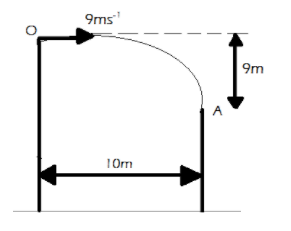
The man’s speed is given as \[9m{s^{ - 1}}\]
The horizontal distance between the buildings is\[10m\]and the height difference is\[9m\]
Let the time taken for the man to fall from points \[O\]to \[A\]be \[t\,\]seconds.
Taking the vertical downward motion from \[O\]to\[A\], we get
$
{y_0} = 0 \\
y = 9m \\
{u_y} = 0 \\
{a_y} = 10m{s^{ - 2}} \\ $
We need to find time, \[t\,\]
The equation of motion is
\[{y_0} = y = {u_y}t + \dfrac{1}{2}{a_y}{t^2}\]
Putting the values in this, we get
\[ - 9 = 0 \times t + \dfrac{1}{2} \times \left( { - 10} \right) \times {t^2}\]
Finding the value of\[t\,\], we get
\[t = \sqrt {\dfrac{{9 \times 2}}{{10}}} = \sqrt {1.8} s\]
Now, considering the horizontal direction of motion,
\[{v_x} = 9m{s^{ - 1}}\]
If \[R\]is the horizontal distance travelled,
\[R = {v_x}t\]
Putting the values in this,
$ R = 9 \times \sqrt {1.8} \\
\Rightarrow R = 12m \\ $
Thus, the man will be able to land on the building.
Note: It is important to note that the charged particles can be created or destroyed as long as the net charge on the particles before and after the process remains the same. But in that case also, charge is not being created but the charged particles only transfer charge from one system to another.
Formula used: The equation of motion is given by
\[y = ut + \dfrac{1}{2}a{t^2}\]
Where, \[y\]is the distance covered, \[u\]is initially speed and \[t\]is time taken.
Complete step by step solution:
Let us first construct a figure for the given situation
The man’s speed is given as \[9m{s^{ - 1}}\]
The horizontal distance between the buildings is\[10m\]and the height difference is\[9m\]
Let the time taken for the man to fall from points \[O\]to \[A\]be \[t\,\]seconds.
Taking the vertical downward motion from \[O\]to\[A\], we get
$
{y_0} = 0 \\
y = 9m \\
{u_y} = 0 \\
{a_y} = 10m{s^{ - 2}} \\ $
We need to find time, \[t\,\]
The equation of motion is
\[{y_0} = y = {u_y}t + \dfrac{1}{2}{a_y}{t^2}\]
Putting the values in this, we get
\[ - 9 = 0 \times t + \dfrac{1}{2} \times \left( { - 10} \right) \times {t^2}\]
Finding the value of\[t\,\], we get
\[t = \sqrt {\dfrac{{9 \times 2}}{{10}}} = \sqrt {1.8} s\]
Now, considering the horizontal direction of motion,
\[{v_x} = 9m{s^{ - 1}}\]
If \[R\]is the horizontal distance travelled,
\[R = {v_x}t\]
Putting the values in this,
$ R = 9 \times \sqrt {1.8} \\
\Rightarrow R = 12m \\ $
Thus, the man will be able to land on the building.
Note: It is important to note that the charged particles can be created or destroyed as long as the net charge on the particles before and after the process remains the same. But in that case also, charge is not being created but the charged particles only transfer charge from one system to another.
Recently Updated Pages
Master Class 11 Computer Science: Engaging Questions & Answers for Success

Master Class 11 Business Studies: Engaging Questions & Answers for Success
Master Class 11 Economics: Engaging Questions & Answers for Success
Master Class 11 English: Engaging Questions & Answers for Success
Master Class 11 Maths: Engaging Questions & Answers for Success
Master Class 11 Biology: Engaging Questions & Answers for Success
Trending doubts
One Metric ton is equal to kg A 10000 B 1000 C 100 class 11 physics CBSE
There are 720 permutations of the digits 1 2 3 4 5 class 11 maths CBSE
Discuss the various forms of bacteria class 11 biology CBSE
Draw a diagram of a plant cell and label at least eight class 11 biology CBSE
State the laws of reflection of light
Explain zero factorial class 11 maths CBSE