




A man running on a horizontal road at \[8\,{\text{km/h}}\] finds the rain falling vertically. He increases his speed to \[12\,{\text{km/h}}\] and finds that the drops make angle \[30^\circ \] with the vertical. Find the speed and direction of the rain with respect to the road.
Answer
 Verified
562.8k+ views
Hint: Use the concept of relativity to solve this problem. First calculate the relative velocity of the rain with respect to the ground. Then first calculate the horizontal component of velocity of the rain for the man in the second condition and use the trigonometric relation and calculate the velocity of the rain with respect to the ground. Calculate the net velocity of the rain. Using the components of the velocity of rain with respect to ground, calculate the angle made by the rain with the vertical.
Formula sued:
The relative velocity \[{v_{BA}}\] of object B with respect to object A is
\[{v_{BA}} = {v_B} - {v_A}\] …… (1)
Here, \[{v_B}\] is the velocity of object B and \[{v_A}\] is the velocity of object A.
Complete step by step answer:
We have given that the horizontal velocity of the man is \[8\,{\text{km/h}}\].
\[{v_{mx}} = 8\,{\text{km/h}}\]
The man finds that the rain is falling vertically. Hence, the relative velocity of the rain with respect to the man in the horizontal direction is zero.
\[{v_{Rmx}} = 0\,{\text{km/h}}\]
\[ \Rightarrow {v_{Rx}} - {v_{mx}} = 0\,{\text{km/h}}\]
\[ \Rightarrow {v_{Rx}} = {v_{mx}}\]
\[ \Rightarrow {v_{Rx}} = 8\,{\text{km/h}}\]
Hence, the horizontal component of velocity of the rain with respect to ground is \[8\,{\text{km/h}}\].
In the second case, the velocity of the man with respect to the ground is \[12\,{\text{km/h}}\]. At this speed, the man finds the rain making an angle of \[30^\circ \] with the vertical.
\[{v_{mx}} = 12\,{\text{km/h}}\]
\[\theta = 30^\circ \]
Now the horizontal component of the velocity of the rain with respect to the man is
\[{v_x} = {v_{Rx}} - {v_{mx}}\]
\[ \Rightarrow {v_x} = \left( {8\,{\text{km/h}}} \right) - \left( {12\,{\text{km/h}}} \right)\]
\[ \Rightarrow {v_x} = - 4\,{\text{km/h}}\]
Hence, the horizontal component of the velocity of the rain for the man is \[ - 4\,{\text{km/h}}\].
Let us consider tan of the angle made by the rain with the vertical.
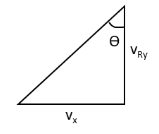
\[\tan \theta = \dfrac{{\left| {{v_x}} \right|}}{{\left| {{v_{Ry}}} \right|}}\]
\[ \Rightarrow \left| {{v_{Ry}}} \right| = \dfrac{{\left| {{v_x}} \right|}}{{\tan \theta }}\]
Substitute \[4\,{\text{km/h}}\] for \[{v_x}\] and \[30^\circ \] for \[\theta \] in the above equation.
\[ \Rightarrow \left| {{v_{Ry}}} \right| = \dfrac{{4\,{\text{km/h}}}}{{\tan 30^\circ }}\]
\[ \Rightarrow \left| {{v_{Ry}}} \right| = \dfrac{{4\,{\text{km/h}}}}{{\dfrac{1}{{\sqrt 3 }}}}\]
\[ \Rightarrow \left| {{v_{Ry}}} \right| = 4\sqrt 3 \,{\text{km/h}}\]
Hence, the vertical component of the rain with respect to the man is \[4\sqrt 3 \,{\text{km/h}}\].
The net velocity of the rain is
\[{v_R} = \sqrt {v_{Rx}^2 + v_{Ry}^2} \]
\[ \Rightarrow {v_R} = \sqrt {{{\left( {8\,{\text{km/h}}} \right)}^2} + {{\left( {4\sqrt 3 \,{\text{km/h}}} \right)}^2}} \]
\[ \Rightarrow {v_R} = \sqrt {64 + 48} \]
\[ \Rightarrow {v_R} = \sqrt {112} \]
\[ \Rightarrow {v_R} = 4\sqrt 7 \,{\text{km/h}}\]
Hence, the magnitude of the velocity of the rain is \[4\sqrt 7 \,{\text{km/h}}\].
Let us now calculate the angle made by the rain with the vertical.
\[\tan \alpha = \dfrac{{{v_{Rx}}}}{{{v_{Ry}}}}\]
\[ \Rightarrow \tan \alpha = \dfrac{{8\,{\text{km/h}}}}{{4\sqrt 3 \,{\text{km/h}}}}\]
\[ \Rightarrow \tan \alpha = \dfrac{2}{{\sqrt 3 }}\]
\[ \therefore \alpha = {\tan ^{ - 1}}\left( {\dfrac{2}{{\sqrt 3 }}} \right)\]
Hence, the rain makes an angle of \[{\tan ^{ - 1}}\left( {\dfrac{2}{{\sqrt 3 }}} \right)\] with the vertical.
Hence, the magnitude of velocity of the rain is \[4\sqrt 7 \,{\text{km/h}}\] and the rain makes an angle of \[{\tan ^{ - 1}}\left( {\dfrac{2}{{\sqrt 3 }}} \right)\] with the vertical.
Note:The students should not get confused between the different velocities of the rain. Using the first condition, we can calculate the horizontal velocity of rain with respect to ground. Then using the second condition, we have first calculated the horizontal component of velocity of rain with respect to the man and not ground. Using this velocity, we have calculated the vertical component of velocity of the rain with respect to the ground.
Formula sued:
The relative velocity \[{v_{BA}}\] of object B with respect to object A is
\[{v_{BA}} = {v_B} - {v_A}\] …… (1)
Here, \[{v_B}\] is the velocity of object B and \[{v_A}\] is the velocity of object A.
Complete step by step answer:
We have given that the horizontal velocity of the man is \[8\,{\text{km/h}}\].
\[{v_{mx}} = 8\,{\text{km/h}}\]
The man finds that the rain is falling vertically. Hence, the relative velocity of the rain with respect to the man in the horizontal direction is zero.
\[{v_{Rmx}} = 0\,{\text{km/h}}\]
\[ \Rightarrow {v_{Rx}} - {v_{mx}} = 0\,{\text{km/h}}\]
\[ \Rightarrow {v_{Rx}} = {v_{mx}}\]
\[ \Rightarrow {v_{Rx}} = 8\,{\text{km/h}}\]
Hence, the horizontal component of velocity of the rain with respect to ground is \[8\,{\text{km/h}}\].
In the second case, the velocity of the man with respect to the ground is \[12\,{\text{km/h}}\]. At this speed, the man finds the rain making an angle of \[30^\circ \] with the vertical.
\[{v_{mx}} = 12\,{\text{km/h}}\]
\[\theta = 30^\circ \]
Now the horizontal component of the velocity of the rain with respect to the man is
\[{v_x} = {v_{Rx}} - {v_{mx}}\]
\[ \Rightarrow {v_x} = \left( {8\,{\text{km/h}}} \right) - \left( {12\,{\text{km/h}}} \right)\]
\[ \Rightarrow {v_x} = - 4\,{\text{km/h}}\]
Hence, the horizontal component of the velocity of the rain for the man is \[ - 4\,{\text{km/h}}\].
Let us consider tan of the angle made by the rain with the vertical.
\[\tan \theta = \dfrac{{\left| {{v_x}} \right|}}{{\left| {{v_{Ry}}} \right|}}\]
\[ \Rightarrow \left| {{v_{Ry}}} \right| = \dfrac{{\left| {{v_x}} \right|}}{{\tan \theta }}\]
Substitute \[4\,{\text{km/h}}\] for \[{v_x}\] and \[30^\circ \] for \[\theta \] in the above equation.
\[ \Rightarrow \left| {{v_{Ry}}} \right| = \dfrac{{4\,{\text{km/h}}}}{{\tan 30^\circ }}\]
\[ \Rightarrow \left| {{v_{Ry}}} \right| = \dfrac{{4\,{\text{km/h}}}}{{\dfrac{1}{{\sqrt 3 }}}}\]
\[ \Rightarrow \left| {{v_{Ry}}} \right| = 4\sqrt 3 \,{\text{km/h}}\]
Hence, the vertical component of the rain with respect to the man is \[4\sqrt 3 \,{\text{km/h}}\].
The net velocity of the rain is
\[{v_R} = \sqrt {v_{Rx}^2 + v_{Ry}^2} \]
\[ \Rightarrow {v_R} = \sqrt {{{\left( {8\,{\text{km/h}}} \right)}^2} + {{\left( {4\sqrt 3 \,{\text{km/h}}} \right)}^2}} \]
\[ \Rightarrow {v_R} = \sqrt {64 + 48} \]
\[ \Rightarrow {v_R} = \sqrt {112} \]
\[ \Rightarrow {v_R} = 4\sqrt 7 \,{\text{km/h}}\]
Hence, the magnitude of the velocity of the rain is \[4\sqrt 7 \,{\text{km/h}}\].
Let us now calculate the angle made by the rain with the vertical.
\[\tan \alpha = \dfrac{{{v_{Rx}}}}{{{v_{Ry}}}}\]
\[ \Rightarrow \tan \alpha = \dfrac{{8\,{\text{km/h}}}}{{4\sqrt 3 \,{\text{km/h}}}}\]
\[ \Rightarrow \tan \alpha = \dfrac{2}{{\sqrt 3 }}\]
\[ \therefore \alpha = {\tan ^{ - 1}}\left( {\dfrac{2}{{\sqrt 3 }}} \right)\]
Hence, the rain makes an angle of \[{\tan ^{ - 1}}\left( {\dfrac{2}{{\sqrt 3 }}} \right)\] with the vertical.
Hence, the magnitude of velocity of the rain is \[4\sqrt 7 \,{\text{km/h}}\] and the rain makes an angle of \[{\tan ^{ - 1}}\left( {\dfrac{2}{{\sqrt 3 }}} \right)\] with the vertical.
Note:The students should not get confused between the different velocities of the rain. Using the first condition, we can calculate the horizontal velocity of rain with respect to ground. Then using the second condition, we have first calculated the horizontal component of velocity of rain with respect to the man and not ground. Using this velocity, we have calculated the vertical component of velocity of the rain with respect to the ground.
Recently Updated Pages
Master Class 11 Computer Science: Engaging Questions & Answers for Success

Master Class 11 Business Studies: Engaging Questions & Answers for Success
Master Class 11 Economics: Engaging Questions & Answers for Success
Master Class 11 English: Engaging Questions & Answers for Success
Master Class 11 Maths: Engaging Questions & Answers for Success
Master Class 11 Biology: Engaging Questions & Answers for Success
Trending doubts
One Metric ton is equal to kg A 10000 B 1000 C 100 class 11 physics CBSE
There are 720 permutations of the digits 1 2 3 4 5 class 11 maths CBSE
Discuss the various forms of bacteria class 11 biology CBSE
Draw a diagram of a plant cell and label at least eight class 11 biology CBSE
State the laws of reflection of light
Explain zero factorial class 11 maths CBSE