




A man on the top of a vertical tower observes a car moving at a uniform speed coming directly towards it. If it takes 12 minutes for the angle of depression to change its measure from 30 to 45, how soon after this will the car reach the tower?
Answer
 Verified
586.5k+ views
Hint: “In a right-angled triangle, the square of the hypotenuse side is equal to the sum of squares of the other two sides”, this is the Pythagoras theorem. The sides of this triangle have been named as Perpendicular, Base and Hypotenuse. Here, the hypotenuse is the longest side, as it is opposite to the angle \[90^\circ .\]
Approaching by diagram use of Pythagoras theorem: \[{H^2} = {B^2} + {P^2}\]
Substituting\[H = L\],\[B = A\]and \[P = K\], we have:
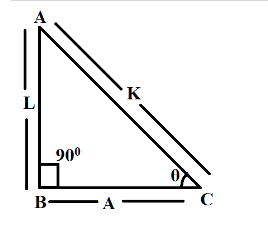
\[{L^2} + {A^2} = {K^2}\] and by trigonometric ratios:
\[\sin \theta = \dfrac{L}{K}\]; \[\cos \theta = \dfrac{A}{K}\]; \[\tan \theta = \dfrac{L}{K}\]
Complete step-by-step answer:
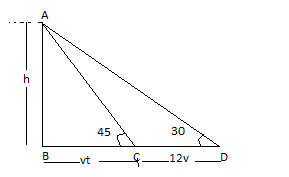
Let the height of the tower be h
Angles of depression of moving cars with respect to man changes from \[{30^ \circ }\]to\[{45^ \circ }\].
We know
Distance = Speed x time
This can be written as
Distance \[ = v \times t = vt\]
Now in \[\vartriangle ABC\]
\[
\tan {45^ \circ } = \dfrac{{AB}}{{BC}} \\
1 = \dfrac{h}{{vt}} \\
vt = h - - (i) \\
\][Since\[\tan {45^ \circ } = 1\]]
Now in\[\vartriangle ABD\]
\[
\tan {30^ \circ } = \dfrac{{AB}}{{BD}} \\
\tan {30^ \circ } = \dfrac{h}{{vt + 12v}} \\
\]
Hence by solving
\[
\tan {30^ \circ } = \dfrac{h}{{vt + 12v}} \\
\dfrac{1}{{\sqrt 3 }} = \dfrac{h}{{vt + 12v}} \\
vt + 12v = \sqrt {30} h \\
\]
Since \[vt = h\]from equation (i), we can write
\[
vt + 12v = \sqrt 3 h \\
vt + 12v = \sqrt 3 vt \\
\sqrt 3 vt - vt = 12v \\
vt\left( {\sqrt 3 - 1} \right) = 12v \\
\left( {\sqrt 3 - 1} \right) = \dfrac{{12v}}{{vt}} \\
\left( {\sqrt 3 - 1} \right) = \dfrac{{12}}{t} \\
\]
Hence by solving, we get
\[
1.732 - 1 = \dfrac{{12}}{t} \\
0.732 = \dfrac{{12}}{t} \\
t = \dfrac{{12}}{{0.732}} \\
\]
Hence the time is taken by the car till it reaches the tower
\[
t = \dfrac{{12}}{{0.732}} \\
= \dfrac{{1200}}{{732}} \\
= 16.43\min \\
\]
Note: Students should not be confused with the angle of elevation and the angle of depression. These are two different things. The angle of elevation is the rising angle generally, from the foot while the angle of depression is measured for the top of the tower.
Approaching by diagram use of Pythagoras theorem: \[{H^2} = {B^2} + {P^2}\]
Substituting\[H = L\],\[B = A\]and \[P = K\], we have:
\[{L^2} + {A^2} = {K^2}\] and by trigonometric ratios:
\[\sin \theta = \dfrac{L}{K}\]; \[\cos \theta = \dfrac{A}{K}\]; \[\tan \theta = \dfrac{L}{K}\]
Complete step-by-step answer:
Let the height of the tower be h
Angles of depression of moving cars with respect to man changes from \[{30^ \circ }\]to\[{45^ \circ }\].
We know
Distance = Speed x time
This can be written as
Distance \[ = v \times t = vt\]
Now in \[\vartriangle ABC\]
\[
\tan {45^ \circ } = \dfrac{{AB}}{{BC}} \\
1 = \dfrac{h}{{vt}} \\
vt = h - - (i) \\
\][Since\[\tan {45^ \circ } = 1\]]
Now in\[\vartriangle ABD\]
\[
\tan {30^ \circ } = \dfrac{{AB}}{{BD}} \\
\tan {30^ \circ } = \dfrac{h}{{vt + 12v}} \\
\]
Hence by solving
\[
\tan {30^ \circ } = \dfrac{h}{{vt + 12v}} \\
\dfrac{1}{{\sqrt 3 }} = \dfrac{h}{{vt + 12v}} \\
vt + 12v = \sqrt {30} h \\
\]
Since \[vt = h\]from equation (i), we can write
\[
vt + 12v = \sqrt 3 h \\
vt + 12v = \sqrt 3 vt \\
\sqrt 3 vt - vt = 12v \\
vt\left( {\sqrt 3 - 1} \right) = 12v \\
\left( {\sqrt 3 - 1} \right) = \dfrac{{12v}}{{vt}} \\
\left( {\sqrt 3 - 1} \right) = \dfrac{{12}}{t} \\
\]
Hence by solving, we get
\[
1.732 - 1 = \dfrac{{12}}{t} \\
0.732 = \dfrac{{12}}{t} \\
t = \dfrac{{12}}{{0.732}} \\
\]
Hence the time is taken by the car till it reaches the tower
\[
t = \dfrac{{12}}{{0.732}} \\
= \dfrac{{1200}}{{732}} \\
= 16.43\min \\
\]
Note: Students should not be confused with the angle of elevation and the angle of depression. These are two different things. The angle of elevation is the rising angle generally, from the foot while the angle of depression is measured for the top of the tower.
Recently Updated Pages
Master Class 11 English: Engaging Questions & Answers for Success

Master Class 11 Maths: Engaging Questions & Answers for Success
Master Class 11 Biology: Engaging Questions & Answers for Success
Master Class 11 Social Science: Engaging Questions & Answers for Success
Master Class 11 Physics: Engaging Questions & Answers for Success
Master Class 11 Accountancy: Engaging Questions & Answers for Success
Trending doubts
One Metric ton is equal to kg A 10000 B 1000 C 100 class 11 physics CBSE
Discuss the various forms of bacteria class 11 biology CBSE
Draw a diagram of a plant cell and label at least eight class 11 biology CBSE
State the laws of reflection of light
Explain zero factorial class 11 maths CBSE
10 examples of friction in our daily life