




A man on the deck of a ship is 10 m above the water level. He observes that the angle of elevation of the top of the cliff is ${{45}^{\circ }}$ and the angle of a depression of the base is ${{30}^{\circ }}$ . Calculate the distance of the cliff from the ship and the height of the cliff.
Answer
 Verified
645k+ views
Hint: We first draw the figure according to the information given in the question. Assume the distance of the cliff from the ship be ‘x’ and height of the cliff be $\left( 10+h \right)$ meters. Consider a triangle, use$\text{tan }\!\!\theta\!\!\text{ =}\dfrac{\text{perpendicular}}{\text{base}}$ in that triangle to find the relation between x and h. Now, consider another triangle and use $\tan \theta =\dfrac{p}{b}$ in that triangle to find the value x. After that calculate h using the relation between h and x obtained above. Now the height of the cliff would be $\left( 10+h \right)$ m.
Complete step by step answer:
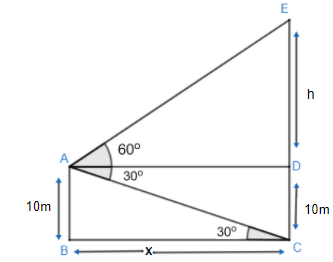
Let a man stand on the deck of a ship at point A, such that AB$=10m$ and let CE be the hill.
Thus, $AB=CD=10m$
The top and bottom of a hill E and C respectively.
Given, we have the angle of depression of the base C of the hill observed from A in ${{30}^{\circ }}$ and the angle of elevation of the top of the hill observed from A is ${{60}^{\circ }}$ .
Then, we can clearly see in the figure
$\angle EAD={{60}^{\circ }}$ and
$\angle CAD=\angle BCA={{30}^{\circ }}$ (Alternate angles)
Let, we have,
$AD=BC=x$ meters
And $DE=h$ meters.
Now, we consider $\Delta ADE$ ,
So, in $\Delta ADE$ , $\text{tan}\angle \text{EAD=}\dfrac{\text{perpendicular}}{\text{base}}$ .
$\tan \angle EAD=\dfrac{DE}{AD}$
We have, $\angle EAD={{60}^{\circ }}$ .
$DE=h$ meters
$AD=x$ meters.
$\Rightarrow \tan {{60}^{\circ }}=\dfrac{h}{x}$ , ( we know that, $\tan {{60}^{\circ }}=\sqrt{3}$ )
$\Rightarrow \sqrt{3}=\dfrac{h}{x}$ ,
$\Rightarrow h=\sqrt{3}x$ ……………………. (1)
Now, we consider $\Delta ABC$ ,
So, in $\Delta ABC$ we have $\tan \angle DAC=\dfrac{AB}{BC}$ .
As, $\text{tan }\!\!\theta\!\!\text{ =}\dfrac{\text{perpendicular}}{\text{base}}$ and we know, $\angle DAC={{30}^{\circ }}$
$\therefore \tan {{30}^{\circ }}=\dfrac{AB}{BC}$ , we have,
$AB=10$ meters, $BC=x$ meters.
$\Rightarrow \dfrac{1}{\sqrt{3}}=\dfrac{10}{x}$ (Since, we know that $\tan {{30}^{\circ }}=\dfrac{1}{\sqrt{3}}$ )
$\Rightarrow x=10\sqrt{3}$ Meters…………………….. (2)
Now, we can substitute the value of x from equation (2) in equation (1), we have
\[\begin{align}
& \Rightarrow h=\sqrt{3}x \\
& \Rightarrow h=\left( \sqrt{3}\times 10\sqrt{3} \right) \\
& \Rightarrow h=\left( 10\times 3 \right) \\
& \Rightarrow h=30 \\
\end{align}\]
So, the height of the hill is 40 m & the distance of the hill from the ship is $10\sqrt{3}$ meter.
Note: Students generally make mistakes in recognizing the angle of depression.
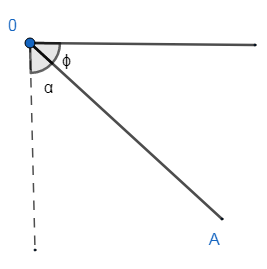
If from point ‘O’, we are watching point ‘A’, angle ‘∅’ is the angle of depression. But students get confused and take angle ‘α’ as an angle of depression.
Complete step by step answer:
Let a man stand on the deck of a ship at point A, such that AB$=10m$ and let CE be the hill.
Thus, $AB=CD=10m$
The top and bottom of a hill E and C respectively.
Given, we have the angle of depression of the base C of the hill observed from A in ${{30}^{\circ }}$ and the angle of elevation of the top of the hill observed from A is ${{60}^{\circ }}$ .
Then, we can clearly see in the figure
$\angle EAD={{60}^{\circ }}$ and
$\angle CAD=\angle BCA={{30}^{\circ }}$ (Alternate angles)
Let, we have,
$AD=BC=x$ meters
And $DE=h$ meters.
Now, we consider $\Delta ADE$ ,
So, in $\Delta ADE$ , $\text{tan}\angle \text{EAD=}\dfrac{\text{perpendicular}}{\text{base}}$ .
$\tan \angle EAD=\dfrac{DE}{AD}$
We have, $\angle EAD={{60}^{\circ }}$ .
$DE=h$ meters
$AD=x$ meters.
$\Rightarrow \tan {{60}^{\circ }}=\dfrac{h}{x}$ , ( we know that, $\tan {{60}^{\circ }}=\sqrt{3}$ )
$\Rightarrow \sqrt{3}=\dfrac{h}{x}$ ,
$\Rightarrow h=\sqrt{3}x$ ……………………. (1)
Now, we consider $\Delta ABC$ ,
So, in $\Delta ABC$ we have $\tan \angle DAC=\dfrac{AB}{BC}$ .
As, $\text{tan }\!\!\theta\!\!\text{ =}\dfrac{\text{perpendicular}}{\text{base}}$ and we know, $\angle DAC={{30}^{\circ }}$
$\therefore \tan {{30}^{\circ }}=\dfrac{AB}{BC}$ , we have,
$AB=10$ meters, $BC=x$ meters.
$\Rightarrow \dfrac{1}{\sqrt{3}}=\dfrac{10}{x}$ (Since, we know that $\tan {{30}^{\circ }}=\dfrac{1}{\sqrt{3}}$ )
$\Rightarrow x=10\sqrt{3}$ Meters…………………….. (2)
Now, we can substitute the value of x from equation (2) in equation (1), we have
\[\begin{align}
& \Rightarrow h=\sqrt{3}x \\
& \Rightarrow h=\left( \sqrt{3}\times 10\sqrt{3} \right) \\
& \Rightarrow h=\left( 10\times 3 \right) \\
& \Rightarrow h=30 \\
\end{align}\]
So, the height of the hill is 40 m & the distance of the hill from the ship is $10\sqrt{3}$ meter.
Note: Students generally make mistakes in recognizing the angle of depression.
If from point ‘O’, we are watching point ‘A’, angle ‘∅’ is the angle of depression. But students get confused and take angle ‘α’ as an angle of depression.
Recently Updated Pages
Basicity of sulphurous acid and sulphuric acid are

Master Class 12 Economics: Engaging Questions & Answers for Success
Master Class 12 Biology: Engaging Questions & Answers for Success
Master Class 11 English: Engaging Questions & Answers for Success
Master Class 11 Physics: Engaging Questions & Answers for Success
Master Class 11 Computer Science: Engaging Questions & Answers for Success
Trending doubts
What is the Total Duration of Football Match?
Explain the Treaty of Vienna of 1815 class 10 social science CBSE
In football, which nation is called "La Roja"?
Why is there a time difference of about 5 hours between class 10 social science CBSE
10 examples of evaporation in daily life with explanations
What is the full form of POSCO class 10 social science CBSE