




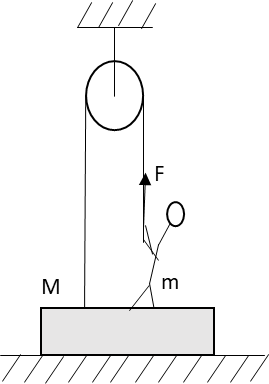
A man of mass \[m\] is standing on a board and pulling the board of mass \[m\] up with a force \[F\] by the pulley system as shown. Normal reaction between man and board is
A.\[mg - F\]
B. \[mg + F\]
C. \[\left( {m + M} \right)g + F\]
D. \[\left( {m - M} \right)g - F\]
Answer
 Verified
607.5k+ views
Hint: Use the expression for Newton’s second law of motion. Draw a free body diagram of the man. Apply Newton’s second law of motion to the man in vertical direction and derive the equation for the normal force exerted by the surface of the board on the man.
Formula used:
The expression for Newton’s second law of motion is given by
\[{F_{net}} = ma\] …… (1)
Here, \[{F_{net}}\] is the net force acting on the object, \[m\] is the mass of the object and \[a\] is acceleration of the object.
Complete step by step answer:
We have given that a man of mass \[m\] is standing on the board and pulling the same board of mass \[M\] with a force \[F\].
Let us first draw the free body diagram of the man.

In the above free body diagram, \[mg\] is the weight of the man acting in the downward direction, \[F\] is the force by which the man is pulling up the board and \[N\] is the normal force exerted by the surface of the board on the man.
The man is in a steady state with no motion in any direction. Hence, the acceleration of the man is zero. Hence, the right hand side term in the expression of Newton’s second law of motion becomes zero.
Apply Newton’s second law of motion on the man in the vertical direction.
\[F + N - mg = 0\]
\[ \Rightarrow N = mg - F\]
Therefore, the normal force exerted by the surface of the board on man is \[mg - F\].
So, the correct answer is “Option A”.
Note:
The students may apply Newton’s second law of motion to the whole system of man, board and pulley. But the answer for the normal force obtained in such a way is not in the given options and it will be incorrect also as we have asked only the normal force exerted by the board surface on the man.
Formula used:
The expression for Newton’s second law of motion is given by
\[{F_{net}} = ma\] …… (1)
Here, \[{F_{net}}\] is the net force acting on the object, \[m\] is the mass of the object and \[a\] is acceleration of the object.
Complete step by step answer:
We have given that a man of mass \[m\] is standing on the board and pulling the same board of mass \[M\] with a force \[F\].
Let us first draw the free body diagram of the man.
In the above free body diagram, \[mg\] is the weight of the man acting in the downward direction, \[F\] is the force by which the man is pulling up the board and \[N\] is the normal force exerted by the surface of the board on the man.
The man is in a steady state with no motion in any direction. Hence, the acceleration of the man is zero. Hence, the right hand side term in the expression of Newton’s second law of motion becomes zero.
Apply Newton’s second law of motion on the man in the vertical direction.
\[F + N - mg = 0\]
\[ \Rightarrow N = mg - F\]
Therefore, the normal force exerted by the surface of the board on man is \[mg - F\].
So, the correct answer is “Option A”.
Note:
The students may apply Newton’s second law of motion to the whole system of man, board and pulley. But the answer for the normal force obtained in such a way is not in the given options and it will be incorrect also as we have asked only the normal force exerted by the board surface on the man.
Recently Updated Pages
Master Class 12 Economics: Engaging Questions & Answers for Success

Master Class 12 English: Engaging Questions & Answers for Success
Master Class 12 Social Science: Engaging Questions & Answers for Success
Master Class 12 Maths: Engaging Questions & Answers for Success
Master Class 12 Physics: Engaging Questions & Answers for Success
Master Class 9 General Knowledge: Engaging Questions & Answers for Success
Trending doubts
One Metric ton is equal to kg A 10000 B 1000 C 100 class 11 physics CBSE
Difference Between Prokaryotic Cells and Eukaryotic Cells
Find the value of the expression given below sin 30circ class 11 maths CBSE
Two of the body parts which do not appear in MRI are class 11 biology CBSE
Draw a diagram of nephron and explain its structur class 11 biology CBSE
10 examples of friction in our daily life