




A man of mass m climbs on a rope of length L suspended below a balloon of mass H. The balloon is stationary with respect to ground. If the man begins to climb up the rope at a speed ${v_{rel}}$ $($relative to rope$)$. In what direction and with what speed $($relative to ground$)$ will the balloon move ?
(A) downwards, $\dfrac{{m{v_{rel}}}}{{m + H}}$
(B) upwards, $\dfrac{{m{v_{rel}}}}{{m + H}}$
(C) downwards, $\dfrac{{m{v_{rel}}}}{M}$
(D) downwards, $\dfrac{{(m + m){v_{rel}}}}{M}$
Answer
 Verified
587.7k+ views
Hint:In order to solve above problem, first we have to remember the concept of relative motion.Now using conservation of momentum we can calculate the relative speed of the balloon with respect to ground.
Complete step by step solution:
Here given that velocity of man with respect to rope is ${v_{rel}}$.
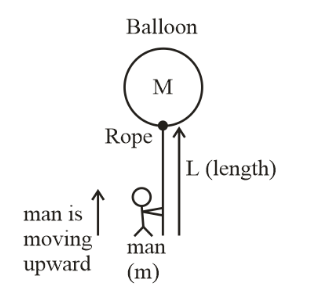
Let velocity of man respect to ground, velocity of balloon respect to ground and velocity of man respect to balloon is ${v_{MG}}$, ${v_{BG}}$ and ${v_{MB}}$ respectively.
According to diagram we can write
${v_{MB}} = {v_{MG}} - {v_{BG}}$
So, ${v_{MG}} = {v_{MG}} + {v_{BG}}$ …..(1)
Now, on applying conservation of momentum
$m{v_{MG}} + m{v_{BG}} = 0$
Given that
$m = $ mass of man
$M = $ mass of balloon
From equation 1
$m({v_{MB}} + {v_{BG}}) + m{v_{BG}} = 0$
$\Rightarrow m{v_{MB}} + {v_{BG}}(m + M) = 0$
$\Rightarrow m{v_{MB}} = - (m + H){v_{BG}}$
$\Rightarrow{v_{BG}} = \dfrac{{ - m}}{{(m + M)}}{v_{MB}}$
Given that ${v_{MB}} = {v_{rel}}$
$\therefore {v_{BG}} = \dfrac{{ - m}}{{(m + M)}}{v_{rel}}$
Here negative sign represents the direction balloon i.e., downwards respect to ground.
Hence, option A is the correct answer.
Note:Many time students may get confused with the concept of relative motion and frame of reference. Always remember that time does not depend on the frame of ref. and relative motion with the help of relative motion numerical can be solved easier.
Complete step by step solution:
Here given that velocity of man with respect to rope is ${v_{rel}}$.
Let velocity of man respect to ground, velocity of balloon respect to ground and velocity of man respect to balloon is ${v_{MG}}$, ${v_{BG}}$ and ${v_{MB}}$ respectively.
According to diagram we can write
${v_{MB}} = {v_{MG}} - {v_{BG}}$
So, ${v_{MG}} = {v_{MG}} + {v_{BG}}$ …..(1)
Now, on applying conservation of momentum
$m{v_{MG}} + m{v_{BG}} = 0$
Given that
$m = $ mass of man
$M = $ mass of balloon
From equation 1
$m({v_{MB}} + {v_{BG}}) + m{v_{BG}} = 0$
$\Rightarrow m{v_{MB}} + {v_{BG}}(m + M) = 0$
$\Rightarrow m{v_{MB}} = - (m + H){v_{BG}}$
$\Rightarrow{v_{BG}} = \dfrac{{ - m}}{{(m + M)}}{v_{MB}}$
Given that ${v_{MB}} = {v_{rel}}$
$\therefore {v_{BG}} = \dfrac{{ - m}}{{(m + M)}}{v_{rel}}$
Here negative sign represents the direction balloon i.e., downwards respect to ground.
Hence, option A is the correct answer.
Note:Many time students may get confused with the concept of relative motion and frame of reference. Always remember that time does not depend on the frame of ref. and relative motion with the help of relative motion numerical can be solved easier.
Recently Updated Pages
Basicity of sulphurous acid and sulphuric acid are

Master Class 11 Business Studies: Engaging Questions & Answers for Success
Master Class 11 Computer Science: Engaging Questions & Answers for Success
Master Class 11 Economics: Engaging Questions & Answers for Success
Master Class 11 Social Science: Engaging Questions & Answers for Success
Master Class 11 English: Engaging Questions & Answers for Success
Trending doubts
One Metric ton is equal to kg A 10000 B 1000 C 100 class 11 physics CBSE
What are the examples of C3 and C4 plants class 11 biology CBSE
State and prove Bernoullis theorem class 11 physics CBSE
Draw a diagram of a plant cell and label at least eight class 11 biology CBSE
10 examples of friction in our daily life
A body is said to be in dynamic equilibrium if A When class 11 physics CBSE