




A man of mass $62\,kg$ is standing on a stationary boat of mass $238\,kg$ . The man is carrying a sphere of mass $0.5\,kg$ in his hands. If the man throws the sphere horizontally with a velocity of $12\,m{s^{ - 1}}$ , find the velocity with which the boat will move (in magnitude)
A. $0.02\,m{s^{ - 1}}$
B. $0.5\,m{s^{ - 1}}$
C. $0.04\,m{s^{ - 1}}$
D. $0.06\,m{s^{ - 1}}$
Answer
 Verified
497.4k+ views
Hint:This question utilizes the concept of conservation of momentum. The total mass of the system is given to us. Also, the mass of the object thrown is given and also the velocity it attains is given. Also, since the man throws the sphere horizontally, it involves only the x axis.
Formulae used:
$p = mv$
where $p$ is the linear momentum, $m$ is the mass of the body and $v$ is the velocity of the body
Complete step by step answer:
According to the given question
Mass of the man ${m_m} = 62\,kg$
Mass of the stationary boat ${m_b} = 238\,kg$
Mass of the sphere ${m_s} = 0.5\,kg$
Initial velocity of the sphere $u = 12\,m{s^{ - 1}}$
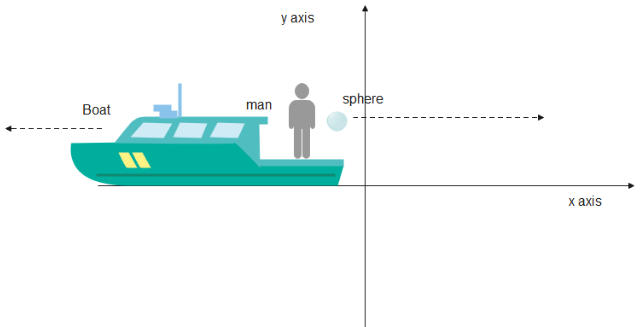
Here, we consider the boat – man – sphere as an isolated system which is devoid of any external force.From the Law of conservation of momentum, we deduce that the total momentum of an isolated system remains constant.Thus, to maintain this law, the boat – man system will need to move with a velocity $v'$ opposite to that of the sphere.
From the law of conservation of momentum, we get
$momentum{\kern 1pt} {\kern 1pt} of{\kern 1pt} {\kern 1pt} man \cdot boat{\kern 1pt} {\kern 1pt} system + momentum{\kern 1pt} {\kern 1pt} of{\kern 1pt} {\kern 1pt} sphere = 0$ (since the man-boat-sphere system is stationary)
Substituting the respective symbols, we get
$ \Rightarrow ({m_m} + {m_b})v' + {m_s}u = 0$
Now, putting in the values, we have
$\Rightarrow (62kg + 238kg)v' + 0.5kg \times 12m{s^{ - 1}} = 0 \\
\Rightarrow 300kg \times v' = - (0.5kg \times 12m{s^{ - 1}}) \\
\Rightarrow 300kg \times v' = - 6kgm{s^{ - 1}} \\
\Rightarrow v' = \dfrac{{ - 6kgm{s^{ - 1}}}}{{300kg}} \\
\therefore v' = - 0.02\,m{s^{ - 1}} \\ $
Thus, the correct answer to the question is option A.
Note:The negative sign shows that the velocity of the man-boat system is opposite to the direction of velocity of the sphere. Here, we consider that there is no friction between the body of the boat and the water, hence the boat moves. In normal circumstances, this wouldn’t be the case as the friction would stop it.
Formulae used:
$p = mv$
where $p$ is the linear momentum, $m$ is the mass of the body and $v$ is the velocity of the body
Complete step by step answer:
According to the given question
Mass of the man ${m_m} = 62\,kg$
Mass of the stationary boat ${m_b} = 238\,kg$
Mass of the sphere ${m_s} = 0.5\,kg$
Initial velocity of the sphere $u = 12\,m{s^{ - 1}}$
Here, we consider the boat – man – sphere as an isolated system which is devoid of any external force.From the Law of conservation of momentum, we deduce that the total momentum of an isolated system remains constant.Thus, to maintain this law, the boat – man system will need to move with a velocity $v'$ opposite to that of the sphere.
From the law of conservation of momentum, we get
$momentum{\kern 1pt} {\kern 1pt} of{\kern 1pt} {\kern 1pt} man \cdot boat{\kern 1pt} {\kern 1pt} system + momentum{\kern 1pt} {\kern 1pt} of{\kern 1pt} {\kern 1pt} sphere = 0$ (since the man-boat-sphere system is stationary)
Substituting the respective symbols, we get
$ \Rightarrow ({m_m} + {m_b})v' + {m_s}u = 0$
Now, putting in the values, we have
$\Rightarrow (62kg + 238kg)v' + 0.5kg \times 12m{s^{ - 1}} = 0 \\
\Rightarrow 300kg \times v' = - (0.5kg \times 12m{s^{ - 1}}) \\
\Rightarrow 300kg \times v' = - 6kgm{s^{ - 1}} \\
\Rightarrow v' = \dfrac{{ - 6kgm{s^{ - 1}}}}{{300kg}} \\
\therefore v' = - 0.02\,m{s^{ - 1}} \\ $
Thus, the correct answer to the question is option A.
Note:The negative sign shows that the velocity of the man-boat system is opposite to the direction of velocity of the sphere. Here, we consider that there is no friction between the body of the boat and the water, hence the boat moves. In normal circumstances, this wouldn’t be the case as the friction would stop it.
Recently Updated Pages
Master Class 11 Computer Science: Engaging Questions & Answers for Success

Master Class 11 Business Studies: Engaging Questions & Answers for Success
Master Class 11 Economics: Engaging Questions & Answers for Success
Master Class 11 English: Engaging Questions & Answers for Success
Master Class 11 Maths: Engaging Questions & Answers for Success
Master Class 11 Biology: Engaging Questions & Answers for Success
Trending doubts
One Metric ton is equal to kg A 10000 B 1000 C 100 class 11 physics CBSE
There are 720 permutations of the digits 1 2 3 4 5 class 11 maths CBSE
Discuss the various forms of bacteria class 11 biology CBSE
Draw a diagram of a plant cell and label at least eight class 11 biology CBSE
State the laws of reflection of light
Explain zero factorial class 11 maths CBSE