




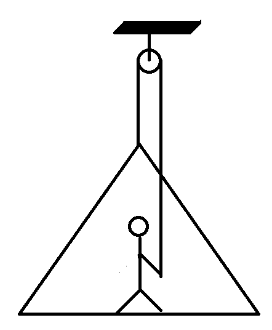
A man of mass $50kg$ stands on a frame of mass $30kg$. He pulls on a light rope which passes over a pulley. The other end of the rope is attached to the frame. For the system to be in equilibrium, what force man must exert on the rope?
Answer
 Verified
592.8k+ views
Hint:Here, a man is pulling a rope in downward direction, therefore, tension is created in both the sides of the rope acting in upward direction. The weight of a man and frame both act in downward direction. Thus, for the system to be in the equilibrium, these both upward and downward forces should be balanced.
Formula used:
$W = mg$,
Where $W$ is the weight of the body, $m$ is the mass of the body and $g$ is the gravitational acceleration
Complete step by step answer:
Let us understand the forces acting in this case as by the help of a diagram. Here, The force exerted by the man is equal to the tension developed in the rope.
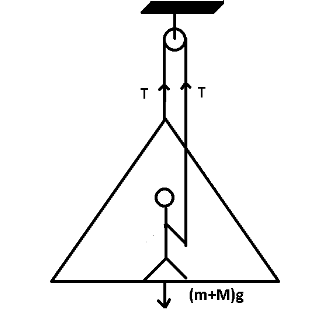
Here, the tensile \[W = \left( {m + M} \right)g = \left( {80g} \right)N\] force is balanced by the downward force due to the weight of the man and the frame. The mass of the frame $m = 30kg$ and the mass of the man $M = 50kg$. Now the man is standing on a frame. Therefore, the total mass of the system is $m + M = 30 + 50 = 80kg$
As shown in figure, total downward force on the system is the weight of the system \[W = \left( {m + M} \right)g = \left( {80g} \right)N\]
And total upward force will be $T + T = \left( {2T} \right)N$
For the equilibrium condition,
$
2T = W \\
\Rightarrow 2T = 80g \\
\therefore T = 40g \\ $
We know that this tension is equal to the force with which the man is pulling the rope. Thus, we can say that the man must exert a force of $40g$ for the system to be in equilibrium.
Hence, option (A) is the right answer.
Note: Here, we have rope on both the sides of pulley with a downward force on each end. In this case, the system is in equilibrium. Because of this, we have considered that the tension on both the sides of the rope is equal. Tension can be defined as an action-reaction pair of forces acting at each end of the said elements. While considering a rope, the tension force is felt by every section of the rope in both the directions, apart from the endpoints. The endpoints experience tension on one side and the force from the weight attached.
Formula used:
$W = mg$,
Where $W$ is the weight of the body, $m$ is the mass of the body and $g$ is the gravitational acceleration
Complete step by step answer:
Let us understand the forces acting in this case as by the help of a diagram. Here, The force exerted by the man is equal to the tension developed in the rope.
Here, the tensile \[W = \left( {m + M} \right)g = \left( {80g} \right)N\] force is balanced by the downward force due to the weight of the man and the frame. The mass of the frame $m = 30kg$ and the mass of the man $M = 50kg$. Now the man is standing on a frame. Therefore, the total mass of the system is $m + M = 30 + 50 = 80kg$
As shown in figure, total downward force on the system is the weight of the system \[W = \left( {m + M} \right)g = \left( {80g} \right)N\]
And total upward force will be $T + T = \left( {2T} \right)N$
For the equilibrium condition,
$
2T = W \\
\Rightarrow 2T = 80g \\
\therefore T = 40g \\ $
We know that this tension is equal to the force with which the man is pulling the rope. Thus, we can say that the man must exert a force of $40g$ for the system to be in equilibrium.
Hence, option (A) is the right answer.
Note: Here, we have rope on both the sides of pulley with a downward force on each end. In this case, the system is in equilibrium. Because of this, we have considered that the tension on both the sides of the rope is equal. Tension can be defined as an action-reaction pair of forces acting at each end of the said elements. While considering a rope, the tension force is felt by every section of the rope in both the directions, apart from the endpoints. The endpoints experience tension on one side and the force from the weight attached.
Recently Updated Pages
Master Class 12 Economics: Engaging Questions & Answers for Success

Master Class 12 English: Engaging Questions & Answers for Success
Master Class 12 Social Science: Engaging Questions & Answers for Success
Master Class 12 Maths: Engaging Questions & Answers for Success
Master Class 12 Physics: Engaging Questions & Answers for Success
Master Class 11 Social Science: Engaging Questions & Answers for Success
Trending doubts
One Metric ton is equal to kg A 10000 B 1000 C 100 class 11 physics CBSE
Difference Between Prokaryotic Cells and Eukaryotic Cells
Find the value of the expression given below sin 30circ class 11 maths CBSE
Two of the body parts which do not appear in MRI are class 11 biology CBSE
Draw a diagram of nephron and explain its structur class 11 biology CBSE
10 examples of friction in our daily life