




A man (mass = 50 kg) and his son (mass = 20 kg) are standing on a frictionless surface facing each other. The man pushes his son so that he starts moving at a speed of 0.70 m/s with respect to the man. The speed of the man with respect to the surface is:
A. 0.20 m/s
B. 0.14 m/s
C. 0.47 m/s
D. 0.28 m/s
Answer
 Verified
611.1k+ views
Hint: We need to use the fact that the sum of the initial momentum of the man and the son will be equal to the sum of the final momentum of the man and the son. The momentum is equal to the product of mass and velocity of an object. By using this formula and solving for final velocity, we can get the required answer.
Formula used:
The momentum of an object having mass m and velocity v is given as
$p = mv$
Complete step by step answer:
We are given a man and his son. Their masses are respectively given as
$
{m_1} = 50kg \\
{m_2} = 20kg \\
$
Initially they are at rest, standing facing each other. In this state, their velocities are zero, so their momentums are also zero. Hence, the total momentum of this initial state is zero.
Now the man pushes his son so that he starts moving at a speed of 0.70 m/s with respect to the man. If ${V_1}$ is the velocity of man and ${V_2}$ is the velocity of his son, then according previous statement,
$
{V_1} + {V_2} = 0.7m/s \\
{V_2} = 0.7 - {V_1}{\text{ }}...{\text{(i)}} \\
$
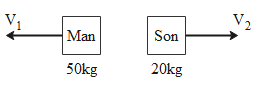
Now in this state, the total momentum of the man and his son will be the same as the initial state because of the law of the conservation of linear momentum. Therefore, we can write that
$
0 = {m_1}{V_1} + {m_2}{V_2} \\
\Rightarrow 0 = - 50{V_1} + 20{V_2} \\
$
Using equation (i) here, we get
$
\Rightarrow 0 = - 50{V_1} + 20\left( {0.7 - {V_1}} \right) \\
\Rightarrow 0 = - 50{V_1} + 14 - 20{V_1} \\
\Rightarrow 0 = - 70{V_1} + 14 \\
\Rightarrow 70{V_1} = 14 \\
\Rightarrow {V_1} = \dfrac{{14}}{{70}} = 0.2m/s \\
$
This is the required value of velocity of man.
Hence, the correct answer is option A.
Note:
In the final state, the directions of velocities of man and the son are opposite to each other and since velocity is a vector quantity, we have taken the direction of velocity of the son as positive direction. Since the velocity of man is directed in the opposite direction, it is taken negatively with respect to his son.
Formula used:
The momentum of an object having mass m and velocity v is given as
$p = mv$
Complete step by step answer:
We are given a man and his son. Their masses are respectively given as
$
{m_1} = 50kg \\
{m_2} = 20kg \\
$
Initially they are at rest, standing facing each other. In this state, their velocities are zero, so their momentums are also zero. Hence, the total momentum of this initial state is zero.
Now the man pushes his son so that he starts moving at a speed of 0.70 m/s with respect to the man. If ${V_1}$ is the velocity of man and ${V_2}$ is the velocity of his son, then according previous statement,
$
{V_1} + {V_2} = 0.7m/s \\
{V_2} = 0.7 - {V_1}{\text{ }}...{\text{(i)}} \\
$
Now in this state, the total momentum of the man and his son will be the same as the initial state because of the law of the conservation of linear momentum. Therefore, we can write that
$
0 = {m_1}{V_1} + {m_2}{V_2} \\
\Rightarrow 0 = - 50{V_1} + 20{V_2} \\
$
Using equation (i) here, we get
$
\Rightarrow 0 = - 50{V_1} + 20\left( {0.7 - {V_1}} \right) \\
\Rightarrow 0 = - 50{V_1} + 14 - 20{V_1} \\
\Rightarrow 0 = - 70{V_1} + 14 \\
\Rightarrow 70{V_1} = 14 \\
\Rightarrow {V_1} = \dfrac{{14}}{{70}} = 0.2m/s \\
$
This is the required value of velocity of man.
Hence, the correct answer is option A.
Note:
In the final state, the directions of velocities of man and the son are opposite to each other and since velocity is a vector quantity, we have taken the direction of velocity of the son as positive direction. Since the velocity of man is directed in the opposite direction, it is taken negatively with respect to his son.
Recently Updated Pages
Master Class 12 Economics: Engaging Questions & Answers for Success

Master Class 12 English: Engaging Questions & Answers for Success
Master Class 12 Social Science: Engaging Questions & Answers for Success
Master Class 12 Maths: Engaging Questions & Answers for Success
Master Class 12 Physics: Engaging Questions & Answers for Success
Master Class 11 Social Science: Engaging Questions & Answers for Success
Trending doubts
One Metric ton is equal to kg A 10000 B 1000 C 100 class 11 physics CBSE
Difference Between Prokaryotic Cells and Eukaryotic Cells
Find the value of the expression given below sin 30circ class 11 maths CBSE
Two of the body parts which do not appear in MRI are class 11 biology CBSE
1 ton equals to A 100 kg B 1000 kg C 10 kg D 10000 class 11 physics CBSE
Draw a diagram of nephron and explain its structur class 11 biology CBSE