




A man is trying to start a fire by focusing sunlight on a piece of paper using an equiconvex lens of focal length 10 cm. The diameter of the sun is $1.39 \times {10}^{9}m$ and its mean distance from the earth is $1.5 \times {10}^{11}m$, the diameter of the sun's image on the paper is
A. $3.1 \times {10}^{-4}m$
B. $6.5 \times {10}^{-5}m$
C. $6.5\times {10}^{-4}m$
D. $9.2 \times {10}^{-4}m$
Answer
 Verified
638.4k+ views
Hint: Use the formula for magnification. Magnification is represented as a ratio of height of the image to the height of the object. But, magnification is also represented as the ratio of image distance to object distance. So, we can equate these two equations. After equating these equations, substitute the values and find the height of the image which in our case is the diameter of the image of the Sun.
Formula used:
$M = \dfrac {Diameter \quad of \quad image}{Diameter \quad of \quad object}= \dfrac {Image \quad distance}{Object \quad distance}$
Complete answer:
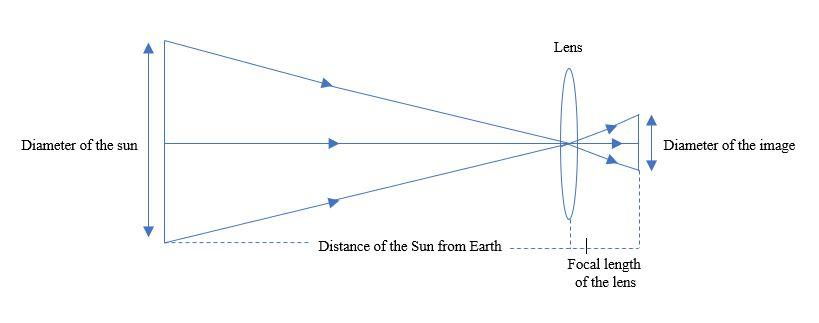
Given: Object distance (u) = $1.5 \times {10}^{11}m$.
Image distance (v)= 10cm= 0.1m
Diameter of Sun (O)= $1.39 \times {10}^{9}m$
Expression for magnification is given by,
Let the diameter of the image of the sun be I.
$M = \dfrac {Diameter \quad of \quad image}{Diameter \quad of \quad object}= \dfrac {Image \quad distance}{Object \quad distance}$
$\therefore \dfrac {I}{O}= \dfrac {v}{u}$
Rearranging above equation we get,
$I= \dfrac {O \times v}{u}$
Substituting values in above equation we get,
$I= \dfrac { 1.39 \times {10}^{9} \times 0.1}{1.5 \times {10}^{11}}$
$\therefore I = \dfrac { 1.39 \times {10}^{8}}{1.5 \times {10}^{11}}$
$\therefore I= 0.92 \times {10}^{-3}$
Thus, the diameter of Sun's image on paper is $9.2 \times {10}^{-4}m$.
So, the correct answer is “Option D”.
Note:
A convex lens can either form a virtual image or real image. Thus, the magnification can be positive or negative. For virtual images, magnification is positive and it is negative for real images. When image size is equal to the object size, then m=1. When the object size is greater than the size of image, image is diminished and magnification is less than 1. If the image size is greater than the object size then the image is magnified and magnification is greater than 1.
Formula used:
$M = \dfrac {Diameter \quad of \quad image}{Diameter \quad of \quad object}= \dfrac {Image \quad distance}{Object \quad distance}$
Complete answer:
Given: Object distance (u) = $1.5 \times {10}^{11}m$.
Image distance (v)= 10cm= 0.1m
Diameter of Sun (O)= $1.39 \times {10}^{9}m$
Expression for magnification is given by,
Let the diameter of the image of the sun be I.
$M = \dfrac {Diameter \quad of \quad image}{Diameter \quad of \quad object}= \dfrac {Image \quad distance}{Object \quad distance}$
$\therefore \dfrac {I}{O}= \dfrac {v}{u}$
Rearranging above equation we get,
$I= \dfrac {O \times v}{u}$
Substituting values in above equation we get,
$I= \dfrac { 1.39 \times {10}^{9} \times 0.1}{1.5 \times {10}^{11}}$
$\therefore I = \dfrac { 1.39 \times {10}^{8}}{1.5 \times {10}^{11}}$
$\therefore I= 0.92 \times {10}^{-3}$
Thus, the diameter of Sun's image on paper is $9.2 \times {10}^{-4}m$.
So, the correct answer is “Option D”.
Note:
A convex lens can either form a virtual image or real image. Thus, the magnification can be positive or negative. For virtual images, magnification is positive and it is negative for real images. When image size is equal to the object size, then m=1. When the object size is greater than the size of image, image is diminished and magnification is less than 1. If the image size is greater than the object size then the image is magnified and magnification is greater than 1.
Recently Updated Pages
Basicity of sulphurous acid and sulphuric acid are

Master Class 12 Economics: Engaging Questions & Answers for Success
Master Class 12 Biology: Engaging Questions & Answers for Success
Master Class 11 English: Engaging Questions & Answers for Success
Master Class 11 Physics: Engaging Questions & Answers for Success
Master Class 11 Computer Science: Engaging Questions & Answers for Success
Trending doubts
Draw a labelled sketch of the human eye class 12 physics CBSE
The chemical formula of tear gas is A CO Cl 2 B C 10 class 12 chemistry CBSE
Draw ray diagrams each showing i myopic eye and ii class 12 physics CBSE
Which are the Top 10 Largest Countries of the World?
Differentiate between homogeneous and heterogeneous class 12 chemistry CBSE
Which is the correct genotypic ratio of mendel dihybrid class 12 biology CBSE