




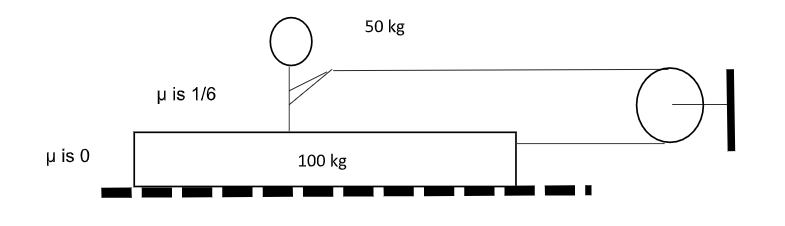
A man has a mass of 50 kg and he is pulling a plank of 100 kg placed on a smooth floor with a force of 100 N. If both man and plank move together, find the frictional force acting on the man.
A) $\dfrac{{100}}{3}{\text{N}}$ towards the left
B) $\dfrac{{100}}{3}{\text{N}}$ towards the right
C) $\dfrac{{250}}{3}{\text{N}}$ towards the left
D) $\dfrac{{250}}{3}{\text{N}}$ towards the right
Answer
 Verified
587.7k+ views
Hint: The plank and man can be considered as a single system that moves with an acceleration. The plank is placed on a smooth surface and therefore, there is no friction between the plank and the surface. The frictional force acting on the man will oppose his motion.
Formula used:
The force acting on a body of mass $m$ and acceleration $a$ is given by, $F = ma$
Complete step by step answer:
Step 1: List the data provided in the question.
The mass of the man is ${m_0} = 50{\text{kg}}$ and that of the plank is ${m_p} = 100{\text{kg}}$.
A force $F = 100{\text{N}}$ is applied in the right direction to pull the plank.
Step 2: Using the force equation, find the acceleration of the man.
We can consider the man standing on the plank as a single system.
Then, the mass of the system will be the sum of the masses of the man and the plank.
i.e., $m = {m_0} + {m_p}$
Substituting values for ${m_0} = 50{\text{kg}}$ and ${m_p} = 100{\text{kg}}$ in the above equation, we get $m = 50 + 100 = 150{\text{kg}}$
Thus, the mass of the system is $m = 150{\text{kg}}$.
Now it is said that when a force of 100 N was applied both man and plank moved together. Thus, the force acting on the system is $F = 100{\text{N}}$.
The force equation is given by, $F = ma$. Then the expression for the acceleration will be, $a = \dfrac{F}{m}$.
Substituting the values of $F = 100{\text{N}}$ and $m = 150{\text{kg}}$ in the above expression we get, $a = \dfrac{{100}}{{150}} = \dfrac{2}{3}{\text{m/}}{{\text{s}}^2}$
Again as both man and plank move together with acceleration $a = \dfrac{2}{3}{\text{m/}}{{\text{s}}^2}$, the man must have the same acceleration.
Hence, the acceleration of the man is $a = \dfrac{2}{3}{\text{m/}}{{\text{s}}^2}$.
Step 3: Find the frictional force acting on the man using the force equation.
Since the acceleration of man, $a = \dfrac{2}{3}{\text{m/}}{{\text{s}}^2}$ and the mass of man, ${m_0} = 50{\text{kg}}$ are known, we can calculate the force on the man as ${F_0} = {m_0}a = 50 \times \dfrac{2}{3}$.
i.e., the force on the man as he moves along the right direction is ${F_0} = \dfrac{{100}}{3}{\text{N}}$.
Frictional forces are exerted on the man. So, the man moves only when the applied force overcomes the frictional force. Since the applied force is ${F_0} = \dfrac{{100}}{3}{\text{N}}$, an equal amount of friction acts in the opposite direction to oppose the motion.
Therefore, the frictional force acting on the man as both man and plank move together is $\dfrac{{100}}{3}{\text{N}}$ towards the left. Hence, option (A) is correct.
Note:
We can also solve this by considering the man and the plank as two separate systems having a common acceleration $a$. The man’s legs are pushing the plank forward as he pulls the rope backward. So for the plank, the friction $f$ will be in the forward direction and for the man, it will be in an opposite direction.
The tension on the rope is $T = 100{\text{N}}$.
Now, for the man, the total forces acting will be, $T - f = ma$ and for the plank, it will be $T + f = ma$.
On substituting the values for mass and tension, and solving the equations $100 - f = 50a$ and $100 + f = 150a$ we obtain the acceleration as $a = \dfrac{4}{3}{\text{m/}}{{\text{s}}^2}$. Substituting the value of acceleration in any of the above equations we get, the frictional force on the man as $f = \dfrac{{100}}{3}{\text{N}}$ towards the left.
Formula used:
The force acting on a body of mass $m$ and acceleration $a$ is given by, $F = ma$
Complete step by step answer:
Step 1: List the data provided in the question.
The mass of the man is ${m_0} = 50{\text{kg}}$ and that of the plank is ${m_p} = 100{\text{kg}}$.
A force $F = 100{\text{N}}$ is applied in the right direction to pull the plank.
Step 2: Using the force equation, find the acceleration of the man.
We can consider the man standing on the plank as a single system.
Then, the mass of the system will be the sum of the masses of the man and the plank.
i.e., $m = {m_0} + {m_p}$
Substituting values for ${m_0} = 50{\text{kg}}$ and ${m_p} = 100{\text{kg}}$ in the above equation, we get $m = 50 + 100 = 150{\text{kg}}$
Thus, the mass of the system is $m = 150{\text{kg}}$.
Now it is said that when a force of 100 N was applied both man and plank moved together. Thus, the force acting on the system is $F = 100{\text{N}}$.
The force equation is given by, $F = ma$. Then the expression for the acceleration will be, $a = \dfrac{F}{m}$.
Substituting the values of $F = 100{\text{N}}$ and $m = 150{\text{kg}}$ in the above expression we get, $a = \dfrac{{100}}{{150}} = \dfrac{2}{3}{\text{m/}}{{\text{s}}^2}$
Again as both man and plank move together with acceleration $a = \dfrac{2}{3}{\text{m/}}{{\text{s}}^2}$, the man must have the same acceleration.
Hence, the acceleration of the man is $a = \dfrac{2}{3}{\text{m/}}{{\text{s}}^2}$.
Step 3: Find the frictional force acting on the man using the force equation.
Since the acceleration of man, $a = \dfrac{2}{3}{\text{m/}}{{\text{s}}^2}$ and the mass of man, ${m_0} = 50{\text{kg}}$ are known, we can calculate the force on the man as ${F_0} = {m_0}a = 50 \times \dfrac{2}{3}$.
i.e., the force on the man as he moves along the right direction is ${F_0} = \dfrac{{100}}{3}{\text{N}}$.
Frictional forces are exerted on the man. So, the man moves only when the applied force overcomes the frictional force. Since the applied force is ${F_0} = \dfrac{{100}}{3}{\text{N}}$, an equal amount of friction acts in the opposite direction to oppose the motion.
Therefore, the frictional force acting on the man as both man and plank move together is $\dfrac{{100}}{3}{\text{N}}$ towards the left. Hence, option (A) is correct.
Note:
We can also solve this by considering the man and the plank as two separate systems having a common acceleration $a$. The man’s legs are pushing the plank forward as he pulls the rope backward. So for the plank, the friction $f$ will be in the forward direction and for the man, it will be in an opposite direction.
The tension on the rope is $T = 100{\text{N}}$.
Now, for the man, the total forces acting will be, $T - f = ma$ and for the plank, it will be $T + f = ma$.
On substituting the values for mass and tension, and solving the equations $100 - f = 50a$ and $100 + f = 150a$ we obtain the acceleration as $a = \dfrac{4}{3}{\text{m/}}{{\text{s}}^2}$. Substituting the value of acceleration in any of the above equations we get, the frictional force on the man as $f = \dfrac{{100}}{3}{\text{N}}$ towards the left.
Recently Updated Pages
Master Class 11 Computer Science: Engaging Questions & Answers for Success

Master Class 11 Business Studies: Engaging Questions & Answers for Success
Master Class 11 Economics: Engaging Questions & Answers for Success
Master Class 11 English: Engaging Questions & Answers for Success
Master Class 11 Maths: Engaging Questions & Answers for Success
Master Class 11 Biology: Engaging Questions & Answers for Success
Trending doubts
One Metric ton is equal to kg A 10000 B 1000 C 100 class 11 physics CBSE
There are 720 permutations of the digits 1 2 3 4 5 class 11 maths CBSE
Discuss the various forms of bacteria class 11 biology CBSE
Draw a diagram of a plant cell and label at least eight class 11 biology CBSE
State the laws of reflection of light
Explain zero factorial class 11 maths CBSE