




When a man eats fish which feed on zooplankton which has eaten small plants, the producer in the chain is
(a) Fish
(b) Man
(c) Zooplankton
(d) Small plants
Answer
 Verified
595.8k+ views
Hint: Producers acquire their energy from the sun and other natural elements by the process of photosynthesis. Producers make their own food and do not require another organism to acquire energy.
Complete Step by Step Answer:
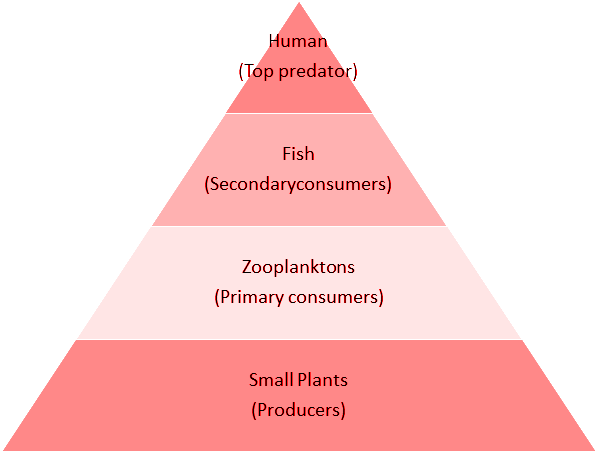
Small plants are the producers in the chain. They do not depend on other organisms to obtain their energy and produce their own food by photosynthesis. Photosynthesis is the process in which sunlight is used to synthesize nutrients from carbon dioxide and water by a pigment called chlorophyll.
So, the correct answer is ‘Small plants’.
Additional information:
- Other than plants some algae also perform photosynthesis to produce energy. In photosynthesis, oxygen is formed as a byproduct, and producers are also known as autotrophs.
Fish: Organisms that cannot make or synthesize their own food and depend on other organisms to acquire their energy is known as consumers.
- If these organisms only consume another consumer, known as carnivores. Since these organisms come in the third level of the food chain they are also called secondary consumers.
Man: Organisms that can consume both consumers and producers to acquire energy are known as omnivores. Human beings are also known as ‘top predators’ because no other creatures hunt them for food.
Zooplankton: Organisms that consume only producers for acquiring energy is known as primary consumers. They are also known as herbivores.
Note:
- Numerous interlinked food chains make one food web, where secondary consumers depend on more than one primary consumer to maintain balance in the ecosystem.
- Decomposers are particular types of consumers who degrade dead organisms to acquire energy. Scavengers are similar types of consumers but they do not degrade the dead organism but eat them to acquire energy.
- Producers occupy the lowest hierarchy level of the ecosystem. Primary consumers and secondary consumers occupy the middle and top hierarchical levels respectively.
Complete Step by Step Answer:
Small plants are the producers in the chain. They do not depend on other organisms to obtain their energy and produce their own food by photosynthesis. Photosynthesis is the process in which sunlight is used to synthesize nutrients from carbon dioxide and water by a pigment called chlorophyll.
So, the correct answer is ‘Small plants’.
Additional information:
- Other than plants some algae also perform photosynthesis to produce energy. In photosynthesis, oxygen is formed as a byproduct, and producers are also known as autotrophs.
Fish: Organisms that cannot make or synthesize their own food and depend on other organisms to acquire their energy is known as consumers.
- If these organisms only consume another consumer, known as carnivores. Since these organisms come in the third level of the food chain they are also called secondary consumers.
Man: Organisms that can consume both consumers and producers to acquire energy are known as omnivores. Human beings are also known as ‘top predators’ because no other creatures hunt them for food.
Zooplankton: Organisms that consume only producers for acquiring energy is known as primary consumers. They are also known as herbivores.
Note:
- Numerous interlinked food chains make one food web, where secondary consumers depend on more than one primary consumer to maintain balance in the ecosystem.
- Decomposers are particular types of consumers who degrade dead organisms to acquire energy. Scavengers are similar types of consumers but they do not degrade the dead organism but eat them to acquire energy.
- Producers occupy the lowest hierarchy level of the ecosystem. Primary consumers and secondary consumers occupy the middle and top hierarchical levels respectively.
Recently Updated Pages
Master Class 12 Social Science: Engaging Questions & Answers for Success

Master Class 12 Physics: Engaging Questions & Answers for Success
Master Class 12 Maths: Engaging Questions & Answers for Success
Master Class 12 Economics: Engaging Questions & Answers for Success
Master Class 12 Chemistry: Engaging Questions & Answers for Success
Master Class 12 Business Studies: Engaging Questions & Answers for Success
Trending doubts
Which are the Top 10 Largest Countries of the World?
Draw a labelled sketch of the human eye class 12 physics CBSE
Explain the structure of megasporangium class 12 biology CBSE
What are the major means of transport Explain each class 12 social science CBSE
How many chromosomes are found in human ovum a 46 b class 12 biology CBSE
The diagram of the section of a maize grain is given class 12 biology CBSE