




A man cycles up a hill whose slope is 1 in 20. If the mass of the man and the cycle is 150 kg and the man covers a distance of 100 m along the incline, calculate the work done by the man.
Answer
 Verified
611.4k+ views
Hint: Work done on a particle by force is the dot product of the force and the displacement. Hence work done is not a vector and it is a scalar quantity. If force and displacement are perpendicular to each other then the work done will be zero as dot product between them will become zero. In this problem we apply the same concept to find the work done.
Complete step by step answer:
In the question it is given that a man is riding the bicycle. We will assume that he is riding with constant velocity. That means there should be no net external force acting on him. The weight of the man and cycle will be resolved in two components. One will be along the plane and the other will be perpendicular to the plane.
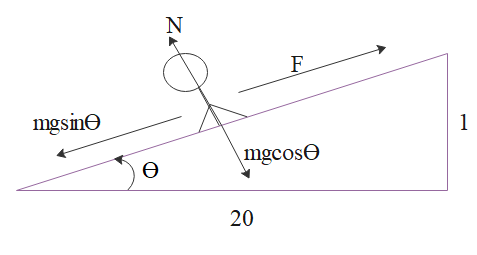
By referring to the above diagram we can clearly tell that $mg\sin \theta $ component is along the plane while $mg\cos \theta $ component is perpendicular to the plane. The perpendicular component is balanced by the normal force while the parallel component will be balanced by the force applied by man i.e ‘F’.
$\tan \theta $ is the slope and it is given as $\dfrac{1}{{20}}$
$\eqalign{
& \Rightarrow \tan \theta = \dfrac{1}{{20}} \cr
& \Rightarrow \sin \theta = 0.05 \cr} $
The work done by the man will be
$W = F.S$
$\eqalign{
& \Rightarrow W = mg\sin \theta .S \cr
& \Rightarrow W = 150 \times 10 \times 0.05 \times 100 \cr
& \therefore W = 7490.62joules \cr} $
So the work done by man will be 7490.62 joules.
Note:
From the diagram, it is clear that the normal and perpendicular components of weight are always perpendicular to the displacement. Hence they will not do work on the man. The work done by parallel components of weight is the same as the work done by man. Hence there will be no change in kinetic energy of the man. Sometimes people consider tangent angle as sinusoidal angle because if tangent angle is very small then it can be equal to the sinusoidal angle but for larger angles this is not accepted.
Complete step by step answer:
In the question it is given that a man is riding the bicycle. We will assume that he is riding with constant velocity. That means there should be no net external force acting on him. The weight of the man and cycle will be resolved in two components. One will be along the plane and the other will be perpendicular to the plane.
By referring to the above diagram we can clearly tell that $mg\sin \theta $ component is along the plane while $mg\cos \theta $ component is perpendicular to the plane. The perpendicular component is balanced by the normal force while the parallel component will be balanced by the force applied by man i.e ‘F’.
$\tan \theta $ is the slope and it is given as $\dfrac{1}{{20}}$
$\eqalign{
& \Rightarrow \tan \theta = \dfrac{1}{{20}} \cr
& \Rightarrow \sin \theta = 0.05 \cr} $
The work done by the man will be
$W = F.S$
$\eqalign{
& \Rightarrow W = mg\sin \theta .S \cr
& \Rightarrow W = 150 \times 10 \times 0.05 \times 100 \cr
& \therefore W = 7490.62joules \cr} $
So the work done by man will be 7490.62 joules.
Note:
From the diagram, it is clear that the normal and perpendicular components of weight are always perpendicular to the displacement. Hence they will not do work on the man. The work done by parallel components of weight is the same as the work done by man. Hence there will be no change in kinetic energy of the man. Sometimes people consider tangent angle as sinusoidal angle because if tangent angle is very small then it can be equal to the sinusoidal angle but for larger angles this is not accepted.
Recently Updated Pages
Master Class 12 Economics: Engaging Questions & Answers for Success

Master Class 12 English: Engaging Questions & Answers for Success
Master Class 12 Social Science: Engaging Questions & Answers for Success
Master Class 12 Maths: Engaging Questions & Answers for Success
Master Class 12 Physics: Engaging Questions & Answers for Success
Master Class 11 Social Science: Engaging Questions & Answers for Success
Trending doubts
1 ton equals to A 100 kg B 1000 kg C 10 kg D 10000 class 11 physics CBSE
Draw a diagram of nephron and explain its structur class 11 biology CBSE
DNA is not present in A Nucleus B Mitochondria C Chloroplast class 11 biology CBSE
Proton was discovered by A Thomson B Rutherford C Chadwick class 11 chemistry CBSE
Mention the important general characters of Urocho class 11 biology CBSE
Define pneumatic bones class 11 biology CBSE