




A man crosses the river, perpendicular to river flow in time \[{\text{t}}\] seconds and travels an equal distance down the stream in \[{\text{T}}\] seconds. The ratio of man’s speed in still water to the speed of river water will be:
A. \[\dfrac{{{{\text{t}}^2} - {{\text{T}}^2}}}{{{{\text{t}}^2}{\text{ + }}{{\text{T}}^2}}}\]
B. \[\dfrac{{{{\text{T}}^2} - {{\text{t}}^2}}}{{{{\text{T}}^2}{\text{ + }}{{\text{t}}^2}}}\]
C. \[\dfrac{{{{\text{t}}^2} + {{\text{T}}^2}}}{{{{\text{t}}^2} - {{\text{T}}^2}}}\]
D. \[\dfrac{{{{\text{T}}^2} + {{\text{t}}^2}}}{{{{\text{T}}^2} - {{\text{t}}^2}}}\]
Answer
 Verified
504.9k+ views
Hint: In this question, the man crosses the river perpendicular to the river flow, so assuming the velocity of man as \[{{\text{v}}_m}\] and velocity of the river as \[{{\text{v}}_{_w}}\] , using vectors we can find out the resultant velocity which is perpendicular to the river flow. Now the speed of the man downstream will be \[{{\text{v}}_m} + {{\text{v}}_{_w}}\]. As they cover the same distance on taking the ratio, express speed as \[\dfrac{{dis\tan ce}}{{time}}\] and solve to get a relation of the speed of the ratio in time.
Complete step by step answer:
We have given,
The man crosses the river, with resultant velocity perpendicular to the flow of the river in \[{\text{t}}\] seconds.
Let the speed of river be \[{{\text{v}}_{_w}}\]
Let the velocity of man in still river be \[{{\text{v}}_m}\]
Let the resultant velocity be \[{\text{V}}\]
Let’s draw the vector diagram
Since resultant velocity is perpendicular to the river flow velocity of man must be in the opposite direction
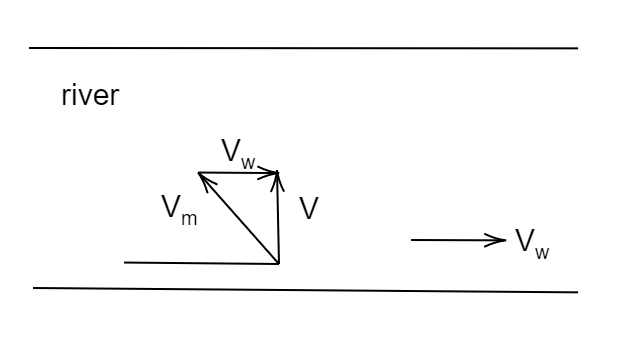
Thus, from this, we can say,
The Resultant velocity of the man or velocity of man with respect to ground, \[{\text{V = }}\sqrt {{{\text{v}}_m}^2 - } {{\text{v}}_{_w}}^2\]
Now suppose the man covers a distance \[{\text{d}}\] in time \[{\text{t}}\]
\[{\text{V = }}\sqrt {{{\text{v}}_m}^2 - } {{\text{v}}_{_w}}^2 = \dfrac{d}{t}\]
Now the man travels an equal distance downstream in time \[{\text{T}}\] second
Let the velocity of the man downstream be \[{\text{u}}\]
\[{\text{u = }}{{\text{v}}_m} + {{\text{v}}_{_w}}\]
Since now the man travels \[{\text{d}}\] distance in \[{\text{T}}\] seconds
\[{\text{u = }}{{\text{v}}_m} + {{\text{v}}_{_w}} = \dfrac{d}{T}\]
We need to find the ratio of man’s speed in still water to the speed of river water
Divide resultant velocity of man in river water and velocity of man downstream
\[\dfrac{{\text{V}}}{u} = \dfrac{{\sqrt {{{\text{v}}_m}^2 - } {{\text{v}}_{_w}}^2}}{{{{\text{v}}_m} + {{\text{v}}_{_w}}}} = \dfrac{{\dfrac{d}{t}}}{{\dfrac{d}{T}}}\]
On simplifying,
\[ \Rightarrow \dfrac{{\sqrt {{{\text{v}}_m}^2 - } {{\text{v}}_{_w}}^2}}{{{{\text{v}}_m} + {{\text{v}}_{_w}}}} = \dfrac{T}{t}\]
Cross multiplying both the sides we get,
\[ \Rightarrow t\sqrt {{{\text{v}}_m}^2 - } {{\text{v}}_{_w}}^2 = T\left( {{{\text{v}}_m} + {{\text{v}}_{_w}}} \right)\]
Squaring both the sides we get,
\[ \Rightarrow {t^2}\left( {{\text{v}}_m^2 - {\text{v}}_w^2} \right) = {T^2}{\left( {{{\text{v}}_m} + {{\text{v}}_{_w}}} \right)^2}\]
Using the formula \[{a^2} - {b^2} = \left( {a + b} \right)\left( {a - b} \right)\] we get,
\[ \Rightarrow {t^2}\left( {{{\text{v}}_m} - {{\text{v}}_w}} \right)\left( {{{\text{v}}_m}{\text{ + }}{{\text{v}}_w}} \right) = {T^2}{\left( {{{\text{v}}_m} + {{\text{v}}_{_w}}} \right)^2}\]
\[ \Rightarrow {t^2}\left( {{{\text{v}}_m} - {{\text{v}}_w}} \right) = {T^2}\left( {{{\text{v}}_m} + {{\text{v}}_{_w}}} \right)\]
On rearranging we get,
\[\dfrac{{\left( {{{\text{v}}_m} + {{\text{v}}_{_w}}} \right)}}{{\left( {{{\text{v}}_m} - {{\text{v}}_w}} \right)}} = \dfrac{{{t^2}}}{{{T^2}}}\]
On taking Componendo-Dividendo on both sides we get,
\[\dfrac{{{{\text{v}}_m}}}{{{{\text{v}}_w}}} = \dfrac{{{{\text{t}}^2} + {{\text{T}}^2}}}{{{{\text{t}}^2} - {{\text{T}}^2}}}\]
Thus, ratio of speed of man in still water and speed of river is \[\dfrac{{{{\text{v}}_m}}}{{{{\text{v}}_w}}} = \dfrac{{{{\text{t}}^2} + {{\text{T}}^2}}}{{{{\text{t}}^2} - {{\text{T}}^2}}}\]
The correct option is option C.
Note: If the body is flowing in the opposite direction to the stream, it is called upstream. In this case, the net speed of the boat is called the upstream speed and if the body is flowing along the direction of the stream, it is called downstream. In this case, the net speed of the boat is called downstream speed.
Complete step by step answer:
We have given,
The man crosses the river, with resultant velocity perpendicular to the flow of the river in \[{\text{t}}\] seconds.
Let the speed of river be \[{{\text{v}}_{_w}}\]
Let the velocity of man in still river be \[{{\text{v}}_m}\]
Let the resultant velocity be \[{\text{V}}\]
Let’s draw the vector diagram
Since resultant velocity is perpendicular to the river flow velocity of man must be in the opposite direction
Thus, from this, we can say,
The Resultant velocity of the man or velocity of man with respect to ground, \[{\text{V = }}\sqrt {{{\text{v}}_m}^2 - } {{\text{v}}_{_w}}^2\]
Now suppose the man covers a distance \[{\text{d}}\] in time \[{\text{t}}\]
\[{\text{V = }}\sqrt {{{\text{v}}_m}^2 - } {{\text{v}}_{_w}}^2 = \dfrac{d}{t}\]
Now the man travels an equal distance downstream in time \[{\text{T}}\] second
Let the velocity of the man downstream be \[{\text{u}}\]
\[{\text{u = }}{{\text{v}}_m} + {{\text{v}}_{_w}}\]
Since now the man travels \[{\text{d}}\] distance in \[{\text{T}}\] seconds
\[{\text{u = }}{{\text{v}}_m} + {{\text{v}}_{_w}} = \dfrac{d}{T}\]
We need to find the ratio of man’s speed in still water to the speed of river water
Divide resultant velocity of man in river water and velocity of man downstream
\[\dfrac{{\text{V}}}{u} = \dfrac{{\sqrt {{{\text{v}}_m}^2 - } {{\text{v}}_{_w}}^2}}{{{{\text{v}}_m} + {{\text{v}}_{_w}}}} = \dfrac{{\dfrac{d}{t}}}{{\dfrac{d}{T}}}\]
On simplifying,
\[ \Rightarrow \dfrac{{\sqrt {{{\text{v}}_m}^2 - } {{\text{v}}_{_w}}^2}}{{{{\text{v}}_m} + {{\text{v}}_{_w}}}} = \dfrac{T}{t}\]
Cross multiplying both the sides we get,
\[ \Rightarrow t\sqrt {{{\text{v}}_m}^2 - } {{\text{v}}_{_w}}^2 = T\left( {{{\text{v}}_m} + {{\text{v}}_{_w}}} \right)\]
Squaring both the sides we get,
\[ \Rightarrow {t^2}\left( {{\text{v}}_m^2 - {\text{v}}_w^2} \right) = {T^2}{\left( {{{\text{v}}_m} + {{\text{v}}_{_w}}} \right)^2}\]
Using the formula \[{a^2} - {b^2} = \left( {a + b} \right)\left( {a - b} \right)\] we get,
\[ \Rightarrow {t^2}\left( {{{\text{v}}_m} - {{\text{v}}_w}} \right)\left( {{{\text{v}}_m}{\text{ + }}{{\text{v}}_w}} \right) = {T^2}{\left( {{{\text{v}}_m} + {{\text{v}}_{_w}}} \right)^2}\]
\[ \Rightarrow {t^2}\left( {{{\text{v}}_m} - {{\text{v}}_w}} \right) = {T^2}\left( {{{\text{v}}_m} + {{\text{v}}_{_w}}} \right)\]
On rearranging we get,
\[\dfrac{{\left( {{{\text{v}}_m} + {{\text{v}}_{_w}}} \right)}}{{\left( {{{\text{v}}_m} - {{\text{v}}_w}} \right)}} = \dfrac{{{t^2}}}{{{T^2}}}\]
On taking Componendo-Dividendo on both sides we get,
\[\dfrac{{{{\text{v}}_m}}}{{{{\text{v}}_w}}} = \dfrac{{{{\text{t}}^2} + {{\text{T}}^2}}}{{{{\text{t}}^2} - {{\text{T}}^2}}}\]
Thus, ratio of speed of man in still water and speed of river is \[\dfrac{{{{\text{v}}_m}}}{{{{\text{v}}_w}}} = \dfrac{{{{\text{t}}^2} + {{\text{T}}^2}}}{{{{\text{t}}^2} - {{\text{T}}^2}}}\]
The correct option is option C.
Note: If the body is flowing in the opposite direction to the stream, it is called upstream. In this case, the net speed of the boat is called the upstream speed and if the body is flowing along the direction of the stream, it is called downstream. In this case, the net speed of the boat is called downstream speed.
Recently Updated Pages
Basicity of sulphurous acid and sulphuric acid are

Master Class 11 Business Studies: Engaging Questions & Answers for Success
Master Class 11 Computer Science: Engaging Questions & Answers for Success
Master Class 11 Economics: Engaging Questions & Answers for Success
Master Class 11 Social Science: Engaging Questions & Answers for Success
Master Class 11 English: Engaging Questions & Answers for Success
Trending doubts
One Metric ton is equal to kg A 10000 B 1000 C 100 class 11 physics CBSE
What are the examples of C3 and C4 plants class 11 biology CBSE
State and prove Bernoullis theorem class 11 physics CBSE
Draw a diagram of a plant cell and label at least eight class 11 biology CBSE
10 examples of friction in our daily life
A body is said to be in dynamic equilibrium if A When class 11 physics CBSE