




A man 2 metres high walks at a uniform speed of 5km/hr away from a lamp post 6 metres high. Find the rate at which the length of his shadow increases.
Answer
 Verified
666k+ views
Hint: Assume that the angle made by the BE with AE be $ \theta $ . Use the fact that in a right-angled triangle the ratio of the opposite side to the adjacent side is the tangent of the angle. Hence prove that $ CE=CD\cot \theta $ . Use the fact that the triangle ABE and DCE are similar and hence prove that $ \dfrac{AB}{DC}=\dfrac{AE}{CE} $ and hence find the length AC. Differentiate with respect to t and hence find the value of $ \dfrac{d\theta }{dt} $ . Differentiate the expression of CE to and substitute the value of $ \dfrac{d\theta }{dt} $ and hence find the speed of the shadow.
Complete step-by-step answer:
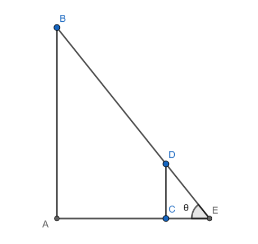
Given: A lamppost AB of height 6 metres and a man DC of height 2 metres is moving away from the post with speed of 5 metres per second.
To determine: The speed of the head of the shadow E.
Let $ \angle DEC=\theta $
In triangle EDC, we have DC is the side opposite to E and CE is the side adjacent to E.
Hence, we have
$ \tan \theta =\dfrac{DC}{CE} $
Multiplying both sides by CE and dividing both sides by $ \tan \theta $ , we get
$ CE=DC\cot \theta $
Differentiating with respect to t(time), we get
$ \dfrac{d\left( CE \right)}{dt}=-DC{{\csc }^{2}}\theta \dfrac{d\theta }{dt}\text{ }\left( i \right) $
Similarly in triangle ABE, we have
$ AE=AB\cot \theta $
Also, we have triangle ABE and DCE are similar (Since AB||DC).
Hence, we have
$ \dfrac{AB}{DC}=\dfrac{AE}{CE} $ (Ratios of corresponding sides of two similar triangles is same)
$ \begin{align}
& \dfrac{6}{2}=\dfrac{AE}{CE} \\
& \Rightarrow AE=3CE \\
\end{align} $
Hence, we have
$ AC=2CE=4\cot \theta $
Hence, we have
$ \dfrac{d\left( AC \right)}{dt}=-4{{\csc }^{2}}\theta \dfrac{d\theta }{dt} $
Since the person moves with velocity of $ 5m{{s}^{-1}} $ , we have
$ \dfrac{d\left( AC \right)}{dt}=5 $
Hence, we have
$ {{\csc }^{2}}\theta \dfrac{d\theta }{dt}=\dfrac{-5}{4} $
Substituting in equation (i), we get
$ \dfrac{d\left( CE \right)}{dt}=-2\left( \dfrac{-5}{4} \right)=\dfrac{5}{2}m{{s}^{-1}} $
Hence the speed of the shadow is $ \dfrac{5}{2}m{{s}^{-1}} $ .
Note: Instead of trigonometry, we can also use simple geometry to solve the question.
We have
$ \begin{align}
& \dfrac{AB}{AE}=\dfrac{DC}{CE} \\
& \Rightarrow AE=\dfrac{6CE}{2}=3CE \\
\end{align} $
Hence, we have
$ AC=2CE $
Differentiating both sides with respect to t, we get
$ \begin{align}
& \dfrac{d\left( AC \right)}{dt}=2\times \dfrac{d\left( CE \right)}{dt} \\
& \Rightarrow \dfrac{d\left( CE \right)}{dt}=\dfrac{5}{2} \\
\end{align} $
Which is the same as obtained above.
Complete step-by-step answer:
Given: A lamppost AB of height 6 metres and a man DC of height 2 metres is moving away from the post with speed of 5 metres per second.
To determine: The speed of the head of the shadow E.
Let $ \angle DEC=\theta $
In triangle EDC, we have DC is the side opposite to E and CE is the side adjacent to E.
Hence, we have
$ \tan \theta =\dfrac{DC}{CE} $
Multiplying both sides by CE and dividing both sides by $ \tan \theta $ , we get
$ CE=DC\cot \theta $
Differentiating with respect to t(time), we get
$ \dfrac{d\left( CE \right)}{dt}=-DC{{\csc }^{2}}\theta \dfrac{d\theta }{dt}\text{ }\left( i \right) $
Similarly in triangle ABE, we have
$ AE=AB\cot \theta $
Also, we have triangle ABE and DCE are similar (Since AB||DC).
Hence, we have
$ \dfrac{AB}{DC}=\dfrac{AE}{CE} $ (Ratios of corresponding sides of two similar triangles is same)
$ \begin{align}
& \dfrac{6}{2}=\dfrac{AE}{CE} \\
& \Rightarrow AE=3CE \\
\end{align} $
Hence, we have
$ AC=2CE=4\cot \theta $
Hence, we have
$ \dfrac{d\left( AC \right)}{dt}=-4{{\csc }^{2}}\theta \dfrac{d\theta }{dt} $
Since the person moves with velocity of $ 5m{{s}^{-1}} $ , we have
$ \dfrac{d\left( AC \right)}{dt}=5 $
Hence, we have
$ {{\csc }^{2}}\theta \dfrac{d\theta }{dt}=\dfrac{-5}{4} $
Substituting in equation (i), we get
$ \dfrac{d\left( CE \right)}{dt}=-2\left( \dfrac{-5}{4} \right)=\dfrac{5}{2}m{{s}^{-1}} $
Hence the speed of the shadow is $ \dfrac{5}{2}m{{s}^{-1}} $ .
Note: Instead of trigonometry, we can also use simple geometry to solve the question.
We have
$ \begin{align}
& \dfrac{AB}{AE}=\dfrac{DC}{CE} \\
& \Rightarrow AE=\dfrac{6CE}{2}=3CE \\
\end{align} $
Hence, we have
$ AC=2CE $
Differentiating both sides with respect to t, we get
$ \begin{align}
& \dfrac{d\left( AC \right)}{dt}=2\times \dfrac{d\left( CE \right)}{dt} \\
& \Rightarrow \dfrac{d\left( CE \right)}{dt}=\dfrac{5}{2} \\
\end{align} $
Which is the same as obtained above.
Recently Updated Pages
If x a + bt + ct2 where x is in meters and t is in class 11 physics CBSE

A car covers the first half distance between two places class 11 physics CBSE
The resultant of two vectors overrightarrow P and overrightarrow class 11 physics CBSE
Find the value of cos 135 class 11 maths CBSE
A mass M is held in place by an applied force F and class 11 physics CBSE
A solution of glucose in water is labelled as 10 dfracwv class 11 chemistry CBSE
Trending doubts
Find the value of the expression given below sin 30circ class 11 maths CBSE
One Metric ton is equal to kg A 10000 B 1000 C 100 class 11 physics CBSE
Draw a diagram of nephron and explain its structur class 11 biology CBSE
10 examples of friction in our daily life
Proton was discovered by A Thomson B Rutherford C Chadwick class 11 chemistry CBSE
Bond order ofO2 O2+ O2 and O22 is in order A O2 langle class 11 chemistry CBSE