




A man $1.6m$ Tall walks at the rate of $0.5m/s$ away from a lamp post of $8m$ height. Find the rate at which his shadow is increasing.
Answer
 Verified
663.3k+ views
Hint: In this question we will use the concept of similarity of triangles and rate of change of distance with time. For two similar triangles, the corresponding sides are proportional.
Complete Step-by-Step solution:
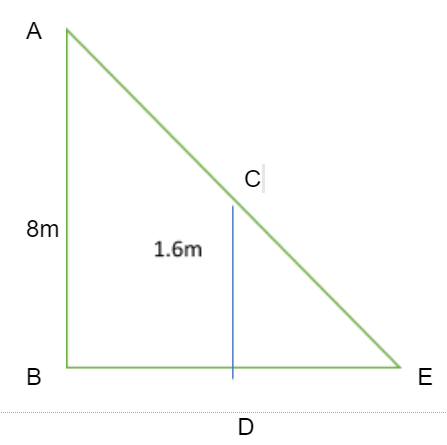
Let us consider $AB$ to be a lamp post, which is of $8m$ height and $CD$ to be the mean height of $1.6m$.
Now man is walking away from the lamp post.
Let us consider that any time $t$, a man has walked $xm$ away from a lamp post. Then \[BD=x\,m\]
Let at this time, the length of shadow of man formed due to the lamp post to be $y\,m$. Then \[DE=ym\]
Now, in \[\vartriangle ABE\] and \[\vartriangle CDE\] we have,
\[\angle ABE=\angle CDE\], as both are right angles.
\[\angle BEA=\angle DEC\], as both angles are common.
\[\angle BAE=\angle DCE\], as both are formed by the same light beam.
Therefore, we get, \[\angle ABE\sim \angle CDE\]by \[AAA\] criteria of similarity of triangles.
Now, since corresponding sides of similar triangle are proportional,
\[\Rightarrow \dfrac{AB}{CD}=\dfrac{BE}{DE}\]
Where, \[AB=8m\], \[CD=1.6m\],
$BE=BD+DE=\left( x+y \right)m$
And $DE=ym$
Putting this value, we get,
$\begin{align}
& \dfrac{8m}{1.6m}=\dfrac{\left( x+y \right)m}{ym} \\
& \Rightarrow \dfrac{8}{1.6}=\dfrac{\left( x+y \right)}{y} \\
\end{align}$
Cross multiplying this equation we get,
$8y=1.6\left( x+y \right)$
Applying distribution law, we get,
$8y=1.6x+1.6y$
Subtracting $1.6y$ from both sides of the equation, we get,
$8y-1.6y=1.6x+1.6y-1.6y$
$=6.4y=1.6x$
Dividing $6.4$ from both sides of the equation, we get,
$\begin{align}
& \dfrac{6.4y}{6.4}=\dfrac{1.6x}{6.4} \\
& \Rightarrow y=\dfrac{1.6}{6.4}x \\
\end{align}$
Simplifying $\dfrac{1.6}{6.4}$, we get,
$y=\dfrac{1}{4}x......(i)$
Now according to the question, man is walking away from a lamp post at the rate of $0.5m/s$ That is the rate of change of $x$ with respect to time $t$ is $0.5m/s$. This can be written as,
$\dfrac{dx}{dt}=0.5m/s..........(ii)$
We are to find the rate of change of length of shadow. That is the rate of change of $y$ with respect to time $t$. This is given as:
$\dfrac{dy}{dt}=\dfrac{dy}{dx}\times \dfrac{dx}{dt}$
Putting value of equation (i) here, we get,
$\begin{align}
& \dfrac{dy}{dt}=\dfrac{d}{dx}\left( \dfrac{1}{4}x \right)\dfrac{dx}{dt} \\
& \Rightarrow \dfrac{dy}{dt}=\dfrac{1}{4}\dfrac{dx}{dt} \\
\end{align}$
Putting value of $\dfrac{dx}{dt}$ from equation(ii)
We get,
$\dfrac{dx}{dt}=\dfrac{1}{4}\times 0.5m/s$
Simplifying this, we get,
$\dfrac{dx}{dt}=0.25m/s$
Hence, the rate of change of shadow is $0.25m/s$.
Note: In this type of equation, we first find expression for the term whose rate of change is to be determined and the differentiated it to find rate of change. While doing calculations, be careful of the sign. Sign mistakes are very common and hence, students should be very careful while doing calculations and substitutions.
Complete Step-by-Step solution:
Let us consider $AB$ to be a lamp post, which is of $8m$ height and $CD$ to be the mean height of $1.6m$.
Now man is walking away from the lamp post.
Let us consider that any time $t$, a man has walked $xm$ away from a lamp post. Then \[BD=x\,m\]
Let at this time, the length of shadow of man formed due to the lamp post to be $y\,m$. Then \[DE=ym\]
Now, in \[\vartriangle ABE\] and \[\vartriangle CDE\] we have,
\[\angle ABE=\angle CDE\], as both are right angles.
\[\angle BEA=\angle DEC\], as both angles are common.
\[\angle BAE=\angle DCE\], as both are formed by the same light beam.
Therefore, we get, \[\angle ABE\sim \angle CDE\]by \[AAA\] criteria of similarity of triangles.
Now, since corresponding sides of similar triangle are proportional,
\[\Rightarrow \dfrac{AB}{CD}=\dfrac{BE}{DE}\]
Where, \[AB=8m\], \[CD=1.6m\],
$BE=BD+DE=\left( x+y \right)m$
And $DE=ym$
Putting this value, we get,
$\begin{align}
& \dfrac{8m}{1.6m}=\dfrac{\left( x+y \right)m}{ym} \\
& \Rightarrow \dfrac{8}{1.6}=\dfrac{\left( x+y \right)}{y} \\
\end{align}$
Cross multiplying this equation we get,
$8y=1.6\left( x+y \right)$
Applying distribution law, we get,
$8y=1.6x+1.6y$
Subtracting $1.6y$ from both sides of the equation, we get,
$8y-1.6y=1.6x+1.6y-1.6y$
$=6.4y=1.6x$
Dividing $6.4$ from both sides of the equation, we get,
$\begin{align}
& \dfrac{6.4y}{6.4}=\dfrac{1.6x}{6.4} \\
& \Rightarrow y=\dfrac{1.6}{6.4}x \\
\end{align}$
Simplifying $\dfrac{1.6}{6.4}$, we get,
$y=\dfrac{1}{4}x......(i)$
Now according to the question, man is walking away from a lamp post at the rate of $0.5m/s$ That is the rate of change of $x$ with respect to time $t$ is $0.5m/s$. This can be written as,
$\dfrac{dx}{dt}=0.5m/s..........(ii)$
We are to find the rate of change of length of shadow. That is the rate of change of $y$ with respect to time $t$. This is given as:
$\dfrac{dy}{dt}=\dfrac{dy}{dx}\times \dfrac{dx}{dt}$
Putting value of equation (i) here, we get,
$\begin{align}
& \dfrac{dy}{dt}=\dfrac{d}{dx}\left( \dfrac{1}{4}x \right)\dfrac{dx}{dt} \\
& \Rightarrow \dfrac{dy}{dt}=\dfrac{1}{4}\dfrac{dx}{dt} \\
\end{align}$
Putting value of $\dfrac{dx}{dt}$ from equation(ii)
We get,
$\dfrac{dx}{dt}=\dfrac{1}{4}\times 0.5m/s$
Simplifying this, we get,
$\dfrac{dx}{dt}=0.25m/s$
Hence, the rate of change of shadow is $0.25m/s$.
Note: In this type of equation, we first find expression for the term whose rate of change is to be determined and the differentiated it to find rate of change. While doing calculations, be careful of the sign. Sign mistakes are very common and hence, students should be very careful while doing calculations and substitutions.
Recently Updated Pages
Master Class 10 Computer Science: Engaging Questions & Answers for Success

State BPT theorem and prove it class 10 maths CBSE
A peacock is sitting on the top of a pillar which -class-10-maths-CBSE
Railways Women Helpline Number?
Explain the refraction of light through a glassslab class 10 physics CBSE
a Why did Mendel choose pea plants for his experiments class 10 biology CBSE
Trending doubts
Explain the Treaty of Vienna of 1815 class 10 social science CBSE
10 examples of evaporation in daily life with explanations
What is the full form of POSCO class 10 social science CBSE
Write short note on buckyball class 10 chemistry CBSE
Write a report on a Bus accident class 10 english CBSE
Five things I will do to build a great India class 10 english CBSE