




A major characteristic of the monocot root is the presence of
A. Vasculature without cambium
B. Cambium sandwiched between xylem and phloem along the radius
C. Open vascular bundles
D. Scattered vascular bundles
Answer
 Verified
618k+ views
Hint: Multicellular eukaryotes that have the ability to carry out photosynthesis and belong to the Kingdom Plantae are known as plants. Plants are classified as either flowering plants or non-flowering plants. Flowering plants are also known as angiosperms are classified specifically based on the number of cotyledons (embryonic leaf) present in the seeds.
Complete answer: The seeds of a plant either contain one cotyledon or two cotyledons. Seeds with one cotyledon are termed as monocots or monocotyledons and seeds with two cotyledons are referred to as dicots or dicotyledons. In the framework of this question, we shall further discuss monocot flowering plants and the characteristics of monocot roots.
Monocotyledons are estimated to produce the majority of the renewable organic material known as biomass in the agricultural field. Biomass is produced through photosynthesis in plants and can be converted to renewable gaseous and liquid fuels and can also be directly for heat. The economically salient monocot crops include grains such as maize, rice, wheat, etc. to name a few and others include bamboo, sugarcane, gingers, and plants belonging to the family Zingiberaceae, bananas, plantains, onion, pineapple, asparagus, cardamom, turmeric, and various palms. Plants that are cultivated for their blooms are also monocotyledons. These include blooms such as lilies, cannas, bluebells, daffodils, amaryllis, and tulips.
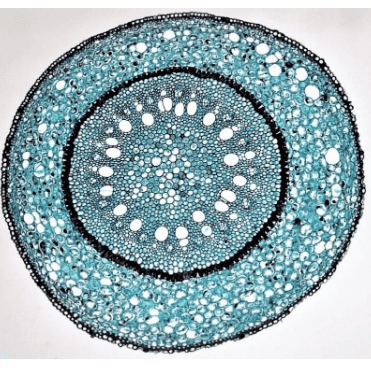
One of the most prominent characteristics of monocot root is the absence of cambium. This limits the roots’ ability to grow sufficiently. The monocot root consists of a distinct pith around which the vascular bundles arrange themselves alternately and radially forming a ring. They do not take part in cambium formation and are separated by narrow strips known as the conjunctive tissue. When compared to the vascular structures of dicot roots, monocot roots have a greater number of the vascular structure.
Based on the particulars provided one can conclude that the major characteristic of the monocot root is the presence of vasculature without cambium.
Therefore the correct answer is option A., i.e., Vasculature without cambium.
Note: About 60,000 species are monocot plants. The species orchids belonging to the family Orchidaceae are considered to be the largest family of the monocotyledons comprising more than 20,000 species. Sedges are also monocotyledons and are often mistaken as grasses. Most economically plant species of monocots are the true grasses belonging to the family Poaceae.
Complete answer: The seeds of a plant either contain one cotyledon or two cotyledons. Seeds with one cotyledon are termed as monocots or monocotyledons and seeds with two cotyledons are referred to as dicots or dicotyledons. In the framework of this question, we shall further discuss monocot flowering plants and the characteristics of monocot roots.
Monocotyledons are estimated to produce the majority of the renewable organic material known as biomass in the agricultural field. Biomass is produced through photosynthesis in plants and can be converted to renewable gaseous and liquid fuels and can also be directly for heat. The economically salient monocot crops include grains such as maize, rice, wheat, etc. to name a few and others include bamboo, sugarcane, gingers, and plants belonging to the family Zingiberaceae, bananas, plantains, onion, pineapple, asparagus, cardamom, turmeric, and various palms. Plants that are cultivated for their blooms are also monocotyledons. These include blooms such as lilies, cannas, bluebells, daffodils, amaryllis, and tulips.
One of the most prominent characteristics of monocot root is the absence of cambium. This limits the roots’ ability to grow sufficiently. The monocot root consists of a distinct pith around which the vascular bundles arrange themselves alternately and radially forming a ring. They do not take part in cambium formation and are separated by narrow strips known as the conjunctive tissue. When compared to the vascular structures of dicot roots, monocot roots have a greater number of the vascular structure.
Based on the particulars provided one can conclude that the major characteristic of the monocot root is the presence of vasculature without cambium.
Therefore the correct answer is option A., i.e., Vasculature without cambium.
Note: About 60,000 species are monocot plants. The species orchids belonging to the family Orchidaceae are considered to be the largest family of the monocotyledons comprising more than 20,000 species. Sedges are also monocotyledons and are often mistaken as grasses. Most economically plant species of monocots are the true grasses belonging to the family Poaceae.
Recently Updated Pages
Master Class 11 English: Engaging Questions & Answers for Success

Master Class 11 Physics: Engaging Questions & Answers for Success
Master Class 11 Computer Science: Engaging Questions & Answers for Success
Master Class 11 Chemistry: Engaging Questions & Answers for Success
Master Class 11 Social Science: Engaging Questions & Answers for Success
Master Class 11 Accountancy: Engaging Questions & Answers for Success
Trending doubts
Difference Between Prokaryotic Cells and Eukaryotic Cells
Two of the body parts which do not appear in MRI are class 11 biology CBSE
One Metric ton is equal to kg A 10000 B 1000 C 100 class 11 physics CBSE
10 examples of friction in our daily life
Draw a diagram of nephron and explain its structur class 11 biology CBSE
Draw a diagram of a plant cell and label at least eight class 11 biology CBSE