




A magnet 10 cm long and having pole strength 2 amp m is deflected through ${{30}^{\circ }}$ from the magnetic meridian. The horizontal component of the Earth's induction is $0.32\times {{10}^{-4}}$ tesla then the value of the deflecting couple is
$\begin{align}
& a)32\times {{10}^{-7}}Nm \\
& b)16\times {{10}^{-7}}Nm \\
& c)64\times {{10}^{-7}}Nm \\
& d)48\times {{10}^{-7}}Nm \\
\end{align}$
Answer
 Verified
602.7k+ views
Hint: The deflecting couple is the torque acting on the magnet due to the horizontal component of the Earth’s magnetic field. When a magnet is placed in a magnetic field the torque acting on that magnet is given by, $\tau =m\times B$ where m is the magnetic moment of the magnet and B is the magnetic field in which the magnet is kept. The above expression can also be written as, $\tau =mB\operatorname{Sin}\theta $ where $\theta $ is the angle between the magnetic field B and the magnetic moment. Hence from this we can calculate the value of the deflecting couple.
Complete step by step answer:
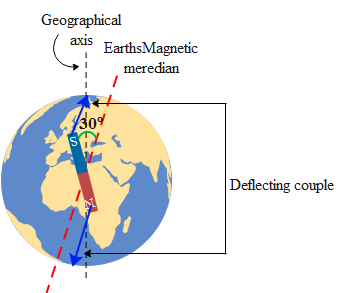
In the above figure we can see the magnet is making 30 degrees with respect to the magnetic ,meridian. The deflecting couple is depicted by the blue arrows in the diagram. Hence the torques on the magnet are given by, $\tau =mB\operatorname{Sin}\theta ...(1)$. The magnetic moment of the magnet is the product of pole strength (p) times the length (l) of the bar magnet. Hence the magnetic moment of the above magnet is,
$m=p(l)=2(10\times {{10}^{-2}})=\text{20}\times {{10}^{-2}}\text{ amp }{{\text{m}}^{\text{2}}}$. Hence substituting this in equation (1) we get,
$\begin{align}
& \tau =mB\operatorname{Sin}\theta \\
& \tau =20\times {{10}^{-2}}(0.32\times {{10}^{-4}})\operatorname{Sin}{{30}^{\circ }},\text{since}\operatorname{Sin}{{30}^{\circ }}=\dfrac{1}{2} \\
& \tau =\dfrac{6.4\times {{10}^{-6}}}{2} \\
& \tau =32\times {{10}^{-7}}Nm \\
\end{align}$
Hence the correct answer to the above question is option a.
Note:
It is to be noted that along the Earth's meridian, the horizontal components of the Earth’s magnetic field is to be considered. This is because there does not exist the vertical component along the Earth's meridian. It is also to be noted that the geographical axis and the Earth’s meridian are oriented differently. Therefore the magnetic north and the geographical north vary slightly. Also it is also to be noted that the geographical poles of the earth are different from the magnetic poles of the Earth.
Complete step by step answer:
In the above figure we can see the magnet is making 30 degrees with respect to the magnetic ,meridian. The deflecting couple is depicted by the blue arrows in the diagram. Hence the torques on the magnet are given by, $\tau =mB\operatorname{Sin}\theta ...(1)$. The magnetic moment of the magnet is the product of pole strength (p) times the length (l) of the bar magnet. Hence the magnetic moment of the above magnet is,
$m=p(l)=2(10\times {{10}^{-2}})=\text{20}\times {{10}^{-2}}\text{ amp }{{\text{m}}^{\text{2}}}$. Hence substituting this in equation (1) we get,
$\begin{align}
& \tau =mB\operatorname{Sin}\theta \\
& \tau =20\times {{10}^{-2}}(0.32\times {{10}^{-4}})\operatorname{Sin}{{30}^{\circ }},\text{since}\operatorname{Sin}{{30}^{\circ }}=\dfrac{1}{2} \\
& \tau =\dfrac{6.4\times {{10}^{-6}}}{2} \\
& \tau =32\times {{10}^{-7}}Nm \\
\end{align}$
Hence the correct answer to the above question is option a.
Note:
It is to be noted that along the Earth's meridian, the horizontal components of the Earth’s magnetic field is to be considered. This is because there does not exist the vertical component along the Earth's meridian. It is also to be noted that the geographical axis and the Earth’s meridian are oriented differently. Therefore the magnetic north and the geographical north vary slightly. Also it is also to be noted that the geographical poles of the earth are different from the magnetic poles of the Earth.
Recently Updated Pages
Master Class 11 Social Science: Engaging Questions & Answers for Success

Master Class 11 Physics: Engaging Questions & Answers for Success
Master Class 11 Maths: Engaging Questions & Answers for Success
Master Class 11 Economics: Engaging Questions & Answers for Success
Master Class 11 Computer Science: Engaging Questions & Answers for Success
Master Class 11 Chemistry: Engaging Questions & Answers for Success
Trending doubts
One Metric ton is equal to kg A 10000 B 1000 C 100 class 11 physics CBSE
There are 720 permutations of the digits 1 2 3 4 5 class 11 maths CBSE
1 Quintal is equal to a 110 kg b 10 kg c 100kg d 1000 class 11 physics CBSE
State and prove Bernoullis theorem class 11 physics CBSE
Difference Between Prokaryotic Cells and Eukaryotic Cells
Which among the following are examples of coming together class 11 social science CBSE