




A longitudinal wave is produced on a toy slinky. The wave travels at a speed of 30 cm/sec and the frequency of the wave is 20Hz. What is the minimum separation between the conservative compressions of slinky?
A) $0.015m$
B) $0.03m$
C) $0.045m$
D) $0.06m$
Answer
 Verified
604.2k+ views
Hint:In this question things are given the velocity of the wave and the frequency of the wave. And we know that the separation between the conservative compression and rarefaction is called wavelength of wave so on this question wavelength of wave is asked.
Step by step solution:
The velocity of wave is given $v = 30cm/\sec $convert it into $m/\sec $
$ \Rightarrow v = 30 \times {10^{ - 2}}m/\sec $
Frequency of wave is given $f = 20Hz$
We know the formula for velocity of wave is
$ \Rightarrow v = f\lambda $
Where $v \Rightarrow $ velocity of wave
$f \Rightarrow $ Frequency of wave
$\lambda \Rightarrow $ Wavelength of wave
As we know the distance between two consecutive compressions or rarefaction is known as wavelength of wave as shown in figure
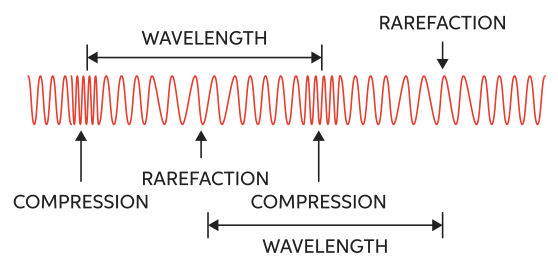
So the wavelength can be calculated by above formula
$ \Rightarrow \lambda = \dfrac{v}{f}$
Put the given value
$ \Rightarrow \lambda = \dfrac{{30 \times {{10}^{ - 2}}}}{{20}}$
$ \Rightarrow \lambda = 1.5 \times {10^{ - 2}}m$
Or can written as
$\therefore \lambda = 0.015m$
Hence option A is correct
Note:
We take here a formula $v = f\lambda $ this gives the relation between wave velocity and frequency, wavelength of wave
Wavelength is known as for longitudinal wave the distance between two adjacent compression and rarefaction called wavelength
And in a transverse wave the distance between two adjacent crusts or through is called the wavelength of the transverse wave.
Step by step solution:
The velocity of wave is given $v = 30cm/\sec $convert it into $m/\sec $
$ \Rightarrow v = 30 \times {10^{ - 2}}m/\sec $
Frequency of wave is given $f = 20Hz$
We know the formula for velocity of wave is
$ \Rightarrow v = f\lambda $
Where $v \Rightarrow $ velocity of wave
$f \Rightarrow $ Frequency of wave
$\lambda \Rightarrow $ Wavelength of wave
As we know the distance between two consecutive compressions or rarefaction is known as wavelength of wave as shown in figure
So the wavelength can be calculated by above formula
$ \Rightarrow \lambda = \dfrac{v}{f}$
Put the given value
$ \Rightarrow \lambda = \dfrac{{30 \times {{10}^{ - 2}}}}{{20}}$
$ \Rightarrow \lambda = 1.5 \times {10^{ - 2}}m$
Or can written as
$\therefore \lambda = 0.015m$
Hence option A is correct
Note:
We take here a formula $v = f\lambda $ this gives the relation between wave velocity and frequency, wavelength of wave
Wavelength is known as for longitudinal wave the distance between two adjacent compression and rarefaction called wavelength
And in a transverse wave the distance between two adjacent crusts or through is called the wavelength of the transverse wave.
Recently Updated Pages
Master Class 11 Social Science: Engaging Questions & Answers for Success

Master Class 11 English: Engaging Questions & Answers for Success
Master Class 11 Maths: Engaging Questions & Answers for Success
Master Class 11 Chemistry: Engaging Questions & Answers for Success
Master Class 11 Biology: Engaging Questions & Answers for Success
Master Class 11 Physics: Engaging Questions & Answers for Success
Trending doubts
One Metric ton is equal to kg A 10000 B 1000 C 100 class 11 physics CBSE
Difference Between Prokaryotic Cells and Eukaryotic Cells
There are 720 permutations of the digits 1 2 3 4 5 class 11 maths CBSE
Draw a diagram of a plant cell and label at least eight class 11 biology CBSE
Two of the body parts which do not appear in MRI are class 11 biology CBSE
Which gas is abundant in air class 11 chemistry CBSE