




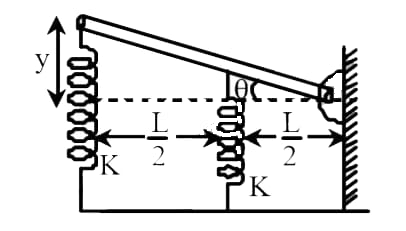
A long uniform rod of length $ L $ , mass $ M $ is free to rotate in a horizontal plane about a vertical axis through its end. Two springs of constant $ K $ each are connected as shown. On equilibrium, the road was horizontal. The frequency of small oscillation of rod if displaced slightly will be:
(A) $ \dfrac{1}{{2\pi }}\sqrt {\dfrac{{15K}}{M}} $
(B) $ \dfrac{1}{{2\pi }}\sqrt {\dfrac{{15}}{{4M}}} $
(C) $ \dfrac{1}{{2\pi }}\sqrt {\dfrac{{3K}}{{4M}}} $
(D) $ \dfrac{1}{{2\pi }}\sqrt {\dfrac{{15K}}{{4M}}} $
Answer
 Verified
480.6k+ views
Hint: If a spring is stretched or compressed, it is displaced from its original position. As a result, restoring force tends to retract the spring back to its equilibrium position. Restoring force of the spring is proportional to the displacement of the spring.
When the rod displaced slightly from its original position the connected spring stretched. Where restoring force of one spring $ F $ is proportional to its displacement $ y $
$ \therefore {F_1} \propto y $ or, $ {F_1} = Ky $ ( $ K $ is the spring constant)
And torque $ \tau $ is proportional to the angular displacement $ \theta $
$ \therefore \tau \propto \theta $
$ \Rightarrow \tau = K\theta $
$ K $ is the torsion constant that is torque per unit angular displacement. If the moment of inertia of the body is $ I $ and the angular acceleration is $ \alpha $
Then, $ \tau = - I\alpha $ .
Complete Step By Step Answer:
Let the uniform rod be displaced slightly at the angle of $ \theta $
Displacement of the spring be $ y $ and $ {y_1} $
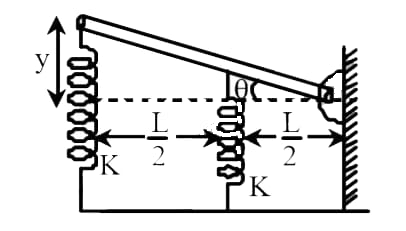
As the image is given we can calculate the value of $ \theta $ is, $ \theta = \dfrac{y}{L} $
Also, $ \theta = \dfrac{{{y_1}}}{{\dfrac{L}{2}}} $
$ \therefore $ $ y = L\theta $ and $ {y_1} = \dfrac{{L\theta }}{2} $
Now let the force applied on the two rods are $ {F_1} $ and $ {F_2} $
Hence the spring constant is $ K $
$ {F_1} = Ky $ $ = KL\theta $
$ {F_2} = K{y_1} $ $ = \dfrac{{KL\theta }}{2} $
The restoring Torque due to the elastic force of the spring is:
$ \tau = ({F_1}\cos \theta \dfrac{L}{2} \times {F_2}\cos \theta L) $
$ \Rightarrow \tau = \left( {\dfrac{{{F_1}}}{2} + {F_2}} \right)\cos \theta $
Here $ \theta $ is very small, hence we can assume $ \cos \theta \simeq 1 $
$ \therefore \tau = (\dfrac{{KL\theta }}{4} + KL\theta )L $
$ = \left( {\dfrac{{K\theta }}{4} + K\theta } \right){L^2} $
$ = \left( {\dfrac{{5KL\theta }}{4}} \right){L^2} $
Now, Net Torque $ \tau = \left( {\dfrac{{5KL\theta }}{4}} \right){L^2} $ $ = - I\alpha $ ( $ \alpha = $ angular acceleration)
$ \Rightarrow \left( {\dfrac{{5KL\theta }}{4}} \right){L^2} = \left( {\dfrac{{M{L^2}}}{3}} \right)\alpha $ ( $ \because I = - \left( {\dfrac{{M{L^2}}}{3}} \right) $ )
$ \Rightarrow \alpha = - \dfrac{{15K}}{{4m}}\theta $
As we know $ \alpha = - {\omega ^2}\theta $
Putting the value we get, $ {\omega ^2} = \dfrac{{15K}}{{4m}} $
$ \because \omega = 2\pi f = \sqrt {\dfrac{{15K}}{{4m}}} $
Hence, the value of frequency $ f = \dfrac{1}{{2\pi }}\sqrt {\dfrac{{15K}}{{4m}}} $
$ \therefore $ A correct answer is an option (D).
Note:
If a spring is attached to a hook and the other is attached to an object with mass and hangs down vertically. The object will have two forces. One is restoring the force of the spring directly upward. The other will be the force of gravity acting on the mass directly downward. When the mass is not moving the net force is zero.
When the rod displaced slightly from its original position the connected spring stretched. Where restoring force of one spring $ F $ is proportional to its displacement $ y $
$ \therefore {F_1} \propto y $ or, $ {F_1} = Ky $ ( $ K $ is the spring constant)
And torque $ \tau $ is proportional to the angular displacement $ \theta $
$ \therefore \tau \propto \theta $
$ \Rightarrow \tau = K\theta $
$ K $ is the torsion constant that is torque per unit angular displacement. If the moment of inertia of the body is $ I $ and the angular acceleration is $ \alpha $
Then, $ \tau = - I\alpha $ .
Complete Step By Step Answer:
Let the uniform rod be displaced slightly at the angle of $ \theta $
Displacement of the spring be $ y $ and $ {y_1} $
As the image is given we can calculate the value of $ \theta $ is, $ \theta = \dfrac{y}{L} $
Also, $ \theta = \dfrac{{{y_1}}}{{\dfrac{L}{2}}} $
$ \therefore $ $ y = L\theta $ and $ {y_1} = \dfrac{{L\theta }}{2} $
Now let the force applied on the two rods are $ {F_1} $ and $ {F_2} $
Hence the spring constant is $ K $
$ {F_1} = Ky $ $ = KL\theta $
$ {F_2} = K{y_1} $ $ = \dfrac{{KL\theta }}{2} $
The restoring Torque due to the elastic force of the spring is:
$ \tau = ({F_1}\cos \theta \dfrac{L}{2} \times {F_2}\cos \theta L) $
$ \Rightarrow \tau = \left( {\dfrac{{{F_1}}}{2} + {F_2}} \right)\cos \theta $
Here $ \theta $ is very small, hence we can assume $ \cos \theta \simeq 1 $
$ \therefore \tau = (\dfrac{{KL\theta }}{4} + KL\theta )L $
$ = \left( {\dfrac{{K\theta }}{4} + K\theta } \right){L^2} $
$ = \left( {\dfrac{{5KL\theta }}{4}} \right){L^2} $
Now, Net Torque $ \tau = \left( {\dfrac{{5KL\theta }}{4}} \right){L^2} $ $ = - I\alpha $ ( $ \alpha = $ angular acceleration)
$ \Rightarrow \left( {\dfrac{{5KL\theta }}{4}} \right){L^2} = \left( {\dfrac{{M{L^2}}}{3}} \right)\alpha $ ( $ \because I = - \left( {\dfrac{{M{L^2}}}{3}} \right) $ )
$ \Rightarrow \alpha = - \dfrac{{15K}}{{4m}}\theta $
As we know $ \alpha = - {\omega ^2}\theta $
Putting the value we get, $ {\omega ^2} = \dfrac{{15K}}{{4m}} $
$ \because \omega = 2\pi f = \sqrt {\dfrac{{15K}}{{4m}}} $
Hence, the value of frequency $ f = \dfrac{1}{{2\pi }}\sqrt {\dfrac{{15K}}{{4m}}} $
$ \therefore $ A correct answer is an option (D).
Note:
If a spring is attached to a hook and the other is attached to an object with mass and hangs down vertically. The object will have two forces. One is restoring the force of the spring directly upward. The other will be the force of gravity acting on the mass directly downward. When the mass is not moving the net force is zero.
Recently Updated Pages
Master Class 11 Computer Science: Engaging Questions & Answers for Success

Master Class 11 Business Studies: Engaging Questions & Answers for Success
Master Class 11 Economics: Engaging Questions & Answers for Success
Master Class 11 English: Engaging Questions & Answers for Success
Master Class 11 Maths: Engaging Questions & Answers for Success
Master Class 11 Biology: Engaging Questions & Answers for Success
Trending doubts
One Metric ton is equal to kg A 10000 B 1000 C 100 class 11 physics CBSE
There are 720 permutations of the digits 1 2 3 4 5 class 11 maths CBSE
Discuss the various forms of bacteria class 11 biology CBSE
Draw a diagram of a plant cell and label at least eight class 11 biology CBSE
State the laws of reflection of light
Explain zero factorial class 11 maths CBSE