




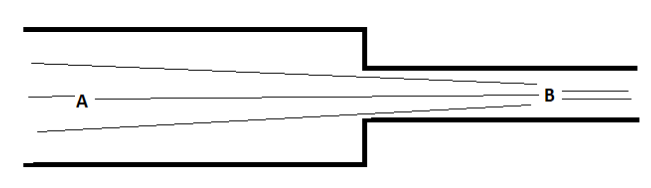
A long thin tube has two different cross sections and liquid flows inside it. Take two points A and B at the same horizontal level. Cross section A is larger than B then,
A. ${P_A} > {P_B}$
B. ${P_B} > {P_A}$
C. ${P_A} = {P_B}$
D. ${V_B} > {V_A}$
Answer
 Verified
642k+ views
Hint: As the liquids are incompressible, the rate of flow into an area must equal the rate of flow out of an area. This is known as the equation of continuity. The equation of continuity can show how much the speed of a liquid increases when it flows through a smaller area.
Formula used:
The equation of continuity ${A_A}{V_A} = {A_B}{V_B}$ is used where ${A_A}$ is the area of cross section at point $A$, ${A_B}$ is the area of cross section at point $B$, ${V_A}$ is the velocity of fluid at point $A$and ${V_B}$ is the velocity of fluid at point $B$.
The Bernoulli’s equation $P + \dfrac{1}{2}\rho {v^2} + \rho gh = C$ is used where $P$is the pressure, $\rho $is the density, $v$is the velocity, $g$is the acceleration due to gravity and $h$is the height.
Complete answer:
Let there be two cross sections at points $A$ and $B$ of different areas, ${A_A}$ and ${A_B}$ respectively. Let the velocities at these points be ${V_A}$ and ${V_B}$ respectively. Since the fluid is incompressible, the volume that flows through any point of the pipe in a given time is constant. This is called the “continuity equation”.
${A_A}{V_A} = {A_B}{V_B}$ . That is, when the area is smaller, the velocity is bigger. That is ${V_B} > {V_A}$.
$\therefore $ Option (D) is correct.
Bernoulli's principle tells us how pressure and velocity are inversely proportional. In this case, where a fluid flows into a narrower cross section, the pressure decreases as the velocity increases. As a matter of fact, it is the difference in pressure that sustains the motion towards the smaller cross section.
Bernoulli’s equation is
$P + \dfrac{1}{2}\rho {v^2} + \rho gh = C$, where $C$ is a constant.
The term $\rho gh$ is derived from the gravitational potential energy. Consider two points that are at the same height. It is clear from the above that, the more the velocity, the lesser the pressure. That is, ${P_A} > {P_B}$.
$\therefore $ Option (A) is correct.
So, the correct answers are “Option A and D”.
Note:
Candidates can get confused when they use the formula \[P = \dfrac{F}{A}\] as it says pressure and area are inversely proportional. The pressure and area are inversely proportional to each other i.e., when area decreases pressure exerted on that area increases. When area increases pressure exerted on that area decreases.
Formula used:
The equation of continuity ${A_A}{V_A} = {A_B}{V_B}$ is used where ${A_A}$ is the area of cross section at point $A$, ${A_B}$ is the area of cross section at point $B$, ${V_A}$ is the velocity of fluid at point $A$and ${V_B}$ is the velocity of fluid at point $B$.
The Bernoulli’s equation $P + \dfrac{1}{2}\rho {v^2} + \rho gh = C$ is used where $P$is the pressure, $\rho $is the density, $v$is the velocity, $g$is the acceleration due to gravity and $h$is the height.
Complete answer:
Let there be two cross sections at points $A$ and $B$ of different areas, ${A_A}$ and ${A_B}$ respectively. Let the velocities at these points be ${V_A}$ and ${V_B}$ respectively. Since the fluid is incompressible, the volume that flows through any point of the pipe in a given time is constant. This is called the “continuity equation”.
${A_A}{V_A} = {A_B}{V_B}$ . That is, when the area is smaller, the velocity is bigger. That is ${V_B} > {V_A}$.
$\therefore $ Option (D) is correct.
Bernoulli's principle tells us how pressure and velocity are inversely proportional. In this case, where a fluid flows into a narrower cross section, the pressure decreases as the velocity increases. As a matter of fact, it is the difference in pressure that sustains the motion towards the smaller cross section.
Bernoulli’s equation is
$P + \dfrac{1}{2}\rho {v^2} + \rho gh = C$, where $C$ is a constant.
The term $\rho gh$ is derived from the gravitational potential energy. Consider two points that are at the same height. It is clear from the above that, the more the velocity, the lesser the pressure. That is, ${P_A} > {P_B}$.
$\therefore $ Option (A) is correct.
So, the correct answers are “Option A and D”.
Note:
Candidates can get confused when they use the formula \[P = \dfrac{F}{A}\] as it says pressure and area are inversely proportional. The pressure and area are inversely proportional to each other i.e., when area decreases pressure exerted on that area increases. When area increases pressure exerted on that area decreases.
Recently Updated Pages
Write structures of the following compounds i 2 Chloro3methylpentane class 11 chemistry CBSE

What is BLO What is the full form of BLO class 8 social science CBSE
Explain the Treaty of Vienna of 1815 class 10 social science CBSE
A Paragraph on Pollution in about 100-150 Words
XIX+XXX A 49 B 51 C 55 D 44 class 5 maths CBSE
If x a + bt + ct2 where x is in meters and t is in class 11 physics CBSE
Trending doubts
One Metric ton is equal to kg A 10000 B 1000 C 100 class 11 physics CBSE
Find the value of the expression given below sin 30circ class 11 maths CBSE
What do you mean by retardation What is its SI uni class 11 physics CBSE
Draw a diagram of nephron and explain its structur class 11 biology CBSE
10 examples of friction in our daily life
Difference between physical and chemical change class 11 chemistry CBSE