




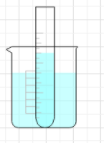
A long capillary tube of mass π gm, radius 2mm and negligible thickness, is partially immersed in a liquid of surface tension 0.1Nm Take angle of contact zero and neglect buoyant force of liquid. The force required to hold the tube vertically, will be (g=10 \[m/{{s}^{2}}\])
Answer
 Verified
585.9k+ views
Hint: We will use the formula and concept of surface tension. The tension on the liquid surface and the capillary tube has been calculated. After getting the value of tension, we will find force by substituting the given values in the formula. Three forces act on the system, one on the liquid, the second on the surface of the test tube and the downward force due to liquid filled in the test tube.
Formula used:
Surface tension= \[=\dfrac{Force}{Length}\]
Complete answer:
We have a long capillary tube having mass \[m\] and radius \[R\] . The tube is partially immersed in a liquid. The surface tension of the liquid is given. We need to find the force which is required to hold the tube vertically.
Let \[F\] be the upward thrust on the tube and \[{{S}_{1}}\] be the tension on the surface of liquid. Surface tension on the surface of the capillary tube be \[{{S}_{2}}\] . \[mg\] be the force acting downward on the capillary tube.
Then the surface tension for the liquid surface and tube surface be
For liquid surface \[{{S}_{1}}=2\pi R(S)\]
For tube surface \[{{S}_{2}}=2\pi R(S)\]
So force can be calculated as = \[{{S}_{1}}+{{S}_{2}}+mg\]
=\[2\times 2\pi R(S)+mg\]……(1)
Given:
\[\begin{align}
& m=\pi gm \\
& R=2mm \\
& g=10m/{{s}^{2}} \\
& S=0.1N/m \\
\end{align}\]
Substituting the given values in equation (1)
\[\begin{align}
& =2\pi (2\times 0.1)\times {{10}^{-3}}+\pi \times 10\times {{10}^{-3}} \\
& =8\pi \times 0.1\times {{10}^{-3}}+10\pi \times {{10}^{-3}} \\
& =10.8\pi mN \\
\end{align}\]
Therefore the total force acting will be \[10.8\pi mN\] .
Note:
Surface tension is a force exerted on the liquid surface. It has the property to occupy minimum possible surface area. Surface tension depends on the radius of the test tube, density of the liquid and height of the column. In our daily life the principle of surface tension can be seen in thermometer, tooth paste, the detergent we use etc.
Formula used:
Surface tension= \[=\dfrac{Force}{Length}\]
Complete answer:
We have a long capillary tube having mass \[m\] and radius \[R\] . The tube is partially immersed in a liquid. The surface tension of the liquid is given. We need to find the force which is required to hold the tube vertically.
Let \[F\] be the upward thrust on the tube and \[{{S}_{1}}\] be the tension on the surface of liquid. Surface tension on the surface of the capillary tube be \[{{S}_{2}}\] . \[mg\] be the force acting downward on the capillary tube.
Then the surface tension for the liquid surface and tube surface be
For liquid surface \[{{S}_{1}}=2\pi R(S)\]
For tube surface \[{{S}_{2}}=2\pi R(S)\]
So force can be calculated as = \[{{S}_{1}}+{{S}_{2}}+mg\]
=\[2\times 2\pi R(S)+mg\]……(1)
Given:
\[\begin{align}
& m=\pi gm \\
& R=2mm \\
& g=10m/{{s}^{2}} \\
& S=0.1N/m \\
\end{align}\]
Substituting the given values in equation (1)
\[\begin{align}
& =2\pi (2\times 0.1)\times {{10}^{-3}}+\pi \times 10\times {{10}^{-3}} \\
& =8\pi \times 0.1\times {{10}^{-3}}+10\pi \times {{10}^{-3}} \\
& =10.8\pi mN \\
\end{align}\]
Therefore the total force acting will be \[10.8\pi mN\] .
Note:
Surface tension is a force exerted on the liquid surface. It has the property to occupy minimum possible surface area. Surface tension depends on the radius of the test tube, density of the liquid and height of the column. In our daily life the principle of surface tension can be seen in thermometer, tooth paste, the detergent we use etc.
Recently Updated Pages
Master Class 11 Computer Science: Engaging Questions & Answers for Success

Master Class 11 Business Studies: Engaging Questions & Answers for Success
Master Class 11 Economics: Engaging Questions & Answers for Success
Master Class 11 English: Engaging Questions & Answers for Success
Master Class 11 Maths: Engaging Questions & Answers for Success
Master Class 11 Biology: Engaging Questions & Answers for Success
Trending doubts
One Metric ton is equal to kg A 10000 B 1000 C 100 class 11 physics CBSE
There are 720 permutations of the digits 1 2 3 4 5 class 11 maths CBSE
Discuss the various forms of bacteria class 11 biology CBSE
Draw a diagram of a plant cell and label at least eight class 11 biology CBSE
State the laws of reflection of light
Explain zero factorial class 11 maths CBSE