




A log of wood of length $l$ and mass $M$ is floating on the surface of a river perpendicular to the banks. One end of the log touches the banks. A man of mass $m$
standing at the other end walks towards the bank. Calculate the displacement of the log when he reaches the nearer end of the log.
Answer
 Verified
584.7k+ views
Hint:
Here we have to first find the initial displacement and then the final displacement and then equate them to get the final answer.
Complete step by step solution:
Given,
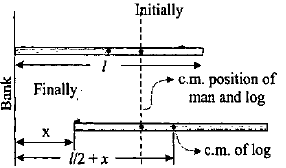
A log of wood of length $l$ and mass $M$ is floating on the surface of a river perpendicular to the banks. One end of the log touches the banks. A man of mass $m$ standing at the other end walks towards the bank.
We know that,
If a system does not undergo any external force, the system’s centre of mass will remain at rest or if it is travelling, will travel at a constant velocity.
Basically, due to Newton’s laws, the centre of mass of a body can be viewed as a point mass.
Let $RO$ be the wooden log. Since, there is no outside force; man’s centre of mass and the log system remain at rest. Let origin $P$ be the bank of the river. The guy is at point $O$ originally.
According to question,
$m = $ mass of man
$M = $ mass of log
$x = $ displacement of log with respect to water
The initial displacement is:
${x_{initial}} = \dfrac{{ml + M\left( {\dfrac{l}
{2}} \right)}}
{{m + M}}$
The final displacement is:
${x_{initial}} = \dfrac{{ml + M\left( {\dfrac{l}
{2} + x} \right)}}
{{m + M}}$
Now let us equate the two displacements:
$
{x_{initial}} = {x_{final}} \\
ml + \dfrac{{Ml}}
{2} = mx + \dfrac{{Ml}}
{2} + Mx \\
x = \dfrac{{ml}}
{{m + M}} \\
$
Hence, the displacement of the log when he reaches the nearer end of the log is
$x = \dfrac{{ml}}{{m + M}}$
Additional information:
If no external force operates on the system, the system’s net linear momentum is conserved. If any external force operates on the system, the system’s portion of momentum, along which no external force is present or their vector sum is zero, is conserved.
Note:
Here we have to be careful while calculating the initial and final displacements. If we write the exchange values then, the answer would be wrong.
Here we have to first find the initial displacement and then the final displacement and then equate them to get the final answer.
Complete step by step solution:
Given,
A log of wood of length $l$ and mass $M$ is floating on the surface of a river perpendicular to the banks. One end of the log touches the banks. A man of mass $m$ standing at the other end walks towards the bank.
We know that,
If a system does not undergo any external force, the system’s centre of mass will remain at rest or if it is travelling, will travel at a constant velocity.
Basically, due to Newton’s laws, the centre of mass of a body can be viewed as a point mass.
Let $RO$ be the wooden log. Since, there is no outside force; man’s centre of mass and the log system remain at rest. Let origin $P$ be the bank of the river. The guy is at point $O$ originally.
According to question,
$m = $ mass of man
$M = $ mass of log
$x = $ displacement of log with respect to water
The initial displacement is:
${x_{initial}} = \dfrac{{ml + M\left( {\dfrac{l}
{2}} \right)}}
{{m + M}}$
The final displacement is:
${x_{initial}} = \dfrac{{ml + M\left( {\dfrac{l}
{2} + x} \right)}}
{{m + M}}$
Now let us equate the two displacements:
$
{x_{initial}} = {x_{final}} \\
ml + \dfrac{{Ml}}
{2} = mx + \dfrac{{Ml}}
{2} + Mx \\
x = \dfrac{{ml}}
{{m + M}} \\
$
Hence, the displacement of the log when he reaches the nearer end of the log is
$x = \dfrac{{ml}}{{m + M}}$
Additional information:
If no external force operates on the system, the system’s net linear momentum is conserved. If any external force operates on the system, the system’s portion of momentum, along which no external force is present or their vector sum is zero, is conserved.
Note:
Here we have to be careful while calculating the initial and final displacements. If we write the exchange values then, the answer would be wrong.
Recently Updated Pages
Master Class 11 Computer Science: Engaging Questions & Answers for Success

Master Class 11 Business Studies: Engaging Questions & Answers for Success
Master Class 11 Economics: Engaging Questions & Answers for Success
Master Class 11 English: Engaging Questions & Answers for Success
Master Class 11 Maths: Engaging Questions & Answers for Success
Master Class 11 Biology: Engaging Questions & Answers for Success
Trending doubts
One Metric ton is equal to kg A 10000 B 1000 C 100 class 11 physics CBSE
There are 720 permutations of the digits 1 2 3 4 5 class 11 maths CBSE
Discuss the various forms of bacteria class 11 biology CBSE
Draw a diagram of a plant cell and label at least eight class 11 biology CBSE
State the laws of reflection of light
10 examples of friction in our daily life