




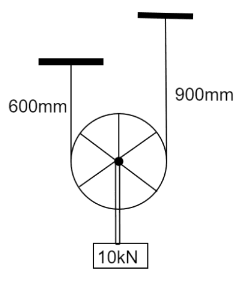
A load of $ 10kN $ is supported from a pulley which in turn is supported by a rope of sectional area, $ {10^3}m{m^2} $ and modulus of elasticity $ {10^3}Nm{m^{ - 2}} $ , as shown in Fig. 5.18. Neglecting the friction at the pulley, then downward deflection of the load is
(A) $ 3.75 $
(B) $ 4.25 $
(C) $ 2.75 $
(D) $ 4.00 $
Answer
 Verified
545.7k+ views
Hint: We can see in the given figure a single rope is attached on the two ends and there is downward force of $ 10kN $ . So tension will act upwards to balance the rope. And because of this tension there will be some extension in the given rope. Use the equation of equilibrium to find that extension.
Complete answer:
We have been given load $ F = 10kN $
Area of cross section $ A = {10^3}m{m^2} $
Modulus of elasticity $ y = {10^3}Nm{m^{ - 2}} $
Length of the rope $ {l_1} = 600mm $ and $ {l_2} = 900mm $
Using equation of equilibrium we will get,
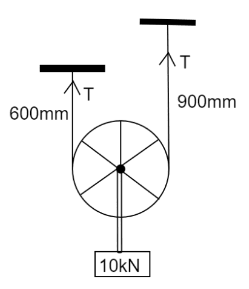
When a rope is holding the weight of an object at rest, the tension of the rope is equal to the weight of the object. On both the wire upward tension $ T $ is applied which will balance the downward force by mass of $ 10kN $
Therefore, $ 2T - 10 = 0 $
$ \Rightarrow T = 5kN = 5 \times {10^3}N $
Now total extension is equal to the extension in the left part of the wire and the extension in the right part of the wire.
$ Extension = \Delta {l_1} + \Delta {l_2} $
$ \Rightarrow Extension = \dfrac{{T{l_1}}}{{Ay}} + \dfrac{{T{l_2}}}{{Ay}} $
$ \Rightarrow Extension = \dfrac{{5 \times {{10}^3}}}{{{{10}^3} \times {{10}^3}}}(600 + 900) $
$ \Rightarrow Extension = 7.5mm $
This is the total extension in the wire so it will distribute equally in both the parts of the single wire
Therefore, $ \dfrac{{7.5}}{2}mm $
$ \Rightarrow 3.75mm $
Hence, option A) $ 3.75mm $ is the correct option.
Note:
We can also solve this problem by using the relation between stress, tension and area.
Longitudinal stress on the rope is given by
$ stress(\sigma ) = \dfrac{{tension(T)}}{{area(A)}} $
$ \sigma = 5\dfrac{N}{{m{m^2}}} $
Now using the relation between extension in the rope, stress, modulus of elasticity $ (y) $ and length of rope.
$ extension = \dfrac{{stress}}{y} \times l $
$ extension = \dfrac{{7.5}}{2} = 3.75mm $ .
Complete answer:
We have been given load $ F = 10kN $
Area of cross section $ A = {10^3}m{m^2} $
Modulus of elasticity $ y = {10^3}Nm{m^{ - 2}} $
Length of the rope $ {l_1} = 600mm $ and $ {l_2} = 900mm $
Using equation of equilibrium we will get,
When a rope is holding the weight of an object at rest, the tension of the rope is equal to the weight of the object. On both the wire upward tension $ T $ is applied which will balance the downward force by mass of $ 10kN $
Therefore, $ 2T - 10 = 0 $
$ \Rightarrow T = 5kN = 5 \times {10^3}N $
Now total extension is equal to the extension in the left part of the wire and the extension in the right part of the wire.
$ Extension = \Delta {l_1} + \Delta {l_2} $
$ \Rightarrow Extension = \dfrac{{T{l_1}}}{{Ay}} + \dfrac{{T{l_2}}}{{Ay}} $
$ \Rightarrow Extension = \dfrac{{5 \times {{10}^3}}}{{{{10}^3} \times {{10}^3}}}(600 + 900) $
$ \Rightarrow Extension = 7.5mm $
This is the total extension in the wire so it will distribute equally in both the parts of the single wire
Therefore, $ \dfrac{{7.5}}{2}mm $
$ \Rightarrow 3.75mm $
Hence, option A) $ 3.75mm $ is the correct option.
Note:
We can also solve this problem by using the relation between stress, tension and area.
Longitudinal stress on the rope is given by
$ stress(\sigma ) = \dfrac{{tension(T)}}{{area(A)}} $
$ \sigma = 5\dfrac{N}{{m{m^2}}} $
Now using the relation between extension in the rope, stress, modulus of elasticity $ (y) $ and length of rope.
$ extension = \dfrac{{stress}}{y} \times l $
$ extension = \dfrac{{7.5}}{2} = 3.75mm $ .
Recently Updated Pages
If x a + bt + ct2 where x is in meters and t is in class 11 physics CBSE

A car covers the first half distance between two places class 11 physics CBSE
The resultant of two vectors overrightarrow P and overrightarrow class 11 physics CBSE
Find the value of cos 135 class 11 maths CBSE
A mass M is held in place by an applied force F and class 11 physics CBSE
A solution of glucose in water is labelled as 10 dfracwv class 11 chemistry CBSE
Trending doubts
Find the value of the expression given below sin 30circ class 11 maths CBSE
One Metric ton is equal to kg A 10000 B 1000 C 100 class 11 physics CBSE
Draw a diagram of nephron and explain its structur class 11 biology CBSE
10 examples of friction in our daily life
Proton was discovered by A Thomson B Rutherford C Chadwick class 11 chemistry CBSE
Bond order ofO2 O2+ O2 and O22 is in order A O2 langle class 11 chemistry CBSE