




A living mechanical tissue having cellulosic wall thickening is
(a)Sclerenchyma
(b)Collenchyma
(c)Parenchyma
(d)Aerenchyma
Answer
 Verified
628.5k+ views
Hint: Cells of these tissues have a thick voltaic cell wall made from cellulose and pectin. The mechanical stress upon the plants strongly affects the thickness of the cell membrane of these tissues. This suggests more strain and more thickness.
Complete answer:
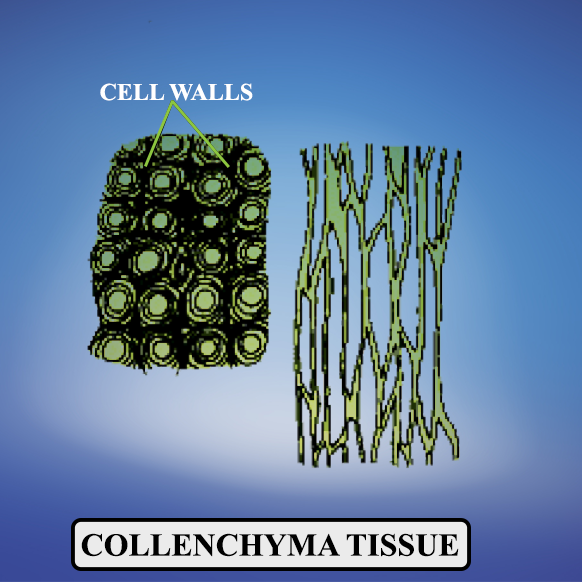
Collenchyma tissue consists of elongated cells with irregularly thickened walls i.e., having thin primary walls with some areas of secondary thickening. They provide extra mechanical and structural support, particularly in growing regions of the latest growth that shoots and leaves.
Collenchyma tissue makes up things like the resilient strands in stalks of celery.
Additional Information: Collenchyma cells are usually living, and have only a thick voltaic cell wall made from cellulose and pectin. cell membrane thickness is strongly suffering from mechanical stress upon the plant.
There are four main sorts of collenchyma:
-Angular collenchyma: they're thickened at intercellular contact points.
-Tangential collenchyma: Their cells are arranged into ordered rows and thickened at the tangential face of the cell membrane.
-Annular collenchyma: they need uniformly thickened cell walls.
-Lacunar collenchyma: These are collenchyma with intercellular spaces.
So, the correct answer is, ’Collenchyma’.
Note: -The first use of "collenchyma" was done by Link (1837) who used it to explain the sticky substance on Bletia (Orchidaceae) pollen.
-The botanist, Schleiden in1839, stated that the term "collenchyma" could have more easily been wont to describe elongated sub-epidermal cells with unevenly thickened cell walls.
-Collenchyma cells are most frequently found near the outer growing tissues like the vascular cambium and are known for increasing the structural support and integrity.
Complete answer:
Collenchyma tissue consists of elongated cells with irregularly thickened walls i.e., having thin primary walls with some areas of secondary thickening. They provide extra mechanical and structural support, particularly in growing regions of the latest growth that shoots and leaves.
Collenchyma tissue makes up things like the resilient strands in stalks of celery.
Additional Information: Collenchyma cells are usually living, and have only a thick voltaic cell wall made from cellulose and pectin. cell membrane thickness is strongly suffering from mechanical stress upon the plant.
There are four main sorts of collenchyma:
-Angular collenchyma: they're thickened at intercellular contact points.
-Tangential collenchyma: Their cells are arranged into ordered rows and thickened at the tangential face of the cell membrane.
-Annular collenchyma: they need uniformly thickened cell walls.
-Lacunar collenchyma: These are collenchyma with intercellular spaces.
So, the correct answer is, ’Collenchyma’.
Note: -The first use of "collenchyma" was done by Link (1837) who used it to explain the sticky substance on Bletia (Orchidaceae) pollen.
-The botanist, Schleiden in1839, stated that the term "collenchyma" could have more easily been wont to describe elongated sub-epidermal cells with unevenly thickened cell walls.
-Collenchyma cells are most frequently found near the outer growing tissues like the vascular cambium and are known for increasing the structural support and integrity.
Recently Updated Pages
Master Class 11 English: Engaging Questions & Answers for Success

Master Class 11 Social Science: Engaging Questions & Answers for Success
Master Class 11 Maths: Engaging Questions & Answers for Success
Master Class 11 Biology: Engaging Questions & Answers for Success
Master Class 11 Physics: Engaging Questions & Answers for Success
Master Class 11 Chemistry: Engaging Questions & Answers for Success
Trending doubts
One Metric ton is equal to kg A 10000 B 1000 C 100 class 11 physics CBSE
Difference Between Prokaryotic Cells and Eukaryotic Cells
Find the value of the expression given below sin 30circ class 11 maths CBSE
Difference between physical and chemical change class 11 chemistry CBSE
Two of the body parts which do not appear in MRI are class 11 biology CBSE
Draw a diagram of a plant cell and label at least eight class 11 biology CBSE