




A line passing through the point with position vector \[2\mathop i\limits^ \wedge - 3\mathop j\limits^ \wedge + 4\mathop k\limits^ \wedge \] and is perpendicular to the plane \[\mathop r\limits^ \to .(3\mathop i\limits^ \wedge + 4\mathop j\limits^ \wedge - 5\mathop k\limits^ \wedge ) = 7\]. Find the equation of the line in Cartesian and vector forms.
Answer
 Verified
603.9k+ views
Hint: Vectors can be defined as a quantity possessing both direction and magnitude position vectors simply denote the position or location of a point in the three-dimensional Cartesian system with respect to a reference origin. Furthers, when the line is perpendicular to the plane the line will be parallel to the normal of the plane.
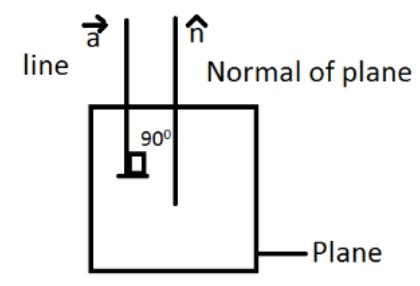
Equation of plane can be given a \[\mathop r\limits^ \to .\mathop n\limits^ \to = d\] and the line having position vector \[\mathop a\limits^ \to \]and parallel to a given vector \[\mathop b\limits^ \to \]is given by \[\mathop r\limits^ \to = \mathop a\limits^ \to + \lambda \mathop b\limits^ \to \].
Complete step by step solution:
Given position vector is \[(\mathop a\limits^ \to ) = 2\mathop i\limits^ \wedge - 3\mathop j\limits^ \wedge + 4\mathop k\limits^ \wedge \]
Now, given line which is perpendicular to plane will be parallel to the normal of the plane.
Finding normal of plane
\[\mathop r\limits^ \to (3\mathop i\limits^ \wedge + 4\mathop j\limits^ \wedge - 5\mathop k\limits^ \wedge ) = 7\]
As we know,
\[E{q^n}\] of plane \[ \Rightarrow \mathop r\limits^ \to .\mathop n\limits^ \to = d\]
We get \[\mathop n\limits^ \to . = 3\mathop i\limits^ \wedge + 4\mathop j\limits^ \wedge - 5\mathop k\limits^ \wedge \]
We known that parallel vectors are equal.
Let this vector be \[\mathop b\limits^ \to = 3\mathop i\limits^ \wedge + 4\mathop j\limits^ \wedge - 5\mathop k\limits^ \wedge \]
The vector equation of a line passing through a point with position vector \[\mathop a\limits^ \to \] and parallel to \[\mathop b\limits^ \to \] is.
\[\mathop r\limits^ \to = \] position vector + \[\lambda \] (parallel vector)
\[\mathop r\limits^ \to = \mathop a\limits^ \to + \lambda \mathop b\limits^ \to \]
\[ \Rightarrow \mathop r\limits^ \to = 2\mathop i\limits^ \wedge - 3\mathop i\limits^ \wedge + 4\mathop k\limits^ \wedge + \lambda (3i + 4\mathop j\limits^ \wedge - 5\mathop k\limits^ \wedge )\]
Hence
Vector \[E{q^n}\] of line is
\[ \Rightarrow \mathop r\limits^ \to = 2\mathop i\limits^ \wedge - 3\mathop i\limits^ \wedge + 4\mathop k\limits^ \wedge + \lambda (3i + 4\mathop j\limits^ \wedge - 5\mathop k\limits^ \wedge )\]
Cartesian form is \[x\mathop i\limits^ \wedge + y\mathop j\limits^ \wedge - z\mathop k\limits^ \wedge \]
\[\begin{gathered}
= (2 + \lambda )\mathop i\limits^ \wedge + ( - 3 + 4\lambda )\mathop i\limits^ \wedge + (4 - 5\lambda )\mathop k\limits^ \wedge \\
\Rightarrow x = 2 + \lambda ,y = - 3 + 4\lambda \\
z = 4 - 5\lambda \\
\Rightarrow \lambda = x - 2 = \dfrac{{y + 3}}{4} = \dfrac{{z - 4}}{{ - 5}} \\
\end{gathered} \]
Which is required Cartesian \[E{q^n}\] of the line
Note: The cartesian equation for a straight line is \[y{\text{ }} = {\text{ }}mx{\text{ }} + {\text{ }}c,\] where m represents the gradient of the line, and c is the point where the line crosses the y-axis. A vector equation for a line similarly needs 2 pieces of information: A point on the line. The direction of the line.
If the normal vector is normalized (unit length) then the constant term of the plane equation ‘d’ becomes the distance from the origin \[\mathop r\limits^ \to .\mathop n\limits^ \wedge = d\left[ {\mathop n\limits^ \wedge } \right] = 1\] (normalized).
Equation of plane can be given a \[\mathop r\limits^ \to .\mathop n\limits^ \to = d\] and the line having position vector \[\mathop a\limits^ \to \]and parallel to a given vector \[\mathop b\limits^ \to \]is given by \[\mathop r\limits^ \to = \mathop a\limits^ \to + \lambda \mathop b\limits^ \to \].
Complete step by step solution:
Given position vector is \[(\mathop a\limits^ \to ) = 2\mathop i\limits^ \wedge - 3\mathop j\limits^ \wedge + 4\mathop k\limits^ \wedge \]
Now, given line which is perpendicular to plane will be parallel to the normal of the plane.
Finding normal of plane
\[\mathop r\limits^ \to (3\mathop i\limits^ \wedge + 4\mathop j\limits^ \wedge - 5\mathop k\limits^ \wedge ) = 7\]
As we know,
\[E{q^n}\] of plane \[ \Rightarrow \mathop r\limits^ \to .\mathop n\limits^ \to = d\]
We get \[\mathop n\limits^ \to . = 3\mathop i\limits^ \wedge + 4\mathop j\limits^ \wedge - 5\mathop k\limits^ \wedge \]
We known that parallel vectors are equal.
Let this vector be \[\mathop b\limits^ \to = 3\mathop i\limits^ \wedge + 4\mathop j\limits^ \wedge - 5\mathop k\limits^ \wedge \]
The vector equation of a line passing through a point with position vector \[\mathop a\limits^ \to \] and parallel to \[\mathop b\limits^ \to \] is.
\[\mathop r\limits^ \to = \] position vector + \[\lambda \] (parallel vector)
\[\mathop r\limits^ \to = \mathop a\limits^ \to + \lambda \mathop b\limits^ \to \]
\[ \Rightarrow \mathop r\limits^ \to = 2\mathop i\limits^ \wedge - 3\mathop i\limits^ \wedge + 4\mathop k\limits^ \wedge + \lambda (3i + 4\mathop j\limits^ \wedge - 5\mathop k\limits^ \wedge )\]
Hence
Vector \[E{q^n}\] of line is
\[ \Rightarrow \mathop r\limits^ \to = 2\mathop i\limits^ \wedge - 3\mathop i\limits^ \wedge + 4\mathop k\limits^ \wedge + \lambda (3i + 4\mathop j\limits^ \wedge - 5\mathop k\limits^ \wedge )\]
Cartesian form is \[x\mathop i\limits^ \wedge + y\mathop j\limits^ \wedge - z\mathop k\limits^ \wedge \]
\[\begin{gathered}
= (2 + \lambda )\mathop i\limits^ \wedge + ( - 3 + 4\lambda )\mathop i\limits^ \wedge + (4 - 5\lambda )\mathop k\limits^ \wedge \\
\Rightarrow x = 2 + \lambda ,y = - 3 + 4\lambda \\
z = 4 - 5\lambda \\
\Rightarrow \lambda = x - 2 = \dfrac{{y + 3}}{4} = \dfrac{{z - 4}}{{ - 5}} \\
\end{gathered} \]
Which is required Cartesian \[E{q^n}\] of the line
Note: The cartesian equation for a straight line is \[y{\text{ }} = {\text{ }}mx{\text{ }} + {\text{ }}c,\] where m represents the gradient of the line, and c is the point where the line crosses the y-axis. A vector equation for a line similarly needs 2 pieces of information: A point on the line. The direction of the line.
If the normal vector is normalized (unit length) then the constant term of the plane equation ‘d’ becomes the distance from the origin \[\mathop r\limits^ \to .\mathop n\limits^ \wedge = d\left[ {\mathop n\limits^ \wedge } \right] = 1\] (normalized).
Recently Updated Pages
Master Class 11 Social Science: Engaging Questions & Answers for Success

Master Class 11 Physics: Engaging Questions & Answers for Success
Master Class 11 Maths: Engaging Questions & Answers for Success
Master Class 11 Economics: Engaging Questions & Answers for Success
Master Class 11 Computer Science: Engaging Questions & Answers for Success
Master Class 11 Chemistry: Engaging Questions & Answers for Success
Trending doubts
One Metric ton is equal to kg A 10000 B 1000 C 100 class 11 physics CBSE
There are 720 permutations of the digits 1 2 3 4 5 class 11 maths CBSE
1 Quintal is equal to a 110 kg b 10 kg c 100kg d 1000 class 11 physics CBSE
State and prove Bernoullis theorem class 11 physics CBSE
Difference Between Prokaryotic Cells and Eukaryotic Cells
Discuss the various forms of bacteria class 11 biology CBSE