




A line passes through the point of intersection of $2x+y=5$ and $x+3y+8=0$ and parallel to the line $3x+4y=7$ is
1. $3x+4y+3=0$
2. $3x+4y=0$
3. $4x-3y+3=0$
4. $4x-3y=3$
Answer
 Verified
508.2k+ views
Hint: In this problem we need to find the equation of the line which passes through the intersection point of the two lines and also parallel to line $3x+4y=7$. First we will calculate the intersection point of the given lines $2x+y=5$ and $x+3y+8=0$ by solving both the equations. After having the intersection point we will calculate the slope of the line $3x+4y=7$ which will be given by $-\dfrac{a}{b}$ . Now we will use the slope point equation which is $\left( y-{{y}_{1}} \right)=m\left( x-{{x}_{1}} \right)$ to find the required equation.
Complete step by step answer:
Given that, the line passes through the intersection of $2x+y=5$ and $x+3y+8=0$ and parallel to the line $3x+4y=7$.
Considering the equations $2x+y=5$ and $x+3y+8=0$.
Multiplying the equation $x+3y+8=0$ with $2$ and subtracting it from $2x+y=5$, then we will have
$\begin{align}
& 2x+y-2\left( x+3y+8 \right)=5+0 \\
& \Rightarrow 2x+y-2x-6y-16=5 \\
& \Rightarrow -5y=21 \\
& \therefore y=-\dfrac{21}{5} \\
\end{align}$
Substituting the value of $y$ in the equation $2x+y=5$ to calculate the value of $x$ , then we will get
$\begin{align}
& 2x-\dfrac{21}{5}=5 \\
& \Rightarrow 2x=\dfrac{25+21}{5} \\
& \Rightarrow 2x=\dfrac{46}{5} \\
& \therefore x=\dfrac{23}{5} \\
\end{align}$
Now the intersection point of the two lines $2x+y=5$ and $x+3y+8=0$ is given by $\left( \dfrac{23}{5},-\dfrac{21}{5} \right)$ .
Considering the line $3x+4y=7$. We know that the slope of the line $ax+by+c=0$ is equal to $-\dfrac{a}{b}$ . Now the slope of the line $3x+4y=7$ is given by
$m=-\dfrac{3}{4}$ .
In the problem they have mentioned that the required line is parallel to the line $3x+4y=7$. So the slope of the require line should be equal to the slope of the line $3x+4y=7$.
Now the equation of the line having slope $m=-\dfrac{3}{4}$ and passing through the point $\left( \dfrac{23}{5},-\dfrac{21}{5} \right)$ from slope point equation is given by
$\begin{align}
& \left( y-{{y}_{1}} \right)=m\left( x-{{x}_{1}} \right) \\
& \Rightarrow \left( y-\left( -\dfrac{21}{5} \right) \right)=-\dfrac{3}{4}\left( x-\dfrac{23}{5} \right) \\
& \Rightarrow 4\left( y+\dfrac{21}{5} \right)=-3x+\dfrac{69}{5} \\
& \Rightarrow 4y+\dfrac{84}{5}+3x-\dfrac{69}{5}=0 \\
& \Rightarrow 3x+4y+3=0 \\
\end{align}$
So the required line equation is $3x+4y+3=0$ .
The relevant diagram for the solution is given by
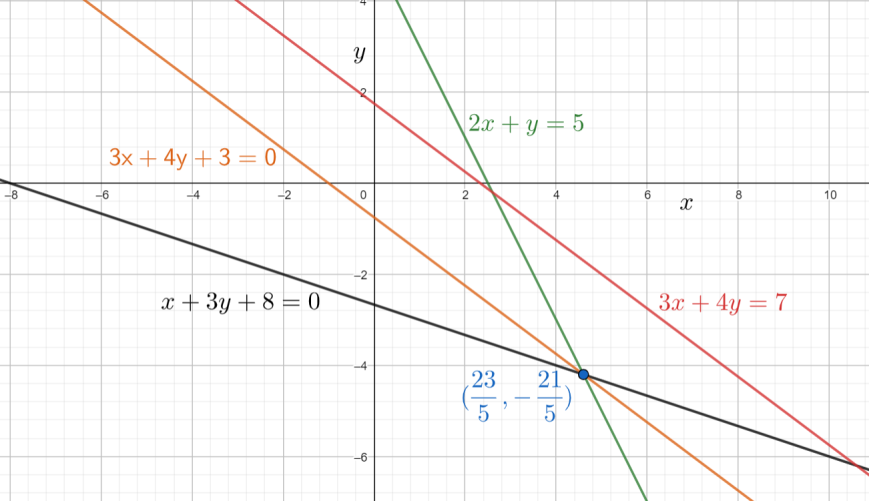
So, the correct answer is “Option 1”.
Note: We can also use another method to find the equation of the required line. The equation of the line which is parallel to the line $ax+by+c=0$ is given by $ax+by+d=0$ . Here substitute the point in the equation $ax+by+d=0$ and find the value of constant $d$ .
Complete step by step answer:
Given that, the line passes through the intersection of $2x+y=5$ and $x+3y+8=0$ and parallel to the line $3x+4y=7$.
Considering the equations $2x+y=5$ and $x+3y+8=0$.
Multiplying the equation $x+3y+8=0$ with $2$ and subtracting it from $2x+y=5$, then we will have
$\begin{align}
& 2x+y-2\left( x+3y+8 \right)=5+0 \\
& \Rightarrow 2x+y-2x-6y-16=5 \\
& \Rightarrow -5y=21 \\
& \therefore y=-\dfrac{21}{5} \\
\end{align}$
Substituting the value of $y$ in the equation $2x+y=5$ to calculate the value of $x$ , then we will get
$\begin{align}
& 2x-\dfrac{21}{5}=5 \\
& \Rightarrow 2x=\dfrac{25+21}{5} \\
& \Rightarrow 2x=\dfrac{46}{5} \\
& \therefore x=\dfrac{23}{5} \\
\end{align}$
Now the intersection point of the two lines $2x+y=5$ and $x+3y+8=0$ is given by $\left( \dfrac{23}{5},-\dfrac{21}{5} \right)$ .
Considering the line $3x+4y=7$. We know that the slope of the line $ax+by+c=0$ is equal to $-\dfrac{a}{b}$ . Now the slope of the line $3x+4y=7$ is given by
$m=-\dfrac{3}{4}$ .
In the problem they have mentioned that the required line is parallel to the line $3x+4y=7$. So the slope of the require line should be equal to the slope of the line $3x+4y=7$.
Now the equation of the line having slope $m=-\dfrac{3}{4}$ and passing through the point $\left( \dfrac{23}{5},-\dfrac{21}{5} \right)$ from slope point equation is given by
$\begin{align}
& \left( y-{{y}_{1}} \right)=m\left( x-{{x}_{1}} \right) \\
& \Rightarrow \left( y-\left( -\dfrac{21}{5} \right) \right)=-\dfrac{3}{4}\left( x-\dfrac{23}{5} \right) \\
& \Rightarrow 4\left( y+\dfrac{21}{5} \right)=-3x+\dfrac{69}{5} \\
& \Rightarrow 4y+\dfrac{84}{5}+3x-\dfrac{69}{5}=0 \\
& \Rightarrow 3x+4y+3=0 \\
\end{align}$
So the required line equation is $3x+4y+3=0$ .
The relevant diagram for the solution is given by
So, the correct answer is “Option 1”.
Note: We can also use another method to find the equation of the required line. The equation of the line which is parallel to the line $ax+by+c=0$ is given by $ax+by+d=0$ . Here substitute the point in the equation $ax+by+d=0$ and find the value of constant $d$ .
Recently Updated Pages
Master Class 11 Computer Science: Engaging Questions & Answers for Success

Master Class 11 Business Studies: Engaging Questions & Answers for Success
Master Class 11 Economics: Engaging Questions & Answers for Success
Master Class 11 English: Engaging Questions & Answers for Success
Master Class 11 Maths: Engaging Questions & Answers for Success
Master Class 11 Biology: Engaging Questions & Answers for Success
Trending doubts
There are 720 permutations of the digits 1 2 3 4 5 class 11 maths CBSE
Discuss the various forms of bacteria class 11 biology CBSE
Explain zero factorial class 11 maths CBSE
What organs are located on the left side of your body class 11 biology CBSE
Draw a diagram of nephron and explain its structur class 11 biology CBSE
How do I convert ms to kmh Give an example class 11 physics CBSE