




A line forms a triangle of area $54\sqrt 3 $ sq. with coordinate axes. Find the equation of the line if \[ \bot \] from origin to the line makes an angle of \[60^\circ \] with x-axis.
Answer
 Verified
574k+ views
Hint: As mentioned in the question the line forms a triangle with coordinate axes which clearly means that the triangle will be a right-angled triangle. The Area of the triangle is also given so we need to calculate the height and base to form the required equation.
Complete step-by-step answer:
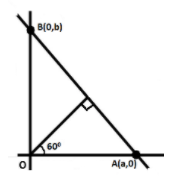
In the question, it is given that a line forms a triangle of area $54\sqrt 3 $ sq. with coordinate axes,
So, let us take a line \[AB\] as shown in figure which forms a triangle of area $54\sqrt 3 $ sq. with coordinate axes.
Since, we can see that point \[A\] lies on x-axis, therefore the y-coordinate of \[A\] will be \[0\]
So, \[A = \left( {a,0} \right)\]
Also, we can see that point \[B\] lies on y-axis, therefore the x-coordinate of \[B\] will be \[0\]
So, \[B = \left( {0,b} \right)\]
As we know, area of a triangle \[ = \dfrac{1}{2} \times height \times base\]
Now, in \[\vartriangle AOB\] , height \[ = b\] and base \[ = a\]
Area of \[\vartriangle AOB = \dfrac{1}{2} \times b \times a\]
And Area of \[\vartriangle AOB\] = $54\sqrt 3 $
Therefore, \[54\sqrt 3 = \dfrac{1}{2}ab\]
Or, \[ab = 108\sqrt 3 \] --- \[\left( 1 \right)\]
Now, the perpendicular drawn from the origin to the line makes an angle of \[60^\circ \] with x-axis as shown in figure.
Let the length of the perpendicular drawn from origin to line be \[P\] .
Also, we know that in a right-angled triangle, \[\cos \theta = \dfrac{{Base}}{{Hypotenuse}}\]
\[\cos 60^\circ = \dfrac{P}{a}\] and \[\cos 60^\circ = \dfrac{1}{2}\]
Or, \[a = \dfrac{P}{{\cos 60^\circ }} = 2P\]
And, \[\cos 30^\circ = \dfrac{P}{b}\] and \[\cos 30^\circ = \dfrac{{\sqrt 3 }}{2}\]
Or, \[b = \dfrac{P}{{\cos 30^\circ }} = \dfrac{{2P}}{{\sqrt 3 }}\]
Now, put values of \[a\] and \[b\] in equation \[\left( 1 \right)\] ,
\[2P \times \dfrac{{2P}}{{\sqrt 3 }} = 108\sqrt 3 \]
Or, \[\dfrac{{4{P^2}}}{{\sqrt 3 }} = 108\sqrt 3 \]
Or, \[{P^2} = 108 \times 3\]
\[P = \pm 18\]
But we can only take \[P = 18\] because the triangle is in the\[{1^{st}}\] quadrant.
So, \[P = 18\]
And, \[a = 2P = 36\] , \[b = \dfrac{{2P}}{{\sqrt 3 }} = \dfrac{{36}}{{\sqrt 3 }} = 12\sqrt 3 \]
The intercept form of the equation of the straight line is \[\dfrac{x}{a} + \dfrac{y}{b} = 1\]
So, the equation of the line becomes \[\dfrac{x}{{36}} + \dfrac{y}{{12\sqrt 3 }} = 1\]
Hence, the equation of line comes out to be \[x + \sqrt 3 y - 36 = 0\]
Note: Few key points used in this question which needs to be remembered are- the points where
line cuts the coordinate axes are called intercepts, area of right-angled triangle is \[\dfrac{1}{2} \times height \times base\]
, and the intercept form of the equation of the straight line is \[\dfrac{x}{a} + \dfrac{y}{b} = 1\]
Complete step-by-step answer:
In the question, it is given that a line forms a triangle of area $54\sqrt 3 $ sq. with coordinate axes,
So, let us take a line \[AB\] as shown in figure which forms a triangle of area $54\sqrt 3 $ sq. with coordinate axes.
Since, we can see that point \[A\] lies on x-axis, therefore the y-coordinate of \[A\] will be \[0\]
So, \[A = \left( {a,0} \right)\]
Also, we can see that point \[B\] lies on y-axis, therefore the x-coordinate of \[B\] will be \[0\]
So, \[B = \left( {0,b} \right)\]
As we know, area of a triangle \[ = \dfrac{1}{2} \times height \times base\]
Now, in \[\vartriangle AOB\] , height \[ = b\] and base \[ = a\]
Area of \[\vartriangle AOB = \dfrac{1}{2} \times b \times a\]
And Area of \[\vartriangle AOB\] = $54\sqrt 3 $
Therefore, \[54\sqrt 3 = \dfrac{1}{2}ab\]
Or, \[ab = 108\sqrt 3 \] --- \[\left( 1 \right)\]
Now, the perpendicular drawn from the origin to the line makes an angle of \[60^\circ \] with x-axis as shown in figure.
Let the length of the perpendicular drawn from origin to line be \[P\] .
Also, we know that in a right-angled triangle, \[\cos \theta = \dfrac{{Base}}{{Hypotenuse}}\]
\[\cos 60^\circ = \dfrac{P}{a}\] and \[\cos 60^\circ = \dfrac{1}{2}\]
Or, \[a = \dfrac{P}{{\cos 60^\circ }} = 2P\]
And, \[\cos 30^\circ = \dfrac{P}{b}\] and \[\cos 30^\circ = \dfrac{{\sqrt 3 }}{2}\]
Or, \[b = \dfrac{P}{{\cos 30^\circ }} = \dfrac{{2P}}{{\sqrt 3 }}\]
Now, put values of \[a\] and \[b\] in equation \[\left( 1 \right)\] ,
\[2P \times \dfrac{{2P}}{{\sqrt 3 }} = 108\sqrt 3 \]
Or, \[\dfrac{{4{P^2}}}{{\sqrt 3 }} = 108\sqrt 3 \]
Or, \[{P^2} = 108 \times 3\]
\[P = \pm 18\]
But we can only take \[P = 18\] because the triangle is in the\[{1^{st}}\] quadrant.
So, \[P = 18\]
And, \[a = 2P = 36\] , \[b = \dfrac{{2P}}{{\sqrt 3 }} = \dfrac{{36}}{{\sqrt 3 }} = 12\sqrt 3 \]
The intercept form of the equation of the straight line is \[\dfrac{x}{a} + \dfrac{y}{b} = 1\]
So, the equation of the line becomes \[\dfrac{x}{{36}} + \dfrac{y}{{12\sqrt 3 }} = 1\]
Hence, the equation of line comes out to be \[x + \sqrt 3 y - 36 = 0\]
Note: Few key points used in this question which needs to be remembered are- the points where
line cuts the coordinate axes are called intercepts, area of right-angled triangle is \[\dfrac{1}{2} \times height \times base\]
, and the intercept form of the equation of the straight line is \[\dfrac{x}{a} + \dfrac{y}{b} = 1\]
Recently Updated Pages
Basicity of sulphurous acid and sulphuric acid are

Master Class 11 English: Engaging Questions & Answers for Success
Master Class 11 Physics: Engaging Questions & Answers for Success
Master Class 11 Computer Science: Engaging Questions & Answers for Success
Master Class 11 Chemistry: Engaging Questions & Answers for Success
Master Class 11 Social Science: Engaging Questions & Answers for Success
Trending doubts
Difference Between Prokaryotic Cells and Eukaryotic Cells
Two of the body parts which do not appear in MRI are class 11 biology CBSE
One Metric ton is equal to kg A 10000 B 1000 C 100 class 11 physics CBSE
10 examples of friction in our daily life
Draw a diagram of nephron and explain its structur class 11 biology CBSE
What will happen if the mucus is not secreted by the class 11 biology CBSE