




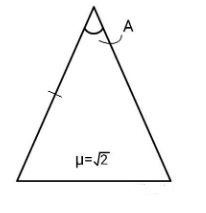
A light ray incident upon the 1st surface of a prism at an angle of incidence $90^\circ $ passes through the other surface grazingly, given $\mu = \sqrt 2 $. The angle of prism is?
(A) $45^\circ $
(B) $90^\circ $
(C) ${\sin ^{ - 1}}\left( {\dfrac{{\sqrt 2 }}{3}} \right)$
(D) Information insufficient.
Answer
 Verified
616.2k+ views
Hint:Here, you are given a prism whose angle is not known to you and you are asked to find that angle. It is given that the angle of incidence at the first surface is $90^\circ $, where the light will refract and will transmit through the prism and then will reach the second surface and then will again refract, it is given that it emerges grazingly. Here, angles and refractive index are involved, so figure out what should be used in order to find the angle of the prism. Also, if needed, try using the relation between angle of refraction, angle of incidence and the angle of prism for events occurring inside the prism.
Complete step by step answer:
So, whenever we are given refraction of light, the first thing that should come in our mind is Snell’s law. Snell’s law gives you the relation between the angle of incidence, angle of refraction and the refractive indexes of both the media. If the angle of incidence is $i$, angle of refraction is $r$ and the light goes from medium ${\mu _1}$ to medium ${\mu _2}$, then Snell’s law is mathematically given as ${\mu _1}\sin i = {\mu _2}\sin r$.
Let us come back to our question. For refraction at first surface, we have,
$\left( 1 \right)\left( {\sin 90^\circ } \right) = {\mu _2}\sin r \\
\Rightarrow 1 = \mu \sin r \\
\Rightarrow 1 = \sqrt 2 \sin r \\
\Rightarrow\sin r = \dfrac{1}{{\sqrt 2 }} \to r = 45^\circ \\ $
Now, let the angle of incidence at the second surface be $r'$, the angle of refraction is $90^\circ $ (grazingly) and the light is going from glass to air, again we apply Snell’s law, we get,
$\left( {\sqrt 2 } \right)\left( {\sin r'} \right) = \left( 1 \right)\left( {\sin 90^\circ } \right) \\
\Rightarrow\sqrt 2 \sin r' = 1 \\
\Rightarrow\sin r' = \dfrac{1}{{\sqrt 2 }} \to r' = 45^\circ \\ $
Now, we will use the relation between angle of refraction, angle of incidence and the angle of prism for events occurring inside the prism.
We have $r + r' = A$,
$r + r' = A \\
\Rightarrow A = 45^\circ + 45^\circ \\
\therefore A= 90^\circ \\ $
Therefore, the angle of the prism is $90^\circ $ and option B is correct.
Note:We have used two formulas, one is the Snell’s law and the other is the relation between the angles, so keep this in mind. These can be useful while solving problems related to prism. Also, you can see that the angle of the prism came out to be $90^\circ $ which according to physics is impossible. But note that you also have the angle of incidence as $90^\circ $ which is also impossible because the ray would never incident on the surface. The answer which we got is just based on mathematics and is only supported by mathematics, it is practically impossible.
Complete step by step answer:
So, whenever we are given refraction of light, the first thing that should come in our mind is Snell’s law. Snell’s law gives you the relation between the angle of incidence, angle of refraction and the refractive indexes of both the media. If the angle of incidence is $i$, angle of refraction is $r$ and the light goes from medium ${\mu _1}$ to medium ${\mu _2}$, then Snell’s law is mathematically given as ${\mu _1}\sin i = {\mu _2}\sin r$.
Let us come back to our question. For refraction at first surface, we have,
$\left( 1 \right)\left( {\sin 90^\circ } \right) = {\mu _2}\sin r \\
\Rightarrow 1 = \mu \sin r \\
\Rightarrow 1 = \sqrt 2 \sin r \\
\Rightarrow\sin r = \dfrac{1}{{\sqrt 2 }} \to r = 45^\circ \\ $
Now, let the angle of incidence at the second surface be $r'$, the angle of refraction is $90^\circ $ (grazingly) and the light is going from glass to air, again we apply Snell’s law, we get,
$\left( {\sqrt 2 } \right)\left( {\sin r'} \right) = \left( 1 \right)\left( {\sin 90^\circ } \right) \\
\Rightarrow\sqrt 2 \sin r' = 1 \\
\Rightarrow\sin r' = \dfrac{1}{{\sqrt 2 }} \to r' = 45^\circ \\ $
Now, we will use the relation between angle of refraction, angle of incidence and the angle of prism for events occurring inside the prism.
We have $r + r' = A$,
$r + r' = A \\
\Rightarrow A = 45^\circ + 45^\circ \\
\therefore A= 90^\circ \\ $
Therefore, the angle of the prism is $90^\circ $ and option B is correct.
Note:We have used two formulas, one is the Snell’s law and the other is the relation between the angles, so keep this in mind. These can be useful while solving problems related to prism. Also, you can see that the angle of the prism came out to be $90^\circ $ which according to physics is impossible. But note that you also have the angle of incidence as $90^\circ $ which is also impossible because the ray would never incident on the surface. The answer which we got is just based on mathematics and is only supported by mathematics, it is practically impossible.
Recently Updated Pages
Which of the following graphs shows the variation of class 12 physics CBSE

Draw a labelled diagram of the human male reproductive class 12 biology CBSE
Describe the experiment to compare the emf of two cells class 12 physics CBSE
What is standard hydrogen electrode
What is conventional current and electric current class 12 physics CBSE
2Bromopentane is treated with an alcoholic KOH solution class 12 chemistry CBSE
Trending doubts
Draw a labelled sketch of the human eye class 12 physics CBSE
Which are the Top 10 Largest Countries of the World?
Differentiate between homogeneous and heterogeneous class 12 chemistry CBSE
Draw ray diagrams each showing i myopic eye and ii class 12 physics CBSE
Which is the correct genotypic ratio of mendel dihybrid class 12 biology CBSE
What is the Full Form of PVC, PET, HDPE, LDPE, PP and PS ?