




A light moves from denser to rarer medium, which of the following is correct?
A. Energy Increases.
B. Frequency Increases.
C. Phase changes by 90 degrees.
D. Velocity increases
Answer
 Verified
648.6k+ views
Hint:
Speed/velocity of light is required.
Refractive Index of light with respect to two mediums is required.
Snell’s law is required to know the relation of refractive index.
Complete step by step answer:
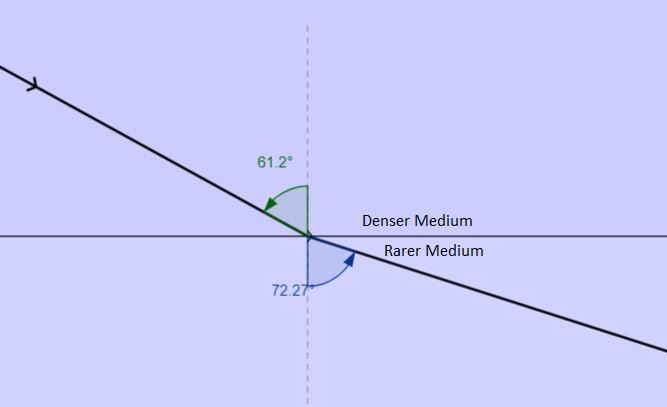
In this image the velocity of light was less than the velocity of light in the rarer medium hence the light went away from the normal.
A medium through which light can pass is called Optical medium.
Denser medium, is the optical medium in which velocity of light is less.
Rarer medium, is the optical medium in which velocity of light is more.
Normal, is a pseudo line which makes an angle of 90 degree with the plane of plane on which light ray strikes.
Now, according to physics whenever a light ray passes from denser medium to rarer medium the ray moves away from the normal because its velocity increases rapidly.
Additional Information:
Snell's law is a formula that is used to describe the relation between the angle of incidence and the angle of refraction, it is referred to light or other waves passing through a boundary between two different mediums.
Angle of incidence is an angle between a ray incident on a surface and the normal.
Angle of refraction is an angle between a refracted ray on a surface and the normal.
Velocity of light in Vacuum is considered as ‘c’ which has a value of $3\times {{10}^{8}}m/s$ .
Note:
Velocity= frequency $\times $ Wavelength.
Wavelength changes with velocity and vice versa.
In a rarer medium speed of light is always more than the denser medium.
Speed/velocity of light is required.
Refractive Index of light with respect to two mediums is required.
Snell’s law is required to know the relation of refractive index.
Complete step by step answer:
In this image the velocity of light was less than the velocity of light in the rarer medium hence the light went away from the normal.
A medium through which light can pass is called Optical medium.
Denser medium, is the optical medium in which velocity of light is less.
Rarer medium, is the optical medium in which velocity of light is more.
Normal, is a pseudo line which makes an angle of 90 degree with the plane of plane on which light ray strikes.
Now, according to physics whenever a light ray passes from denser medium to rarer medium the ray moves away from the normal because its velocity increases rapidly.
Additional Information:
Snell's law is a formula that is used to describe the relation between the angle of incidence and the angle of refraction, it is referred to light or other waves passing through a boundary between two different mediums.
Angle of incidence is an angle between a ray incident on a surface and the normal.
Angle of refraction is an angle between a refracted ray on a surface and the normal.
Velocity of light in Vacuum is considered as ‘c’ which has a value of $3\times {{10}^{8}}m/s$ .
Note:
Velocity= frequency $\times $ Wavelength.
Wavelength changes with velocity and vice versa.
In a rarer medium speed of light is always more than the denser medium.
Recently Updated Pages
Basicity of sulphurous acid and sulphuric acid are

Master Class 12 Economics: Engaging Questions & Answers for Success
Master Class 12 Biology: Engaging Questions & Answers for Success
Master Class 11 English: Engaging Questions & Answers for Success
Master Class 11 Physics: Engaging Questions & Answers for Success
Master Class 11 Computer Science: Engaging Questions & Answers for Success
Trending doubts
Draw a labelled sketch of the human eye class 12 physics CBSE
The chemical formula of tear gas is A CO Cl 2 B C 10 class 12 chemistry CBSE
Draw ray diagrams each showing i myopic eye and ii class 12 physics CBSE
Which are the Top 10 Largest Countries of the World?
Differentiate between homogeneous and heterogeneous class 12 chemistry CBSE
Which is the correct genotypic ratio of mendel dihybrid class 12 biology CBSE