




A lead-acid battery of a car has an e.m.f of 12V. If the internal resistance of the battery is 0.5ohm, the maximum current that can be drawn from the battery will be:
$
{\text{A}}{\text{. 30A}} \\
{\text{B}}{\text{. 20A}} \\
{\text{C}}{\text{. 6A}} \\
{\text{D}}{\text{. 24A}} \\
$
Answer
 Verified
628.2k+ views
Hint: Every battery offers some internal resistance to the flow of current through it which is due to the electrolyte in the battery. A small voltage drop occurs inside the battery and potential drop across the battery is less than the e.m.f. of the battery.
Detailed step by step solution:
The internal resistance is the resistance which is present within the battery that tries to resist the current flow when connected to a circuit. As a result of this resistance, a voltage drop occurs when current flows through the battery. This resistance in the battery is due to the electrolyte and electrodes which are the part of the battery.
This resistance due to the electrolyte and electrodes present in the battery is called internal resistance of the battery which causes a small voltage drop inside the battery.
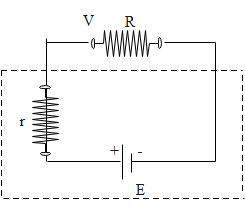
As we know that the potential difference across a battery is given by the following expression:
\[V = \varepsilon - Ir\]
Here V represents the potential difference across the battery, $\varepsilon $ is the e.m.f. produced by the battery while r is the internal resistance of the battery and I is the amount of current that can be drawn from the battery.
Now, for the given battery if we consider that it is not yet connected to the car then V = 0. Then we have
$\varepsilon - Ir = 0$
We are already given the values of e.m.f. and the internal resistance of the battery, therefore, we have
$I = \dfrac{\varepsilon }{r} = \dfrac{{12}}{{0.5}} = 24A$
Hence, the correct answer is option D.
Note: The obtained amount of current is the maximum amount of current which can be drawn from the battery. The current may be reduced further due to the resistance of the wires used to connect the circuit. The voltage drop is very small so it can be neglected.
Detailed step by step solution:
The internal resistance is the resistance which is present within the battery that tries to resist the current flow when connected to a circuit. As a result of this resistance, a voltage drop occurs when current flows through the battery. This resistance in the battery is due to the electrolyte and electrodes which are the part of the battery.
This resistance due to the electrolyte and electrodes present in the battery is called internal resistance of the battery which causes a small voltage drop inside the battery.
As we know that the potential difference across a battery is given by the following expression:
\[V = \varepsilon - Ir\]
Here V represents the potential difference across the battery, $\varepsilon $ is the e.m.f. produced by the battery while r is the internal resistance of the battery and I is the amount of current that can be drawn from the battery.
Now, for the given battery if we consider that it is not yet connected to the car then V = 0. Then we have
$\varepsilon - Ir = 0$
We are already given the values of e.m.f. and the internal resistance of the battery, therefore, we have
$I = \dfrac{\varepsilon }{r} = \dfrac{{12}}{{0.5}} = 24A$
Hence, the correct answer is option D.
Note: The obtained amount of current is the maximum amount of current which can be drawn from the battery. The current may be reduced further due to the resistance of the wires used to connect the circuit. The voltage drop is very small so it can be neglected.
Recently Updated Pages
Master Class 12 Economics: Engaging Questions & Answers for Success

Master Class 12 English: Engaging Questions & Answers for Success
Master Class 12 Social Science: Engaging Questions & Answers for Success
Master Class 12 Maths: Engaging Questions & Answers for Success
Master Class 12 Physics: Engaging Questions & Answers for Success
Master Class 11 Social Science: Engaging Questions & Answers for Success
Trending doubts
1 ton equals to A 100 kg B 1000 kg C 10 kg D 10000 class 11 physics CBSE
Draw a diagram of nephron and explain its structur class 11 biology CBSE
DNA is not present in A Nucleus B Mitochondria C Chloroplast class 11 biology CBSE
Proton was discovered by A Thomson B Rutherford C Chadwick class 11 chemistry CBSE
Mention the important general characters of Urocho class 11 biology CBSE
Define pneumatic bones class 11 biology CBSE