




A lead pencil consists of a cylinder of wood with a solid cylinder of graphite filled in the interior. The diameter of the pencil is 7 mm and the diameter of graphite is 1 mm. If the length of the pencil is 14 cm. Find the volume of wood and that of graphite.
Answer
 Verified
612.6k+ views
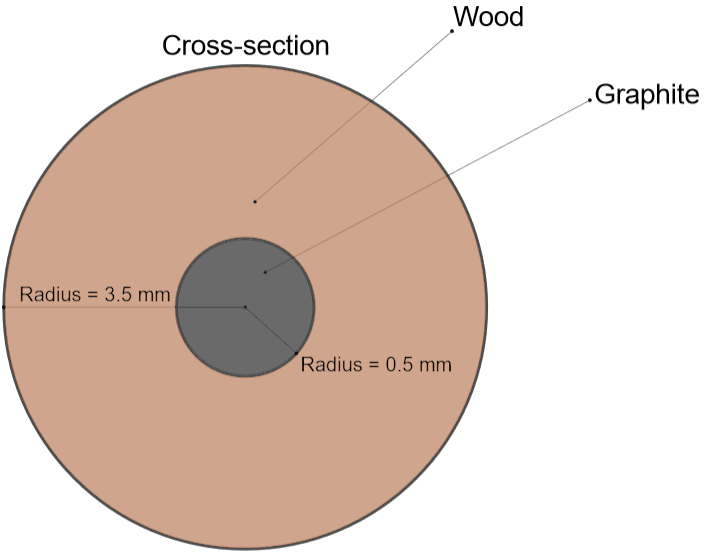
Hint: To solve this problem, we should know the formula for volume of a cylinder. The volume of a cylinder of height $h$ units and a radius of r units is given by volume \[=\pi {{r}^{2}}h\]. In the question, we are given a pencil of diameter 7 mm and length of 14 cm. The inner part of the pencil contains graphite of diameter 1 mm and length of graphite is equal to the length of pencil which is 14 cm. The graphite is a smaller cylinder with smaller dimensions. We can find the volume of graphite using the radius as $r=\dfrac{diameter}{2}=\dfrac{1}{2}=0.5mm$ and the height h as $h=length=14cm=140mm$ in the formula of volume stated above. We can also find the total volume of the pencil using the radius $r=\dfrac{7}{2}=3.5mm$ and height h as $h=length=14cm=140mm$. We can infer from the cross sectional view that the volume of wood can be calculated by subtracting the volume of graphite from the total volume of pencil.
Complete step-by-step answer:
We know that the volume of a cylinder of height $h$ units and a radius of r units is given by volume \[=\pi {{r}^{2}}h\]
We are given a cylindrical structure of pencil with dimensions as diameter = 7 mm and height = 14 cm. We have wood and graphite inside the pencil and the graphite is in the shape of a smaller cylinder with dimensions as diameter = 1 mm and height = 14 cm.
We will calculate the volume of the graphite and the total volume of the pencil using the volume of the cylinder formula as both of them are cylinders. For, calculating the volume of wood, we should note that the portion of pencil remaining after the graphite has occupied is wood. So, we can infer that the difference in the volumes of pencil and graphite gives the volume of wood.
Dimensions of graphite
$\text{height h}=\text{length}=14cm=14\times 10mm=140mm$
$\text{radius r}=\dfrac{\text{diameter}}{2}=\dfrac{1}{2}=0.5mm$
\[\begin{align}
& Volume=\pi {{r}^{2}}h \\
& =\pi {{\left( 0.5mm \right)}^{2}}140\ mm \\
& =\dfrac{22}{7}\times 0.25\times 140\ m{{m}^{3}} \\
& =110\ m{{m}^{3}} \\
\end{align}\]
Dimensions of pencil
$\text{height h}=\text{length}=14cm=14\times 10mm=140mm$
$\text{radius r}=\dfrac{\text{diameter}}{2}=\dfrac{7}{2}=3.5mm$
\[\begin{align}
& Volume=\pi {{r}^{2}}h \\
& =\pi {{\left( 3.5mm \right)}^{2}}140\ mm \\
& =\dfrac{22}{7}\times 12.25\times 140\ m{{m}^{3}} \\
& =5390\ m{{m}^{3}} \\
\end{align}\]
Volume of wood = Volume of pencil – Volume of graphite
Volume $=\left( 5390-110 \right)m{{m}^{3}}=5280m{{m}^{3}}$
$\therefore $ The volumes of wood and graphite are $5280m{{m}^{3}}$ and $110m{{m}^{3}}$ respectively.
Note: The students can make an error when it comes to units. The dimensions of diameter are in millimeter and height is in centimeter. If we substitute the values as they are given in the question, we get wrong answers. To nullify this mistake, it is always a good practice to write down all the quantities given in the question in the same units and then start solving the problem.
Complete step-by-step answer:
We know that the volume of a cylinder of height $h$ units and a radius of r units is given by volume \[=\pi {{r}^{2}}h\]
We are given a cylindrical structure of pencil with dimensions as diameter = 7 mm and height = 14 cm. We have wood and graphite inside the pencil and the graphite is in the shape of a smaller cylinder with dimensions as diameter = 1 mm and height = 14 cm.
We will calculate the volume of the graphite and the total volume of the pencil using the volume of the cylinder formula as both of them are cylinders. For, calculating the volume of wood, we should note that the portion of pencil remaining after the graphite has occupied is wood. So, we can infer that the difference in the volumes of pencil and graphite gives the volume of wood.
Dimensions of graphite
$\text{height h}=\text{length}=14cm=14\times 10mm=140mm$
$\text{radius r}=\dfrac{\text{diameter}}{2}=\dfrac{1}{2}=0.5mm$
\[\begin{align}
& Volume=\pi {{r}^{2}}h \\
& =\pi {{\left( 0.5mm \right)}^{2}}140\ mm \\
& =\dfrac{22}{7}\times 0.25\times 140\ m{{m}^{3}} \\
& =110\ m{{m}^{3}} \\
\end{align}\]
Dimensions of pencil
$\text{height h}=\text{length}=14cm=14\times 10mm=140mm$
$\text{radius r}=\dfrac{\text{diameter}}{2}=\dfrac{7}{2}=3.5mm$
\[\begin{align}
& Volume=\pi {{r}^{2}}h \\
& =\pi {{\left( 3.5mm \right)}^{2}}140\ mm \\
& =\dfrac{22}{7}\times 12.25\times 140\ m{{m}^{3}} \\
& =5390\ m{{m}^{3}} \\
\end{align}\]
Volume of wood = Volume of pencil – Volume of graphite
Volume $=\left( 5390-110 \right)m{{m}^{3}}=5280m{{m}^{3}}$
$\therefore $ The volumes of wood and graphite are $5280m{{m}^{3}}$ and $110m{{m}^{3}}$ respectively.
Note: The students can make an error when it comes to units. The dimensions of diameter are in millimeter and height is in centimeter. If we substitute the values as they are given in the question, we get wrong answers. To nullify this mistake, it is always a good practice to write down all the quantities given in the question in the same units and then start solving the problem.
Recently Updated Pages
Master Class 11 English: Engaging Questions & Answers for Success

Master Class 11 Social Science: Engaging Questions & Answers for Success
Master Class 11 Maths: Engaging Questions & Answers for Success
Master Class 11 Biology: Engaging Questions & Answers for Success
Master Class 11 Physics: Engaging Questions & Answers for Success
Master Class 11 Chemistry: Engaging Questions & Answers for Success
Trending doubts
Explain the Treaty of Vienna of 1815 class 10 social science CBSE
What is the full form of POSCO class 10 social science CBSE
Define Potential, Developed, Stock and Reserved resources
The diagonals of a rhombus are 10cm and 24cm Find the class 10 maths CBSE
Fill the blanks with proper collective nouns 1 A of class 10 english CBSE
One number is chosen from numbers 1 to 200 Find the class 10 maths CBSE