




A layer of ice of thickness y is on the surface of a lake. The air is at constant temperature \[ - \theta \]°\[C\] and the ice water interface is at \[0^\circ \]. Then that the rate at which the thickness increases is given by.
\[\dfrac{{dy}}{{dt}} = \dfrac{{k\theta }}{{L\rho y}}\]
Where k is the thermal conductivity of the ice, \[L\] is the latent heat of fusion and \[\rho \] is the density of the ice. Type 1 for true and 0 for false.
Answer
 Verified
640.5k+ views
Hint: As in the question thickness of layer of ice is given and also air at constant temperature and ice water interface is also given. Temperature of water is more than the ice, so heat will be there that is going from water to air through ice. By considering this, we can easily find the rate at which the thickness will be increased.
Complete step by step solution:
Consider one lake and it is having a layer of ice on its surface as shown. The thickness of the ice is y and the air is at constant temperature \[ - \theta \]°\[C\] and the ice water interface is at \[0^\circ \].
Rate at which the thickness increases, \[\dfrac{{dy}}{{dt}} = \dfrac{{k\theta }}{{L\rho y}}\]
Where k is the thermal conductivity of the ice, \[L\] is the latent heat of fusion and \[\rho \] is the density of the ice.
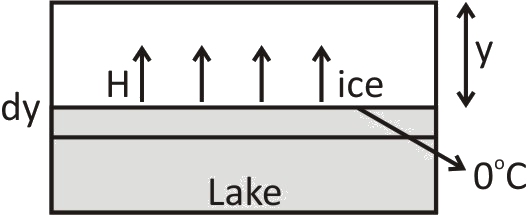
As heat will be going from water to air through ice, so
\[H = \dfrac{{\Delta T}}{R}\]
\[\dfrac{{0 - \left( \theta \right)}}{R} = \dfrac{\theta }{R}\] ----- (1)
We know,
\[H = \dfrac{{dQ}}{{dt}}\] ------ (2)
Compare equation (1) and (2), we get-
\[dQ = \dfrac{\theta }{R}.dt\] ---- (3)
Also, \[R = \dfrac{t}{{kA}}\]
Here t is thickness, A is area and K is thermal conductivity.
\[R = \dfrac{y}{{kA}}\]
Substitute the value of R in equation (3), we get-
\[dQ = \dfrac{{\theta kA}}{y}.dt\]
This \[dQ\] is the heat that is going from water to air through ice. Using this much amount of heat, ice formed and \[dy\] layer of ice is increased (as shown)
If Q heat is used then, \[Q = m \times L\]
Here L is the latent heat of the fusion.
We know, \[m = v \times \rho \] (mass= volume× density)
\[ = A \times dy \times \rho \times L\]
\[dQ = \dfrac{{\theta kA}}{y}.dt\]
\[Ady.L.\rho = \dfrac{{\theta kA}}{y}.dt\]
So, \[\dfrac{{dy}}{{dt}} = \dfrac{{\theta kA}}{{y.A.L.\rho }}\]
\[\dfrac{{dy}}{{dt}} = \] \[\dfrac{{\theta k}}{{L\rho y}}\]
So, this is true.
Note:
The latent heat of fusion is the amount of heat that is gained by solid substance to convert into liquid without any other increase in temperature.
Or we can also solve directly by rate of loss of heat = \[L.A\rho \dfrac{{dy}}{{dt}}\] =\[\dfrac{{K\theta A}}{y}\]
By comparing equations, we will get the \[\dfrac{{dy}}{{dt}}\]
Complete step by step solution:
Consider one lake and it is having a layer of ice on its surface as shown. The thickness of the ice is y and the air is at constant temperature \[ - \theta \]°\[C\] and the ice water interface is at \[0^\circ \].
Rate at which the thickness increases, \[\dfrac{{dy}}{{dt}} = \dfrac{{k\theta }}{{L\rho y}}\]
Where k is the thermal conductivity of the ice, \[L\] is the latent heat of fusion and \[\rho \] is the density of the ice.
As heat will be going from water to air through ice, so
\[H = \dfrac{{\Delta T}}{R}\]
\[\dfrac{{0 - \left( \theta \right)}}{R} = \dfrac{\theta }{R}\] ----- (1)
We know,
\[H = \dfrac{{dQ}}{{dt}}\] ------ (2)
Compare equation (1) and (2), we get-
\[dQ = \dfrac{\theta }{R}.dt\] ---- (3)
Also, \[R = \dfrac{t}{{kA}}\]
Here t is thickness, A is area and K is thermal conductivity.
\[R = \dfrac{y}{{kA}}\]
Substitute the value of R in equation (3), we get-
\[dQ = \dfrac{{\theta kA}}{y}.dt\]
This \[dQ\] is the heat that is going from water to air through ice. Using this much amount of heat, ice formed and \[dy\] layer of ice is increased (as shown)
If Q heat is used then, \[Q = m \times L\]
Here L is the latent heat of the fusion.
We know, \[m = v \times \rho \] (mass= volume× density)
\[ = A \times dy \times \rho \times L\]
\[dQ = \dfrac{{\theta kA}}{y}.dt\]
\[Ady.L.\rho = \dfrac{{\theta kA}}{y}.dt\]
So, \[\dfrac{{dy}}{{dt}} = \dfrac{{\theta kA}}{{y.A.L.\rho }}\]
\[\dfrac{{dy}}{{dt}} = \] \[\dfrac{{\theta k}}{{L\rho y}}\]
So, this is true.
Note:
The latent heat of fusion is the amount of heat that is gained by solid substance to convert into liquid without any other increase in temperature.
Or we can also solve directly by rate of loss of heat = \[L.A\rho \dfrac{{dy}}{{dt}}\] =\[\dfrac{{K\theta A}}{y}\]
By comparing equations, we will get the \[\dfrac{{dy}}{{dt}}\]
Recently Updated Pages
Write structures of the following compounds i 2 Chloro3methylpentane class 11 chemistry CBSE

What is BLO What is the full form of BLO class 8 social science CBSE
Explain the Treaty of Vienna of 1815 class 10 social science CBSE
A Paragraph on Pollution in about 100-150 Words
XIX+XXX A 49 B 51 C 55 D 44 class 5 maths CBSE
If x a + bt + ct2 where x is in meters and t is in class 11 physics CBSE
Trending doubts
One Metric ton is equal to kg A 10000 B 1000 C 100 class 11 physics CBSE
Find the value of the expression given below sin 30circ class 11 maths CBSE
What do you mean by retardation What is its SI uni class 11 physics CBSE
Draw a diagram of nephron and explain its structur class 11 biology CBSE
10 examples of friction in our daily life
Difference between physical and chemical change class 11 chemistry CBSE