




A lasing action is working on the principle of………….
A. electromagnetic theory
B. quantum theory
C. wave theory
D. corpuscular theory
Answer
 Verified
637.8k+ views
Hint: The real phenomenon that takes place during the production of a beam of laser light is called a lasing process. The action which creates the laser light will occur within a few nanoseconds. The combination of spontaneous emission as well as the stimulated emission respectively will cause the laser to laser. This means that it produces a coherent beam of light which all are at a single frequency. This may help you to solve this question.
Complete answer:
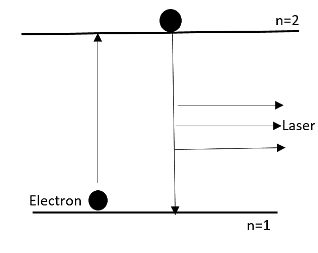
The word Laser is an acronym used as a short for light amplification by stimulated emission of radiation. A laser has been produced when the electrons in atoms in some kind of crystals, or gases which absorb energy from an electrical current or another laser beam. This makes them excited. These excited electrons can move from a lesser energy orbit to a greater energy orbit around the nucleus of an atom. After that when they return back to their normal state which is the ground state, the electrons will emit photons in order to lose that energy. This process is known as the lasing action. There are some characteristics for this photon beam. They all will be coherent or at the same frequency and the same wavelength. This makes them different from the ordinary visible light which includes multiple wavelengths and is not in coherence. The quantum theory of light is explaining the light wave as photons rather than wave characteristics. Therefore the lasing action is explained using this principle of quantum.
So, the correct answer is “Option B”.
Note:
Quantum theory describes the nature and behaviour of matter and energy in the subatomic level. This theory mentions that the particles are having dual characteristics. It is having characteristics of both particles and waves. The energy has been considered to be discrete units of energy packets which are known as photons.
Complete answer:
The word Laser is an acronym used as a short for light amplification by stimulated emission of radiation. A laser has been produced when the electrons in atoms in some kind of crystals, or gases which absorb energy from an electrical current or another laser beam. This makes them excited. These excited electrons can move from a lesser energy orbit to a greater energy orbit around the nucleus of an atom. After that when they return back to their normal state which is the ground state, the electrons will emit photons in order to lose that energy. This process is known as the lasing action. There are some characteristics for this photon beam. They all will be coherent or at the same frequency and the same wavelength. This makes them different from the ordinary visible light which includes multiple wavelengths and is not in coherence. The quantum theory of light is explaining the light wave as photons rather than wave characteristics. Therefore the lasing action is explained using this principle of quantum.
So, the correct answer is “Option B”.
Note:
Quantum theory describes the nature and behaviour of matter and energy in the subatomic level. This theory mentions that the particles are having dual characteristics. It is having characteristics of both particles and waves. The energy has been considered to be discrete units of energy packets which are known as photons.
Recently Updated Pages
Basicity of sulphurous acid and sulphuric acid are

Master Class 12 Economics: Engaging Questions & Answers for Success
Master Class 12 Biology: Engaging Questions & Answers for Success
Master Class 11 English: Engaging Questions & Answers for Success
Master Class 11 Physics: Engaging Questions & Answers for Success
Master Class 11 Computer Science: Engaging Questions & Answers for Success
Trending doubts
Draw a labelled sketch of the human eye class 12 physics CBSE
The chemical formula of tear gas is A CO Cl 2 B C 10 class 12 chemistry CBSE
Draw ray diagrams each showing i myopic eye and ii class 12 physics CBSE
Which are the Top 10 Largest Countries of the World?
Differentiate between homogeneous and heterogeneous class 12 chemistry CBSE
Which is the correct genotypic ratio of mendel dihybrid class 12 biology CBSE