




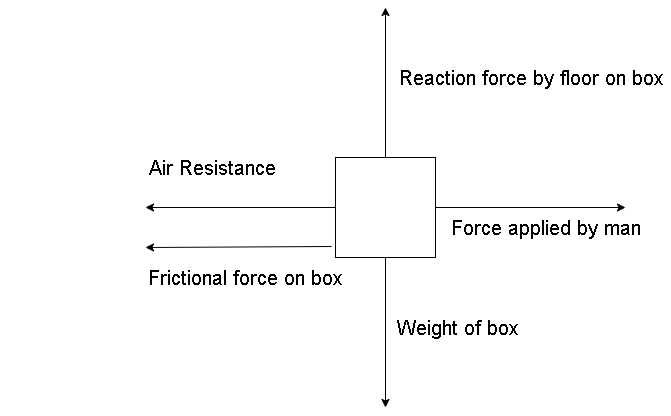
A large cardboard box of mass $0.75kg$ is pushed across a horizontal floor by a force of $4.5N$. The motion of the box is opposed by:
1) Kinetic frictional force of $1.5N$ between the box and the floor.
2) Air resistance $k{v^2}$ where $k = 0.06kg/m$ and $v$ is the speed of the box in $m/s$ .
What is the maximum acceleration of the block?
A) $3m/{s^2}$
B) $6m/{s^2}$
C) $8m/{s^2}$
D) $4m/{s^2}$
Answer
 Verified
629.4k+ views
Hint:The cardboard is pushed on the floor horizontally, and the air resistance force will oppose its motion. The resistance that is caused by air to the motion of the object is known as air resistance. It always acts in an opposite direction to the motion of the object.
Step-by-Step Explanation:
Step I:
Since the air resistance force will try to stop the box from moving, therefore the acceleration of the cardboard will be maximum if the force of air resistance is zero. At this point the object will start moving.
Step II:
Also the frictional force will affect the motion of the cardboard.
${F_{frictional}} = 1.5$
${F_{horizontal}} = 4.5N$
For maximum acceleration, ${F_{airresis\tan ce}} = 0$
Step III:
Net force acting on the cardboard is given by
${F_{net}} = {F_{horizontal}} - {F_{frictional}} - {F_{airresis\tan ce}}$
${F_{net}} = 4.5 - 1.5 - 0$
${F_{net}} = 3.0N$
Step IV:
According to Newton’s second law, the acceleration of an object is directly proportional to the net force and inversely proportional to the mass. It can be written as
$a = \dfrac{{{F_{net}}}}{m}$
Where ‘a’ is the acceleration
‘m’ is the mass
Step V:
Substituting the values and evaluating the value of acceleration of the cardboard,
$a = \dfrac{{3.0}}{{0.75}}$
$a = 4.0m{s^{ - 2}}$
Step VI:
The box starts moving in equilibrium at its maximum speed. Therefore,
${F_{airresis\tan ce}} + {F_{friction}} = {F_{man}}$
$k{v^2} + 1.5 = 4.5$
Given $k = 0.06m/{s^2} = 6 \times {10^3}kg{m^{ - 1}}$
Substituting the value of ‘k’ and solving for ‘v’,
$6.0 \times {10^3} \times {v^2} = 4.5 - 1.5$
$6.0 \times {10^3} \times {v^2} = 3.0$
${v^2} = \dfrac{{3.0}}{{6.0 \times {{10}^3}}}$
$v = 7.1m{s^{ - 1}}$
Step VII:
The maximum acceleration of the cardboard is $4.0m/{s^2}$ .
Therefore, Option D is the right answer.
Note:In the atmosphere, there are many microscopic particles. When an object moves, its particles collide with the microscopic particles that are present in the atmosphere. The force of air resistance occurs when these particles collide with each other. Also, this force is directly proportional to the area of the object. If the area is more, then more particles will collide due to which air resistance will also increase.
Step-by-Step Explanation:
Step I:
Since the air resistance force will try to stop the box from moving, therefore the acceleration of the cardboard will be maximum if the force of air resistance is zero. At this point the object will start moving.
Step II:
Also the frictional force will affect the motion of the cardboard.
${F_{frictional}} = 1.5$
${F_{horizontal}} = 4.5N$
For maximum acceleration, ${F_{airresis\tan ce}} = 0$
Step III:
Net force acting on the cardboard is given by
${F_{net}} = {F_{horizontal}} - {F_{frictional}} - {F_{airresis\tan ce}}$
${F_{net}} = 4.5 - 1.5 - 0$
${F_{net}} = 3.0N$
Step IV:
According to Newton’s second law, the acceleration of an object is directly proportional to the net force and inversely proportional to the mass. It can be written as
$a = \dfrac{{{F_{net}}}}{m}$
Where ‘a’ is the acceleration
‘m’ is the mass
Step V:
Substituting the values and evaluating the value of acceleration of the cardboard,
$a = \dfrac{{3.0}}{{0.75}}$
$a = 4.0m{s^{ - 2}}$
Step VI:
The box starts moving in equilibrium at its maximum speed. Therefore,
${F_{airresis\tan ce}} + {F_{friction}} = {F_{man}}$
$k{v^2} + 1.5 = 4.5$
Given $k = 0.06m/{s^2} = 6 \times {10^3}kg{m^{ - 1}}$
Substituting the value of ‘k’ and solving for ‘v’,
$6.0 \times {10^3} \times {v^2} = 4.5 - 1.5$
$6.0 \times {10^3} \times {v^2} = 3.0$
${v^2} = \dfrac{{3.0}}{{6.0 \times {{10}^3}}}$
$v = 7.1m{s^{ - 1}}$
Step VII:
The maximum acceleration of the cardboard is $4.0m/{s^2}$ .
Therefore, Option D is the right answer.
Note:In the atmosphere, there are many microscopic particles. When an object moves, its particles collide with the microscopic particles that are present in the atmosphere. The force of air resistance occurs when these particles collide with each other. Also, this force is directly proportional to the area of the object. If the area is more, then more particles will collide due to which air resistance will also increase.
Recently Updated Pages
Master Class 5 English: Engaging Questions & Answers for Success

Master Class 5 Maths: Engaging Questions & Answers for Success
Master Class 5 Social Science: Engaging Questions & Answers for Success
Master Class 5 Science: Engaging Questions & Answers for Success
Class 5 Question and Answer - Your Ultimate Solutions Guide
Master Class 9 General Knowledge: Engaging Questions & Answers for Success
Trending doubts
One Metric ton is equal to kg A 10000 B 1000 C 100 class 11 physics CBSE
What is cell theory Who formulated it class 11 biology CBSE
Phyllotaxy is the arrangement of ALeaflets BLeaves class 11 biology CBSE
Difference Between Prokaryotic Cells and Eukaryotic Cells
The symbiotic association of fungi and algae is called class 11 biology CBSE
Cell theory was formulated by A Schleiden and Schwann class 11 biology CBSE