




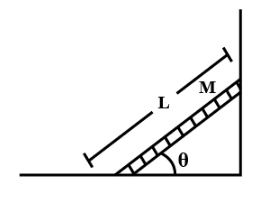
A ladder of length $ L $ leans against a wall at an angle of $ \theta $ from the horizontal, as shown in figure. The normal force $ {F_N} $ applied from the ground on the ladder applies what torque about the ladders center of mass?
$ \left( A \right){F_N}\dfrac{L}{2} \\
\left( B \right){F_N}L\cos \theta \\
\left( C \right){F_N}L\sin \theta \\
\left( D \right){F_N}\dfrac{L}{2}\cos \theta \\ $
Answer
 Verified
606k+ views
Hint :In order to solve this question, we are going to draw a figure showing all the forces that are present on the ladder at the different points in the vertical and the horizontal directions. Then, by defining the torque, we can calculate the torque on the ladder due to the forces acting on it.
The torque on the ladder is given as
$ \tau = {F_H} \times r $
Where $ {F_H} $ is the horizontal component of the force
And $ r $ is the perpendicular distance from the center of mass of the rod.
Complete Step By Step Answer:
First of all, we need to start off by drawing a free body diagram for this configuration of the ladder, which gives the different forces with directions that are acting on this.
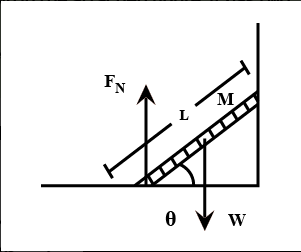
The direction of the normal force is shown in the figure above. The force $ {F_N} $ can be divided into two components, $ {F_N}\sin \theta $ the vertical component is along the ladder, and $ {F_N}\cos \theta $ the horizontal component is perpendicular to the ladder.
The torque about the ladder’s center of mass is given as:
$ \tau = {F_H} \times r $
Where $ {F_H} $ is the horizontal component of the force
And $ r $ is the perpendicular distance from the center of mass of the rod.
$ \tau = {F_N}\cos \theta \times \dfrac{L}{2} \\
\Rightarrow \tau = {F_N}\dfrac{L}{2}\cos \theta \\ $
Hence, option $ \left( D \right){F_N}\dfrac{L}{2}\cos \theta $ is the correct answer.
Note :
The torque is defined as the moment of the force that makes a rod or ladder to rotate. Mathematically, the torque is the product of the force and the perpendicular distance from the center of mass of the rod. Although the torque is unable to rotate the ladder completely but it may cause a display.
The torque on the ladder is given as
$ \tau = {F_H} \times r $
Where $ {F_H} $ is the horizontal component of the force
And $ r $ is the perpendicular distance from the center of mass of the rod.
Complete Step By Step Answer:
First of all, we need to start off by drawing a free body diagram for this configuration of the ladder, which gives the different forces with directions that are acting on this.
The direction of the normal force is shown in the figure above. The force $ {F_N} $ can be divided into two components, $ {F_N}\sin \theta $ the vertical component is along the ladder, and $ {F_N}\cos \theta $ the horizontal component is perpendicular to the ladder.
The torque about the ladder’s center of mass is given as:
$ \tau = {F_H} \times r $
Where $ {F_H} $ is the horizontal component of the force
And $ r $ is the perpendicular distance from the center of mass of the rod.
$ \tau = {F_N}\cos \theta \times \dfrac{L}{2} \\
\Rightarrow \tau = {F_N}\dfrac{L}{2}\cos \theta \\ $
Hence, option $ \left( D \right){F_N}\dfrac{L}{2}\cos \theta $ is the correct answer.
Note :
The torque is defined as the moment of the force that makes a rod or ladder to rotate. Mathematically, the torque is the product of the force and the perpendicular distance from the center of mass of the rod. Although the torque is unable to rotate the ladder completely but it may cause a display.
Recently Updated Pages
If x a + bt + ct2 where x is in meters and t is in class 11 physics CBSE

A car covers the first half distance between two places class 11 physics CBSE
The resultant of two vectors overrightarrow P and overrightarrow class 11 physics CBSE
Find the value of cos 135 class 11 maths CBSE
A mass M is held in place by an applied force F and class 11 physics CBSE
A solution of glucose in water is labelled as 10 dfracwv class 11 chemistry CBSE
Trending doubts
One Metric ton is equal to kg A 10000 B 1000 C 100 class 11 physics CBSE
Find the value of the expression given below sin 30circ class 11 maths CBSE
What do you mean by retardation What is its SI uni class 11 physics CBSE
Draw a diagram of nephron and explain its structur class 11 biology CBSE
10 examples of friction in our daily life
Difference between physical and chemical change class 11 chemistry CBSE