




A ladder has rungs 25cm apart. The rungs decrease uniformly in the length from 45cm at the bottom to 25cm at the top. If the top and bottom rungs are $2\dfrac{1}{2}$ m apart, what is the length of the wood required for the rungs
(a) 280cm
(b) 320cm
(c) 250cm
(d) 385cm
Answer
 Verified
597k+ views
Hint: In order to solve this problem, we need to find the total number of rungs. To find this we formula we need is $\text{number of rungs = }\dfrac{\text{total length}}{\text{distance between 2 rungs}}\text{+1}$ . After that, we need to find the total wood with the help of arithmetic progression. The total wood required = sum of $n$ terms in arithmetic progression. The formula for that is $S=\dfrac{n}{2}\left( a+l \right)$ , where $a$ is the first term and $n$ is the last term.
Complete step-by-step answer:
We are given that the distance between two rungs is 25cm.
The rungs decrease uniformly starting with 45cm at the bottom and 25cm at the top.
We know that the gap between two rungs is 25cm.
To understand better, we need to draw a rough figure.
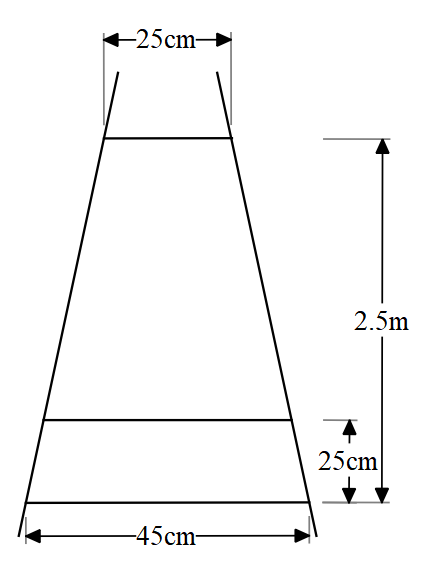
We are also given that the total length of the ladder is $2\dfrac{1}{2}$ m.
We need to convert this length into centimetres.
Total length = $2\dfrac{1}{2}m$ .
Total length = $\dfrac{5}{2}m=\dfrac{5}{2}\times 100=250cm$ .
We know the spacing between the rungs and the total length of the ladder so we can find the number of rungs.
The formula for that is $\text{Number of rungs = }\dfrac{\text{Total length}}{\text{Distrance between 2 rungs}}\text{+1}.............\text{(i)}$
Substituting the values we get,
$\text{Number of rungs}=\dfrac{250}{25}+1=10+1=11$ .
This problem can be now solved by arithmetic progression. And we need to find the total wood required for rungs.
In arithmetic progression,
Total wood required for rungs = Sum of $n$ terms in A.P.
The formula for that is,
$S=\dfrac{n}{2}\left( a+l \right)$ .
Where $a$ is the first term and $n$ is the last term.
Substituting the values as $n=11,a=25,l=45$ we get,
$S=\dfrac{11}{2}\left( 45+25 \right)=\dfrac{11}{2}\times 70=385cm$ .
Therefore, the length of the wood required is 385cm.
Note: In the formula for the total number of rungs we need to add 1 because we tend to miss the first rungs as we divide the total length by distance between 2 rungs. Also, we need to take care that the length of the ladder is given in metres and the rest of the dimensions are in centimetres. We need to convert meters into centimetres.
Complete step-by-step answer:
We are given that the distance between two rungs is 25cm.
The rungs decrease uniformly starting with 45cm at the bottom and 25cm at the top.
We know that the gap between two rungs is 25cm.
To understand better, we need to draw a rough figure.
We are also given that the total length of the ladder is $2\dfrac{1}{2}$ m.
We need to convert this length into centimetres.
Total length = $2\dfrac{1}{2}m$ .
Total length = $\dfrac{5}{2}m=\dfrac{5}{2}\times 100=250cm$ .
We know the spacing between the rungs and the total length of the ladder so we can find the number of rungs.
The formula for that is $\text{Number of rungs = }\dfrac{\text{Total length}}{\text{Distrance between 2 rungs}}\text{+1}.............\text{(i)}$
Substituting the values we get,
$\text{Number of rungs}=\dfrac{250}{25}+1=10+1=11$ .
This problem can be now solved by arithmetic progression. And we need to find the total wood required for rungs.
In arithmetic progression,
Total wood required for rungs = Sum of $n$ terms in A.P.
The formula for that is,
$S=\dfrac{n}{2}\left( a+l \right)$ .
Where $a$ is the first term and $n$ is the last term.
Substituting the values as $n=11,a=25,l=45$ we get,
$S=\dfrac{11}{2}\left( 45+25 \right)=\dfrac{11}{2}\times 70=385cm$ .
Therefore, the length of the wood required is 385cm.
Note: In the formula for the total number of rungs we need to add 1 because we tend to miss the first rungs as we divide the total length by distance between 2 rungs. Also, we need to take care that the length of the ladder is given in metres and the rest of the dimensions are in centimetres. We need to convert meters into centimetres.
Recently Updated Pages
Master Class 10 Computer Science: Engaging Questions & Answers for Success

Master Class 10 General Knowledge: Engaging Questions & Answers for Success
Master Class 10 English: Engaging Questions & Answers for Success
Master Class 10 Social Science: Engaging Questions & Answers for Success
Master Class 10 Maths: Engaging Questions & Answers for Success
Master Class 10 Science: Engaging Questions & Answers for Success
Trending doubts
What is the median of the first 10 natural numbers class 10 maths CBSE
Which women's tennis player has 24 Grand Slam singles titles?
Who is the Brand Ambassador of Incredible India?
Why is there a time difference of about 5 hours between class 10 social science CBSE
Write a letter to the principal requesting him to grant class 10 english CBSE
A moving boat is observed from the top of a 150 m high class 10 maths CBSE