




A kite is flying at a height of $60m$ above the ground. The string attached to the kite is temporarily tied to a point on the ground. The inclination of the string with the ground is ${60^ \circ }$ . Find the length of the string, assuming that there is no slack in the string.
Answer
 Verified
623.1k+ views
Hint:In order to solve this question, we need to analyse the information given in the question. After that, we will be able to form a figure which is a right-angled triangle. After that, by using the basic trigonometric ratios, we can solve this question.
Complete step-by-step answer:
Let us first understand the question. A kite is flying at a height of $60m$ which means that the perpendicular distance between the kite and the ground is $60m$.
It is attached to a string with inclination ${60^ \circ }$ which means that the angle between the string attached to the kite and the string is ${60^ \circ }$. After understanding the question and analysing the situation, we can clearly see that the figure formed by analysing the situation is a right-angled triangle as shown
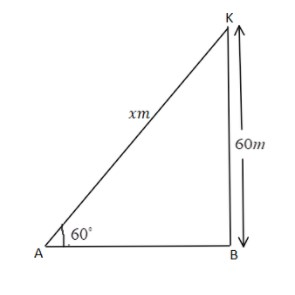
Now, we need to find out the length of the string.
Let us assume that the length of the string holding the kite is $x{\text{ }}m$ .
Now we can easily find out the value of $x$ by using the basic trigonometric ratio.
$\sin \theta = \dfrac{{{\text{Perpendicular}}}}{{{\text{Hypotenuse}}}}$ , we get
$\sin {60^ \circ } = \dfrac{{60}}{x}$
Now the value of $\sin {60^ \circ }$ is $\dfrac{{\sqrt 3 }}{2}$
$
\Rightarrow \dfrac{{\sqrt 3 }}{2} = \dfrac{{60}}{x} \\
\Rightarrow x = \dfrac{{120}}{{\sqrt 3 }} = \dfrac{{120\times\sqrt 3}}{{\sqrt 3\times\sqrt 3 }}= \dfrac{{120\times\sqrt 3}}{3} = 40\sqrt 3 m \\
$
Therefore, length of the string is $40\sqrt 3 m$
Note:For solving these kind of practical trigonometric equations , the key is to imagine the situation carefully and draw the diagram according to given information in question.Also students should remember the trigonometric ratios , formulas and identities for solving these types of problems.
Complete step-by-step answer:
Let us first understand the question. A kite is flying at a height of $60m$ which means that the perpendicular distance between the kite and the ground is $60m$.
It is attached to a string with inclination ${60^ \circ }$ which means that the angle between the string attached to the kite and the string is ${60^ \circ }$. After understanding the question and analysing the situation, we can clearly see that the figure formed by analysing the situation is a right-angled triangle as shown
Now, we need to find out the length of the string.
Let us assume that the length of the string holding the kite is $x{\text{ }}m$ .
Now we can easily find out the value of $x$ by using the basic trigonometric ratio.
$\sin \theta = \dfrac{{{\text{Perpendicular}}}}{{{\text{Hypotenuse}}}}$ , we get
$\sin {60^ \circ } = \dfrac{{60}}{x}$
Now the value of $\sin {60^ \circ }$ is $\dfrac{{\sqrt 3 }}{2}$
$
\Rightarrow \dfrac{{\sqrt 3 }}{2} = \dfrac{{60}}{x} \\
\Rightarrow x = \dfrac{{120}}{{\sqrt 3 }} = \dfrac{{120\times\sqrt 3}}{{\sqrt 3\times\sqrt 3 }}= \dfrac{{120\times\sqrt 3}}{3} = 40\sqrt 3 m \\
$
Therefore, length of the string is $40\sqrt 3 m$
Note:For solving these kind of practical trigonometric equations , the key is to imagine the situation carefully and draw the diagram according to given information in question.Also students should remember the trigonometric ratios , formulas and identities for solving these types of problems.
Recently Updated Pages
Master Class 12 Economics: Engaging Questions & Answers for Success

Master Class 12 English: Engaging Questions & Answers for Success
Master Class 12 Social Science: Engaging Questions & Answers for Success
Master Class 12 Maths: Engaging Questions & Answers for Success
Master Class 12 Physics: Engaging Questions & Answers for Success
Master Class 11 Social Science: Engaging Questions & Answers for Success
Trending doubts
Find the value of the expression given below sin 30circ class 11 maths CBSE
Draw a diagram of a plant cell and label at least eight class 11 biology CBSE
Name the Largest and the Smallest Cell in the Human Body ?
Draw a diagram showing the external features of fish class 11 biology CBSE
What organs are located on the left side of your body class 11 biology CBSE
Difference between physical and chemical change class 11 chemistry CBSE