




A kite in the shape of a square with a diagonal 32cm and an isosceles triangle of base 8cm and sides 6cm each is to be made of three different shades as shown in figure. How much paper if each shade has been used in it?
Answer
 Verified
633k+ views
Hint: In this, first we find the area of the square using the length of diagonal given in the question. Then, dividing the area of the square by 2, we get the area of each triangle (I and II). Now, we calculate the area of triangle III. By using this methodology, we get how much paper is required.
Complete step-by-step answer:
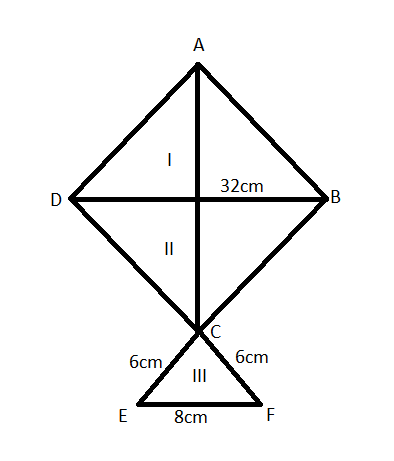
As given in the problem statement, diagonal of square $=32cm$.
Also, base of isosceles triangle$=8cm$.
Also, side of triangle III as per problem $=6cm$.
By using the formula $\dfrac{1}{2}\times {{\left( diagonal \right)}^{2}}$, we calculate the area of square.
Area of the square$=\dfrac{1}{2}\times {{\left( 32 \right)}^{2}}$
Area of the square$=512c{{m}^{2}}$.
From the diagram, Area of triangle I + Area of triangle II = half area of the square $=\dfrac{512}{2}c{{m}^{2}}=256c{{m}^{2}}$.
Area of triangle I and II $=256c{{m}^{2}}$.
$\therefore $Area of paper required triangle I and II $=256c{{m}^{2}}$.
Now,
The Sides of triangle III are 6cm, 6cm and 8cm. The semi-perimeter of triangle is calculated as,
S$=\dfrac{a+b+c}{2}$.
Here, a = 6cm, b = 6cm and c = 8cm.
$\begin{align}
& S=\dfrac{6+6+8}{2} \\
& S=\dfrac{20}{2} \\
& S=10cm \\
\end{align}$
For area of triangle III, we use the Heron’s formula which can be stated as:
$Area=\sqrt{S\left( S-a \right)\left( S-b \right)\left( S-c \right)}$
Now, putting values in the above formula, we get
$\begin{align}
& Area=\sqrt{10\left( 10-6 \right)\left( 10-6 \right)\left( 10-8 \right)} \\
& Area=\sqrt{10\times 4\times 4\times 2}c{{m}^{2}} \\
& Area=4\times 2\sqrt{5}c{{m}^{2}} \\
& Area=17.92c{{m}^{2}} \\
\end{align}$
Area of paper required for the third triangle is 17.92 square cm.
Therefore, area for paper required for triangle I and II is 256 square cm and for triangle III is 17.92 square cm.
Note: The key concept for solving this question is the knowledge of the area of the square when diagonal is given. Also, Heron's formula is used to evaluate one of the areas of the triangle. These concepts are helpful for solving complex problems.
Complete step-by-step answer:
As given in the problem statement, diagonal of square $=32cm$.
Also, base of isosceles triangle$=8cm$.
Also, side of triangle III as per problem $=6cm$.
By using the formula $\dfrac{1}{2}\times {{\left( diagonal \right)}^{2}}$, we calculate the area of square.
Area of the square$=\dfrac{1}{2}\times {{\left( 32 \right)}^{2}}$
Area of the square$=512c{{m}^{2}}$.
From the diagram, Area of triangle I + Area of triangle II = half area of the square $=\dfrac{512}{2}c{{m}^{2}}=256c{{m}^{2}}$.
Area of triangle I and II $=256c{{m}^{2}}$.
$\therefore $Area of paper required triangle I and II $=256c{{m}^{2}}$.
Now,
The Sides of triangle III are 6cm, 6cm and 8cm. The semi-perimeter of triangle is calculated as,
S$=\dfrac{a+b+c}{2}$.
Here, a = 6cm, b = 6cm and c = 8cm.
$\begin{align}
& S=\dfrac{6+6+8}{2} \\
& S=\dfrac{20}{2} \\
& S=10cm \\
\end{align}$
For area of triangle III, we use the Heron’s formula which can be stated as:
$Area=\sqrt{S\left( S-a \right)\left( S-b \right)\left( S-c \right)}$
Now, putting values in the above formula, we get
$\begin{align}
& Area=\sqrt{10\left( 10-6 \right)\left( 10-6 \right)\left( 10-8 \right)} \\
& Area=\sqrt{10\times 4\times 4\times 2}c{{m}^{2}} \\
& Area=4\times 2\sqrt{5}c{{m}^{2}} \\
& Area=17.92c{{m}^{2}} \\
\end{align}$
Area of paper required for the third triangle is 17.92 square cm.
Therefore, area for paper required for triangle I and II is 256 square cm and for triangle III is 17.92 square cm.
Note: The key concept for solving this question is the knowledge of the area of the square when diagonal is given. Also, Heron's formula is used to evaluate one of the areas of the triangle. These concepts are helpful for solving complex problems.
Recently Updated Pages
Master Class 10 Social Science: Engaging Questions & Answers for Success

Master Class 10 Science: Engaging Questions & Answers for Success
Master Class 10 Maths: Engaging Questions & Answers for Success
Master Class 10 General Knowledge: Engaging Questions & Answers for Success
Master Class 10 Computer Science: Engaging Questions & Answers for Success
Class 10 Question and Answer - Your Ultimate Solutions Guide
Trending doubts
What is the full form of PNG A Petrol Natural Gas B class 10 chemistry CBSE
Explain the Treaty of Vienna of 1815 class 10 social science CBSE
In cricket, how many legal balls are there in a standard over?
Why is there a time difference of about 5 hours between class 10 social science CBSE
Who Won 36 Oscar Awards? Record Holder Revealed
What is the median of the first 10 natural numbers class 10 maths CBSE