




A is connected to a meteorological ground station by a cable of length 215m inclined at \[{60^ \circ }\] to the horizontal. Determine the height to the balloon from the ground. There is no slack in cable.
Answer
 Verified
656.4k+ views
Hint: Consider C as the point where the station is located, A as the point where the balloon is there and B is the point perpendicular to A at the ground. Then, it is given AC as 215m. Hence, use the \[\sin \theta \] ratio which is \[\dfrac{{{\rm{opposite side}}}}{{{\rm{hypotenuse}}}}\] where hypotenuse is given, thus, find the height which is asked.
Complete step-by-step answer:
In the question, we are told that a balloon is connected to a meteorological ground station by a cable of 215m that is inclined at an angle \[{60^ \circ }\]. Now, we have to find the height of the balloon from the ground if there is no shock in the cable.
Let's suppose the location of the meteorological ground station be marked as C, A be marked as location of balloon and B represents the point on the ground formed when the perpendicular is drawn vertically from A.
So, thus this can be represented in form of a diagram which is,
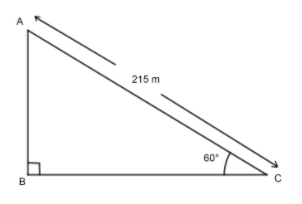
We are given the length which represents length of string, whose measure is 215m and also the measure of angle is given ACB which is \[{60^ \circ }\]
From this, we have to find the length of AB, so we have to consider the trigonometric ratio \[\sin \theta \].
So, if the right angled triangle, let’s say triangle DEF is given,
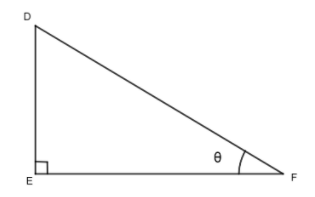
The value of \[\sin \angle \theta \] will be \[\dfrac{{{\rm{opposite side}}}}{{{\rm{hypotenuse}}}} \Rightarrow \dfrac{{DE}}{{DF}}\]
Hence, for the triangle ABC, the value of \[\sin {60^ \circ }\] will be \[\dfrac{{{\rm{opposite side}}}}{{{\rm{hypotenuse}}}} \Rightarrow \dfrac{{AB}}{{AC}}\]
As we know that, AC length is 215m, so we can say that,
\[\sin {60^ \circ } = \dfrac{{AB}}{{215}}\]
As we know that \[\sin {60^ \circ }{\rm{ is }}\dfrac{{\sqrt 3 }}{2}\] by saying it is a value of standard angles of trigonometric functions.
Thus, we get,
\[\dfrac{{\sqrt 3 }}{2} = \dfrac{{AB}}{{215}}\]
Now, on cross multiplication we get,
\[AB = 215 \times \dfrac{{\sqrt 3 }}{2}\]
We know that the value of\[\sqrt 3 {\rm{ is }}1.732\]. Thus, the value of AB is
\[\left( {215 \times \dfrac{{1.732}}{2}} \right) \Rightarrow \left( {215 \times 0.866} \right)\]
Which on calculation, we get, 186.19m.
Hence, the height of the balloon from ground is 186.19m.
Note: Students generally confuse themselves while finding length and choosing which trigonometric function one should take to compare and for further calculation. We can also solve it by taking cosine ratio and finding the base of the triangle, i.e. BC. Then, we can apply the tangent ratio to get the perpendicular, i.e. AB. But this is a long process, so it is better to use the sine ratio here.
Complete step-by-step answer:
In the question, we are told that a balloon is connected to a meteorological ground station by a cable of 215m that is inclined at an angle \[{60^ \circ }\]. Now, we have to find the height of the balloon from the ground if there is no shock in the cable.
Let's suppose the location of the meteorological ground station be marked as C, A be marked as location of balloon and B represents the point on the ground formed when the perpendicular is drawn vertically from A.
So, thus this can be represented in form of a diagram which is,
We are given the length which represents length of string, whose measure is 215m and also the measure of angle is given ACB which is \[{60^ \circ }\]
From this, we have to find the length of AB, so we have to consider the trigonometric ratio \[\sin \theta \].
So, if the right angled triangle, let’s say triangle DEF is given,
The value of \[\sin \angle \theta \] will be \[\dfrac{{{\rm{opposite side}}}}{{{\rm{hypotenuse}}}} \Rightarrow \dfrac{{DE}}{{DF}}\]
Hence, for the triangle ABC, the value of \[\sin {60^ \circ }\] will be \[\dfrac{{{\rm{opposite side}}}}{{{\rm{hypotenuse}}}} \Rightarrow \dfrac{{AB}}{{AC}}\]
As we know that, AC length is 215m, so we can say that,
\[\sin {60^ \circ } = \dfrac{{AB}}{{215}}\]
As we know that \[\sin {60^ \circ }{\rm{ is }}\dfrac{{\sqrt 3 }}{2}\] by saying it is a value of standard angles of trigonometric functions.
Thus, we get,
\[\dfrac{{\sqrt 3 }}{2} = \dfrac{{AB}}{{215}}\]
Now, on cross multiplication we get,
\[AB = 215 \times \dfrac{{\sqrt 3 }}{2}\]
We know that the value of\[\sqrt 3 {\rm{ is }}1.732\]. Thus, the value of AB is
\[\left( {215 \times \dfrac{{1.732}}{2}} \right) \Rightarrow \left( {215 \times 0.866} \right)\]
Which on calculation, we get, 186.19m.
Hence, the height of the balloon from ground is 186.19m.
Note: Students generally confuse themselves while finding length and choosing which trigonometric function one should take to compare and for further calculation. We can also solve it by taking cosine ratio and finding the base of the triangle, i.e. BC. Then, we can apply the tangent ratio to get the perpendicular, i.e. AB. But this is a long process, so it is better to use the sine ratio here.
Recently Updated Pages
Class 10 Question and Answer - Your Ultimate Solutions Guide

Master Class 10 Computer Science: Engaging Questions & Answers for Success
Master Class 10 General Knowledge: Engaging Questions & Answers for Success
Master Class 12 Economics: Engaging Questions & Answers for Success
Master Class 12 Social Science: Engaging Questions & Answers for Success
Master Class 12 English: Engaging Questions & Answers for Success
Trending doubts
Explain the Treaty of Vienna of 1815 class 10 social science CBSE
The slogan Jai Hind was given by A Lal Bahadur Shastri class 10 social science CBSE
10 examples of evaporation in daily life with explanations
What is the full form of POSCO class 10 social science CBSE
Identify the feminine form of noun nephew a shenephew class 10 english CBSE
CSIR full form?