




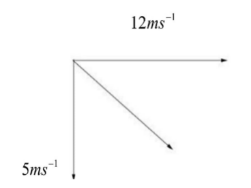
A hydrogen balloon is flying eastward with speed $12\,m{s^{ - 1}}$.when wind starts blowing from north to south with the speed $5\,m{s^{ - 1}}$,what is the resultant velocity of balloon ?
Answer
 Verified
516k+ views
Hint: To answer this question, we first need to understand what is resultant velocity. The sum of an object's individual vector velocities is its resultant velocity. The scalar product of an object's mass and its acceleration vector equals the sum of the vector forces acting on it.
Complete step by step answer:
As given in this question the speed of the hydrogen balloon and the wind are perpendicular to each other. So, this forms a right-angled triangle with a base of $12\,m{s^{ - 1}}$ and a height of $5\,m{s^{ - 1}}$. Whereas the resultant velocity is the hypotenuse. So, in order to find out this resultant velocity we have to apply the Pythagoras theorem to get the solution.
According to Pythagoras theorem
$H = \sqrt {{h^2} + {b^2}}$
Here $H$ is the hypotenuse whereas $b$ is the base and $h$ are the height.
So, substituting the values of $h$ and $b$.
$H = \sqrt {{5^2} + {{12}^2}} $
$\Rightarrow H = \sqrt {25 + 144} $
$\Rightarrow H = \sqrt {169} $
$\therefore H = 13\,m{s^{ - 1}}$.
So, the final answer is that the resultant velocity is $13\,m{s^{ - 1}}$.
Note: The velocity's sign is determined by the coordinate system used to define the spot. A positive velocity indicates that the object is moving in the positive direction as defined by the coordinate system, while a negative velocity indicates that the object is moving in the opposite direction.
Complete step by step answer:
As given in this question the speed of the hydrogen balloon and the wind are perpendicular to each other. So, this forms a right-angled triangle with a base of $12\,m{s^{ - 1}}$ and a height of $5\,m{s^{ - 1}}$. Whereas the resultant velocity is the hypotenuse. So, in order to find out this resultant velocity we have to apply the Pythagoras theorem to get the solution.
According to Pythagoras theorem
$H = \sqrt {{h^2} + {b^2}}$
Here $H$ is the hypotenuse whereas $b$ is the base and $h$ are the height.
So, substituting the values of $h$ and $b$.
$H = \sqrt {{5^2} + {{12}^2}} $
$\Rightarrow H = \sqrt {25 + 144} $
$\Rightarrow H = \sqrt {169} $
$\therefore H = 13\,m{s^{ - 1}}$.
So, the final answer is that the resultant velocity is $13\,m{s^{ - 1}}$.
Note: The velocity's sign is determined by the coordinate system used to define the spot. A positive velocity indicates that the object is moving in the positive direction as defined by the coordinate system, while a negative velocity indicates that the object is moving in the opposite direction.
Recently Updated Pages
Master Class 11 Computer Science: Engaging Questions & Answers for Success

Master Class 11 Business Studies: Engaging Questions & Answers for Success
Master Class 11 Economics: Engaging Questions & Answers for Success
Master Class 11 English: Engaging Questions & Answers for Success
Master Class 11 Maths: Engaging Questions & Answers for Success
Master Class 11 Biology: Engaging Questions & Answers for Success
Trending doubts
One Metric ton is equal to kg A 10000 B 1000 C 100 class 11 physics CBSE
There are 720 permutations of the digits 1 2 3 4 5 class 11 maths CBSE
Discuss the various forms of bacteria class 11 biology CBSE
Draw a diagram of a plant cell and label at least eight class 11 biology CBSE
State the laws of reflection of light
Explain zero factorial class 11 maths CBSE