




(a) How does carboxylate ion get stabilised by resonance? Explain the structure.
(b) Carboxylic acids are more acidic than phenols. Explain.
Answer
 Verified
639.9k+ views
Hint: Resonance is the phenomenon in which the bonding in a complex is determined by several structures known as resonance structures into a resonance hybrid in the valence bond theory. The actual bond lies in between these structures, usually the delocalisation of the electrons is described by this process.
Complete step by step answer:
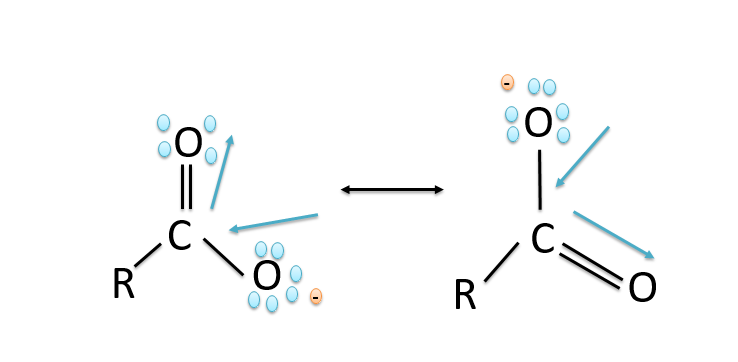
a).The stability of the carboxylate ions is due to the stabilization of the carboxylate ion due to the resonance. The negative charge in the carboxylate ion is delocalised on both the oxygen atoms by the two equivalent structures and thus the charge gets delocalised and the delocalisation of the charges leads to stability. The resonance in the carboxylate ion is shown below:
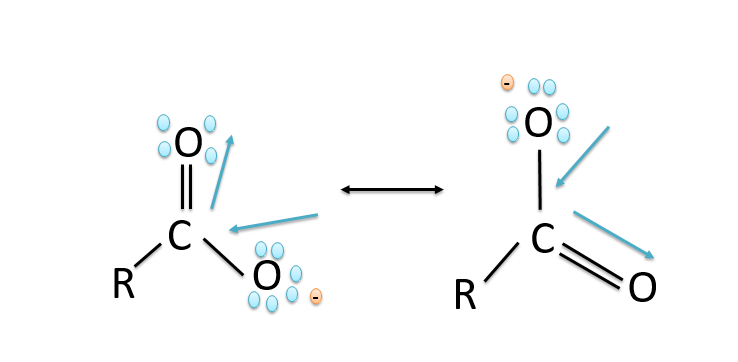
b)Carboxylic acids are more acidic than phenols because in phenols the negative charge is delocalized less effectively over one oxygen atom and carbon atoms in phenoxide ion less electronegative while in the carboxylic acids the carboxylate ion exhibits higher stability in comparison to phenoxide ion due to which the phenols are less acidic since they rarely give the hydronium ion during the chemical reactions. While the stability of the carboxylate ion accounts for the acidity of carboxylic acids. The resonance structures in phenoxide ions are non-equivalent whereas in carboxylate ions the structures are equivalent in nature. The resonance in the carboxylate ion is shown below:
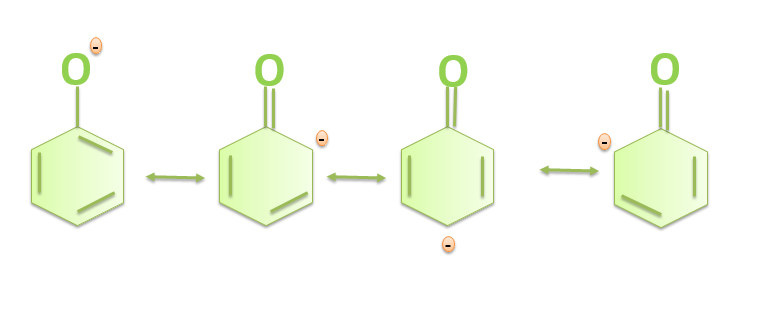
The resonance in the phenoxide ion is shown below:
Note:
The stability of the molecule depends on the delocalisation of the electrons in the molecule, which in turn is dependent on the resonating structures of the molecule. The delocalisation of the molecule allows for the lowering in the overall energy of the molecule, thus more the resonating structures of the molecule more will be the stability of the molecule.
Complete step by step answer:
a).The stability of the carboxylate ions is due to the stabilization of the carboxylate ion due to the resonance. The negative charge in the carboxylate ion is delocalised on both the oxygen atoms by the two equivalent structures and thus the charge gets delocalised and the delocalisation of the charges leads to stability. The resonance in the carboxylate ion is shown below:
b)Carboxylic acids are more acidic than phenols because in phenols the negative charge is delocalized less effectively over one oxygen atom and carbon atoms in phenoxide ion less electronegative while in the carboxylic acids the carboxylate ion exhibits higher stability in comparison to phenoxide ion due to which the phenols are less acidic since they rarely give the hydronium ion during the chemical reactions. While the stability of the carboxylate ion accounts for the acidity of carboxylic acids. The resonance structures in phenoxide ions are non-equivalent whereas in carboxylate ions the structures are equivalent in nature. The resonance in the carboxylate ion is shown below:
The resonance in the phenoxide ion is shown below:
Note:
The stability of the molecule depends on the delocalisation of the electrons in the molecule, which in turn is dependent on the resonating structures of the molecule. The delocalisation of the molecule allows for the lowering in the overall energy of the molecule, thus more the resonating structures of the molecule more will be the stability of the molecule.
Recently Updated Pages
Explain the structure of megasporangium class 12 biology CBSE

Why is chloroform kept in dark coloured bottles class 12 chemistry CBSE
Derive the balancing condition of a Wheatstone bri class 12 physics CBSE
Draw VI characteristics of a pn junction diode Explain class 12 physics CBSE
Is it possible to carry pride in ones language too class 12 english CBSE
In a population at Hardy Weinberg equilibrium the allele class 12 biology CBSE
Trending doubts
Draw a labelled sketch of the human eye class 12 physics CBSE
Which are the Top 10 Largest Countries of the World?
Draw ray diagrams each showing i myopic eye and ii class 12 physics CBSE
Which is the correct genotypic ratio of mendel dihybrid class 12 biology CBSE
Differentiate between homogeneous and heterogeneous class 12 chemistry CBSE
Give 10 examples of unisexual and bisexual flowers