




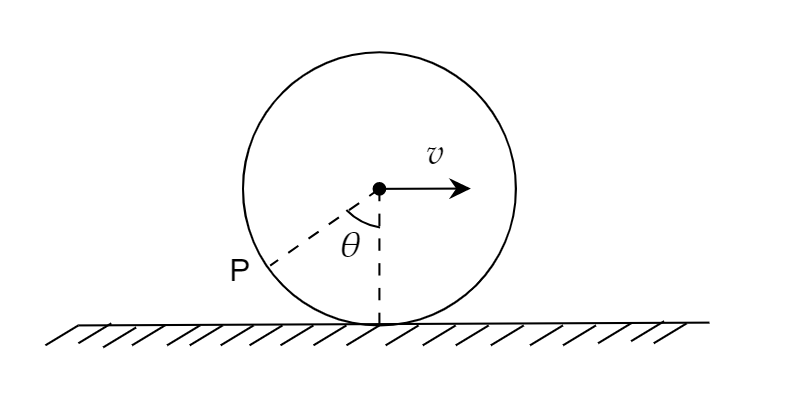
A hoop rolls on a horizontal ground without slipping with linear speed $ v $ . Speed of a particle P on the circumference of the hoop at an angle $ \theta $ is:
A. $ 2v\sin \left( {\dfrac{\theta }{2}} \right) $
B. $ v\sin \theta $
C. $ 2v\cos \left( {\dfrac{\theta }{2}} \right) $
D. $ v\cos \theta $
Answer
 Verified
493.8k+ views
Hint: In the given question, the particle is in rolling motion. At point P it will have both angular velocity and linear velocity, we have to find the resultant velocity from that point. By formulating and comparing equations we will find the answer.
Complete step by step solution:
According to the question, the hoop is in rolling motion on the horizontal ground without slipping. So, at point P the hoop is moving with both linear velocity $ v $ and angular velocity $ v $ .
The direction of the angular velocity is tangential to the point at which it acts.
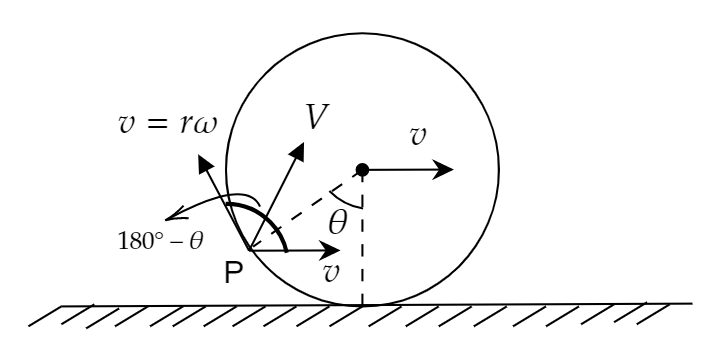
Let the speed of the particle be $ V $ and the angle between the angular velocity and linear velocity is $ {180^ \circ } - \theta $ .
From parallelogram law of vector, we get the speed of the particle as,
$ V = \sqrt {{v^2} + {v^2} + 2.v.v\cos \left( {{{180}^ \circ } - \theta } \right)} $
Simplifying the given equation we get,
$ V = \sqrt {2{v^2} - 2{v^2}\cos \theta } $
Now, taking $ 2{v^2} $ as common we get,
$ V = \sqrt {2{v^2}\left( {1 - \cos \theta } \right)} $
Now, taking $ 2{v^2} $ out of the square root, we get,
$ V = \sqrt 2 v\sqrt {\left( {1 - \cos \theta } \right)} $
From Trigonometric half angle formula, we know that $ 1 - \cos \theta = 2{\sin ^2}\dfrac{\theta }{2} $
Substituting its value we get,
$ V = \sqrt 2 v\sqrt {2{{\sin }^2}\dfrac{\theta }{2}} $
Hence, $ V = 2v\sin \dfrac{\theta }{2} $
The correct option is A. $ 2v\sin \left( {\dfrac{\theta }{2}} \right) $ .
Note:
It must be noted that as the surface is frictionless, so the angular velocity at point P and linear velocity are equal. If the surface had friction, then the angular velocity and linear velocity will not be the same. The angle between the two vectors is found from the parallelogram as we extend the velocity direction.
Complete step by step solution:
According to the question, the hoop is in rolling motion on the horizontal ground without slipping. So, at point P the hoop is moving with both linear velocity $ v $ and angular velocity $ v $ .
The direction of the angular velocity is tangential to the point at which it acts.
Let the speed of the particle be $ V $ and the angle between the angular velocity and linear velocity is $ {180^ \circ } - \theta $ .
From parallelogram law of vector, we get the speed of the particle as,
$ V = \sqrt {{v^2} + {v^2} + 2.v.v\cos \left( {{{180}^ \circ } - \theta } \right)} $
Simplifying the given equation we get,
$ V = \sqrt {2{v^2} - 2{v^2}\cos \theta } $
Now, taking $ 2{v^2} $ as common we get,
$ V = \sqrt {2{v^2}\left( {1 - \cos \theta } \right)} $
Now, taking $ 2{v^2} $ out of the square root, we get,
$ V = \sqrt 2 v\sqrt {\left( {1 - \cos \theta } \right)} $
From Trigonometric half angle formula, we know that $ 1 - \cos \theta = 2{\sin ^2}\dfrac{\theta }{2} $
Substituting its value we get,
$ V = \sqrt 2 v\sqrt {2{{\sin }^2}\dfrac{\theta }{2}} $
Hence, $ V = 2v\sin \dfrac{\theta }{2} $
The correct option is A. $ 2v\sin \left( {\dfrac{\theta }{2}} \right) $ .
Note:
It must be noted that as the surface is frictionless, so the angular velocity at point P and linear velocity are equal. If the surface had friction, then the angular velocity and linear velocity will not be the same. The angle between the two vectors is found from the parallelogram as we extend the velocity direction.
Recently Updated Pages
Master Class 11 Computer Science: Engaging Questions & Answers for Success

Master Class 11 Business Studies: Engaging Questions & Answers for Success
Master Class 11 Economics: Engaging Questions & Answers for Success
Master Class 11 English: Engaging Questions & Answers for Success
Master Class 11 Maths: Engaging Questions & Answers for Success
Master Class 11 Biology: Engaging Questions & Answers for Success
Trending doubts
One Metric ton is equal to kg A 10000 B 1000 C 100 class 11 physics CBSE
There are 720 permutations of the digits 1 2 3 4 5 class 11 maths CBSE
Discuss the various forms of bacteria class 11 biology CBSE
Draw a diagram of a plant cell and label at least eight class 11 biology CBSE
State the laws of reflection of light
Explain zero factorial class 11 maths CBSE