




A hoop of radius r and mass m rotating with an angular velocity ${\omega _0}$ is placed on a rough horizontal surface. The initial velocity of the centre of the hoop is zero. What will be the velocity of the centre of the hoop when it ceases to slip?
A. $\dfrac{{r{\omega _0}}}{3}$
B. $\dfrac{{r{\omega _0}}}{2}$
C. $r{\omega _0}$
D. $\dfrac{{r{\omega _0}}}{4}$
Answer
 Verified
596.1k+ views
Hint: This can be solved by assuming there will be no external torque about the contact point and we can conserve the angular momentum of the hoop. Since the hoop is free to rotate and translate after placing it on the floor there will be linear velocity too and we should solve for it.
Formula used:
$\eqalign{
& L = mvr \cr
& L = I\omega \cr} $
Complete answer:
Initially the hoop is only rotating that means it has angular momentum due to rotation only. Now it is kept on the horizontal rough surface. The word rough denotes that there is friction between the ground and the hoop and that gives some translational velocity. So after some time there will be both translational and angular velocity.
In the initial case the angular momentum will be due to the rotational velocity whereas later the angular momentum will be due to both rotational and translational velocity.
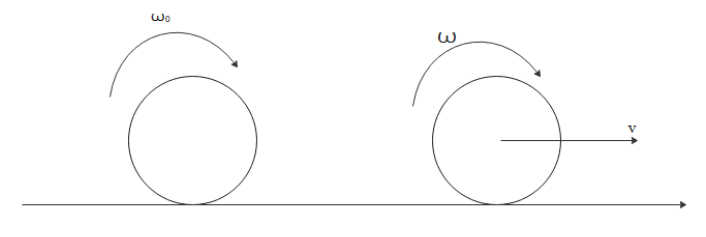
The diagram below depicts the initial and final condition of hoop,
With respect to point of contact we can conserve the angular momentum.
Initial angular momentum is
$L = I\omega $
$ \Rightarrow {L_i} = m{r^2}{\omega _0}$
Where ‘r’ is the radius and ${\omega _0}$ is the initial angular velocity and ‘m’ is the mass of hoop.
Final angular momentum is
$L = I\omega + mvr$
$\eqalign{
& \Rightarrow v = r\omega \cr
& \Rightarrow L = m{r^2}\dfrac{v}{r} + mvr \cr
& \Rightarrow {L_f} = 2mvr \cr} $
Where ‘v’ is the translational velocity attained.
Equate the initial and final angular momentum. Then we will get
${L_i} = {L_f}$
$\eqalign{
& \Rightarrow m{r^2}{\omega _0} = 2mvr \cr
& \Rightarrow \dfrac{{r{\omega _0}}}{2} = v \cr
& \Rightarrow v = \dfrac{{r{\omega _0}}}{2} \cr} $
Hence answer will be option B.
Note:
In case of conservation of angular momentum we can conserve about the point of contact not about the center of mass of the hoop because in only the first case torque acting will be zero which is the essential condition for conserving the angular momentum. Even though frictional force acts at the point of contact, it will not contribute to any torque.
Formula used:
$\eqalign{
& L = mvr \cr
& L = I\omega \cr} $
Complete answer:
Initially the hoop is only rotating that means it has angular momentum due to rotation only. Now it is kept on the horizontal rough surface. The word rough denotes that there is friction between the ground and the hoop and that gives some translational velocity. So after some time there will be both translational and angular velocity.
In the initial case the angular momentum will be due to the rotational velocity whereas later the angular momentum will be due to both rotational and translational velocity.
The diagram below depicts the initial and final condition of hoop,
With respect to point of contact we can conserve the angular momentum.
Initial angular momentum is
$L = I\omega $
$ \Rightarrow {L_i} = m{r^2}{\omega _0}$
Where ‘r’ is the radius and ${\omega _0}$ is the initial angular velocity and ‘m’ is the mass of hoop.
Final angular momentum is
$L = I\omega + mvr$
$\eqalign{
& \Rightarrow v = r\omega \cr
& \Rightarrow L = m{r^2}\dfrac{v}{r} + mvr \cr
& \Rightarrow {L_f} = 2mvr \cr} $
Where ‘v’ is the translational velocity attained.
Equate the initial and final angular momentum. Then we will get
${L_i} = {L_f}$
$\eqalign{
& \Rightarrow m{r^2}{\omega _0} = 2mvr \cr
& \Rightarrow \dfrac{{r{\omega _0}}}{2} = v \cr
& \Rightarrow v = \dfrac{{r{\omega _0}}}{2} \cr} $
Hence answer will be option B.
Note:
In case of conservation of angular momentum we can conserve about the point of contact not about the center of mass of the hoop because in only the first case torque acting will be zero which is the essential condition for conserving the angular momentum. Even though frictional force acts at the point of contact, it will not contribute to any torque.
Recently Updated Pages
Master Class 12 Social Science: Engaging Questions & Answers for Success

Master Class 12 Physics: Engaging Questions & Answers for Success
Master Class 12 Maths: Engaging Questions & Answers for Success
Master Class 12 Economics: Engaging Questions & Answers for Success
Master Class 12 Chemistry: Engaging Questions & Answers for Success
Master Class 12 Business Studies: Engaging Questions & Answers for Success
Trending doubts
Which are the Top 10 Largest Countries of the World?
Draw a labelled sketch of the human eye class 12 physics CBSE
Explain the structure of megasporangium class 12 biology CBSE
What are the major means of transport Explain each class 12 social science CBSE
How many chromosomes are found in human ovum a 46 b class 12 biology CBSE
The diagram of the section of a maize grain is given class 12 biology CBSE