




A homogeneous solid cylindrical roller of radius $R$ and mass $M$ is pulled on a cricket pitch by a horizontal force. Assuming rolling without slipping, angular acceleration of the cylinder is _____?
(A) $\dfrac{{3F}}{{2mR}}$
(B) $\dfrac{F}{{3mR}}$
(C) $\dfrac{{2F}}{{3mR}}$
(D) $\dfrac{F}{{2mR}}$
Answer
 Verified
642k+ views
Hint From the formula for torque given by product of the moment of inertia and the angular acceleration. The torque is also given by the product of the force and the radius. So equating we get the angular acceleration.
In this solution we will be using the following formula,
$\Rightarrow \tau = I\alpha $
where $\tau $ is the torque, $I$ is the moment of inertia and $\alpha $ is the angular acceleration.
again $\tau = FR$
where $F$ is the force and $R$ is the distance from the axis of rotation.
Complete step by step answer
In the question we are given a homogeneous solid cylinder that is given a horizontal force. So we can draw the diagram as,
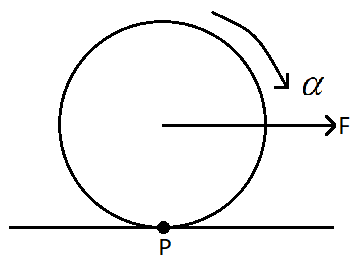
The cylinder, as we can see from the diagram, is touching at the point P. Now the torque is given as the product of the moment of inertia and the angular acceleration. So we can write,
$\Rightarrow \tau = I\alpha $
Now the moment of inertia of a solid homogeneous cylinder about an axis passing through its center and along the length is given by the formula,
$\Rightarrow I = \dfrac{3}{2}M{R^2}$
So substituting this we get,
$\Rightarrow \tau = \dfrac{3}{2}M{R^2}\alpha $
Now the torque on the cylinder due to the force that is acting on it horizontally is given by the product of the force and the distance of the point of contact from the axis of rotation. Hence we have,
$\Rightarrow \tau = FR$
So we can equate the two values of torque as,
$\Rightarrow \dfrac{3}{2}M{R^2}\alpha = FR$
Keeping only the $\alpha $ in the LHS and taking the rest of the terms to the RHS we get,
$\Rightarrow \alpha = \dfrac{2}{{3M{R^2}}}FR$
On cancelling the $R$ from the numerator and the denominator we get,
$\Rightarrow \alpha = \dfrac{{2F}}{{3MR}}$
Hence the angular acceleration is $\dfrac{{2F}}{{3MR}}$
So the correct answer is option (C).
Note
The moment of inertia of a rigid body is the quantity that determines the torque needed for the required angular acceleration about a rotational axis. It is equivalent to the way mass determines the force needed for desired acceleration.
In this solution we will be using the following formula,
$\Rightarrow \tau = I\alpha $
where $\tau $ is the torque, $I$ is the moment of inertia and $\alpha $ is the angular acceleration.
again $\tau = FR$
where $F$ is the force and $R$ is the distance from the axis of rotation.
Complete step by step answer
In the question we are given a homogeneous solid cylinder that is given a horizontal force. So we can draw the diagram as,
The cylinder, as we can see from the diagram, is touching at the point P. Now the torque is given as the product of the moment of inertia and the angular acceleration. So we can write,
$\Rightarrow \tau = I\alpha $
Now the moment of inertia of a solid homogeneous cylinder about an axis passing through its center and along the length is given by the formula,
$\Rightarrow I = \dfrac{3}{2}M{R^2}$
So substituting this we get,
$\Rightarrow \tau = \dfrac{3}{2}M{R^2}\alpha $
Now the torque on the cylinder due to the force that is acting on it horizontally is given by the product of the force and the distance of the point of contact from the axis of rotation. Hence we have,
$\Rightarrow \tau = FR$
So we can equate the two values of torque as,
$\Rightarrow \dfrac{3}{2}M{R^2}\alpha = FR$
Keeping only the $\alpha $ in the LHS and taking the rest of the terms to the RHS we get,
$\Rightarrow \alpha = \dfrac{2}{{3M{R^2}}}FR$
On cancelling the $R$ from the numerator and the denominator we get,
$\Rightarrow \alpha = \dfrac{{2F}}{{3MR}}$
Hence the angular acceleration is $\dfrac{{2F}}{{3MR}}$
So the correct answer is option (C).
Note
The moment of inertia of a rigid body is the quantity that determines the torque needed for the required angular acceleration about a rotational axis. It is equivalent to the way mass determines the force needed for desired acceleration.
Recently Updated Pages
If x a + bt + ct2 where x is in meters and t is in class 11 physics CBSE

A car covers the first half distance between two places class 11 physics CBSE
The resultant of two vectors overrightarrow P and overrightarrow class 11 physics CBSE
Find the value of cos 135 class 11 maths CBSE
A mass M is held in place by an applied force F and class 11 physics CBSE
A solution of glucose in water is labelled as 10 dfracwv class 11 chemistry CBSE
Trending doubts
One Metric ton is equal to kg A 10000 B 1000 C 100 class 11 physics CBSE
Find the value of the expression given below sin 30circ class 11 maths CBSE
What do you mean by retardation What is its SI uni class 11 physics CBSE
Draw a diagram of nephron and explain its structur class 11 biology CBSE
10 examples of friction in our daily life
Difference between physical and chemical change class 11 chemistry CBSE