




A hemispherical depression is cut out from one face of the cubical wooden block such that the diameter (l) of the hemisphere is equal to the edge of the cube. Determine the surface area of the remaining solid.
Answer
 Verified
528.6k+ views
HINT- Proceed the solution of this question, first visualising the remaining part that will be left after a hemispherical depression is cut out from one face of the cubical wooden Block then using mensuration formulae we can find the area of remaining solid.
Complete step-by-step answer:
Consider the diagram shown below.
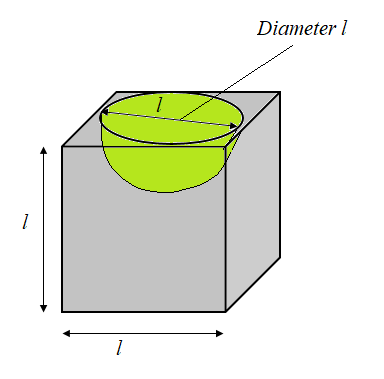
It is given that a hemisphere of radius \[\dfrac{l}{2}\] (diameter = l ) is cut out from the top face of the cubical wooden block.
Here, the diameter of the hemisphere is equal to the edge of the cube.
So, diameter = side of cube = l
Here, the base of the hemisphere would not be included in the total surface area of the wooden cube.
Therefore, surface area of the remaining solid
= surface area of the cubical box who’s each edge is of length l − Area of the top of the hemispherical part + curved surface area of the hemispherical part
Area of cube
Here, side = l
Area of cube = $6 \times {({\text{side}})^2} = 6 \times {(l)^2}$
Curved surface area of hemisphere
Diameter of hemisphere = l
Hence, radius = r = $\dfrac{{{\text{Diameter}}}}{2} = \dfrac{l}{2}$
We know that
Curved surface area of hemisphere = $2\pi {{\text{r}}^2}$
On putting $r = \dfrac{l}{2}$
Curved surface area of hemisphere = $2\pi {\left( {\dfrac{l}{2}} \right)^2} = 2\pi \times \dfrac{{{l^2}}}{4} = \pi \times \dfrac{{{l^2}}}{2}$
Base area of hemisphere
Base area of hemisphere is a circle with radius = radius of hemisphere = r $ = \dfrac{l}{2}$
Base area of hemisphere = $\pi {{\text{r}}^2}$
$ \Rightarrow \pi {\left( {\dfrac{l}{2}} \right)^2}$
$ \Rightarrow \pi \times \dfrac{{{l^2}}}{4}$
Base area of hemisphere $ = \pi \times \dfrac{{{l^2}}}{4}$
Now, surface area of the remaining solid
= surface area of the cubical box who’s each edge is of length l − Area of the top of the hemispherical part + curved surface area of the hemispherical part
$ \Rightarrow 6 \times {(l)^2}$- $\pi \times \dfrac{{{l^2}}}{4}$ + $\pi \times \dfrac{{{l^2}}}{2}$
On further solving
$ \Rightarrow 6 \times {(l)^2}$ + $\pi \times \dfrac{{{l^2}}}{4}$
On taking ${l^2}$ as a common
\[ \Rightarrow {(l)^2}\left( {6 + \dfrac{\pi }{4}} \right) \Rightarrow {(l)^2}\left( {\dfrac{{24 + \pi }}{4}} \right) \Rightarrow \dfrac{{{{(l)}^2}}}{4}\left( {24 + \pi } \right)\]
\[ \Rightarrow \dfrac{{{{(l)}^2}}}{4}\left( {24 + \pi } \right)\] sq. units
Hence, surface area of the remaining solid = \[\dfrac{{{{(l)}^2}}}{4}\left( {24 + \pi } \right)\]
Note- In this particular question, sometimes it is difficult to visualise the red portion area (shown in below figure) and simply tells that surface area of the remaining solid will sum of
= surface area of 5 faces of the cubical box + curved surface area of the hemispherical part
But it’s not true.
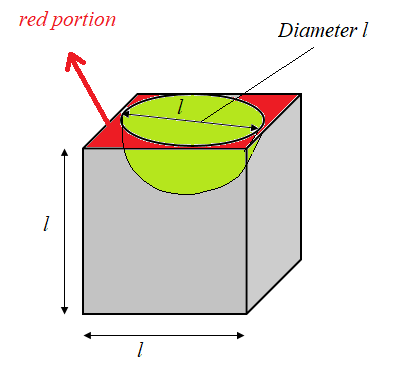
Hence we can also write surface area of the remaining solid
= surface area of 5 faces of the cubical box who’s each edge is of length l + surface area of upper face − Area of the top of the hemispherical part which is a circle + curved surface area of the hemispherical part
By solving like this, we will get the same answer.
Complete step-by-step answer:
Consider the diagram shown below.
It is given that a hemisphere of radius \[\dfrac{l}{2}\] (diameter = l ) is cut out from the top face of the cubical wooden block.
Here, the diameter of the hemisphere is equal to the edge of the cube.
So, diameter = side of cube = l
Here, the base of the hemisphere would not be included in the total surface area of the wooden cube.
Therefore, surface area of the remaining solid
= surface area of the cubical box who’s each edge is of length l − Area of the top of the hemispherical part + curved surface area of the hemispherical part
Area of cube
Here, side = l
Area of cube = $6 \times {({\text{side}})^2} = 6 \times {(l)^2}$
Curved surface area of hemisphere
Diameter of hemisphere = l
Hence, radius = r = $\dfrac{{{\text{Diameter}}}}{2} = \dfrac{l}{2}$
We know that
Curved surface area of hemisphere = $2\pi {{\text{r}}^2}$
On putting $r = \dfrac{l}{2}$
Curved surface area of hemisphere = $2\pi {\left( {\dfrac{l}{2}} \right)^2} = 2\pi \times \dfrac{{{l^2}}}{4} = \pi \times \dfrac{{{l^2}}}{2}$
Base area of hemisphere
Base area of hemisphere is a circle with radius = radius of hemisphere = r $ = \dfrac{l}{2}$
Base area of hemisphere = $\pi {{\text{r}}^2}$
$ \Rightarrow \pi {\left( {\dfrac{l}{2}} \right)^2}$
$ \Rightarrow \pi \times \dfrac{{{l^2}}}{4}$
Base area of hemisphere $ = \pi \times \dfrac{{{l^2}}}{4}$
Now, surface area of the remaining solid
= surface area of the cubical box who’s each edge is of length l − Area of the top of the hemispherical part + curved surface area of the hemispherical part
$ \Rightarrow 6 \times {(l)^2}$- $\pi \times \dfrac{{{l^2}}}{4}$ + $\pi \times \dfrac{{{l^2}}}{2}$
On further solving
$ \Rightarrow 6 \times {(l)^2}$ + $\pi \times \dfrac{{{l^2}}}{4}$
On taking ${l^2}$ as a common
\[ \Rightarrow {(l)^2}\left( {6 + \dfrac{\pi }{4}} \right) \Rightarrow {(l)^2}\left( {\dfrac{{24 + \pi }}{4}} \right) \Rightarrow \dfrac{{{{(l)}^2}}}{4}\left( {24 + \pi } \right)\]
\[ \Rightarrow \dfrac{{{{(l)}^2}}}{4}\left( {24 + \pi } \right)\] sq. units
Hence, surface area of the remaining solid = \[\dfrac{{{{(l)}^2}}}{4}\left( {24 + \pi } \right)\]
Note- In this particular question, sometimes it is difficult to visualise the red portion area (shown in below figure) and simply tells that surface area of the remaining solid will sum of
= surface area of 5 faces of the cubical box + curved surface area of the hemispherical part
But it’s not true.
Hence we can also write surface area of the remaining solid
= surface area of 5 faces of the cubical box who’s each edge is of length l + surface area of upper face − Area of the top of the hemispherical part which is a circle + curved surface area of the hemispherical part
By solving like this, we will get the same answer.
Recently Updated Pages
Master Class 10 Computer Science: Engaging Questions & Answers for Success

Master Class 10 General Knowledge: Engaging Questions & Answers for Success
Master Class 10 English: Engaging Questions & Answers for Success
Master Class 10 Social Science: Engaging Questions & Answers for Success
Master Class 10 Maths: Engaging Questions & Answers for Success
Master Class 10 Science: Engaging Questions & Answers for Success
Trending doubts
What is the median of the first 10 natural numbers class 10 maths CBSE
Which women's tennis player has 24 Grand Slam singles titles?
Who is the Brand Ambassador of Incredible India?
Why is there a time difference of about 5 hours between class 10 social science CBSE
Write a letter to the principal requesting him to grant class 10 english CBSE
A moving boat is observed from the top of a 150 m high class 10 maths CBSE