




A heavy ring of mass m is clamped on the periphery of a light circular disc. A small particle having equal mass is damped at the centre of the disc. The system is rotated in such a way that the centre moves in a circle of radius r with a uniform speed \[v\] . We conclude that the external force …
A. \[\dfrac{{m{v^2}}}{r}\] ,Must be acting on the central particle.
B. \[\dfrac{{2m{v^2}}}{r}\] ,Must be acting on the central particle.
C. \[\dfrac{{2m{v^2}}}{r}\] ,Must be acting on the system.
D. \[\dfrac{{m{v^2}}}{r}\], Must be acting on the ring.
Answer
 Verified
570.9k+ views
Hint: To find out the force on the system of particles , first treat the bodies of the system as a whole system then apply the formula on the centre of mass of the system. Here total of mass 2m is moving with velocity ( v ) so the centrifugal force on the system of particle is \[{F_C} = \dfrac{{{m_{system}}{{(velocity)}^2}}}{{radius\;ofc.o.m}}\].
Complete Step by step solution :
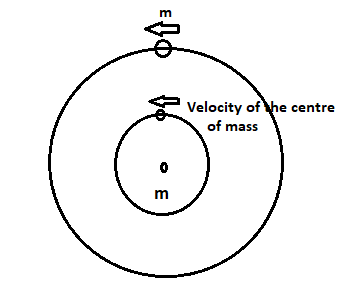
The situation is shown here
\[{F_C}\]
Let us consider the heavy ring of mass m is clamped on the periphery of a light circular disc and a small particle having equal mass is damped at the centre of the disc as a system. Then the centre of mass of the system has a total of mass 2m.
Now, it is given that the centre of mass moves with velocity v in a circle , so due to this circular motion of the centre of mass there will be a centrifugal force .
\[ \Rightarrow {F_C} = \dfrac{{{m_{system}}{{(velocity)}^2}}}{{radius\;ofc.o.m}}\]
Putting the values \[{m_{system}} = 2m\]; \[velocity = v\]; \[radius\;ofc.o.m = r\]
\[ \Rightarrow {F_C} = \dfrac{{2m{v^2}}}{r}\]
Since, \[\dfrac{{2m{v^2}}}{r}\] ,Must be acting on the system as a centrifugal force ,
Hence option ( C ) is the correct answer.
Note:
When a body moves in a circular motion there acts a force due to which the particle still continues its path in a circle and this force is constant in nature if the velocity of the body is constant and called as centripetal force.
The value of the centripetal force is
\[{F_{centripetal}} = \dfrac{{{m_{body}}{{(velocity)}^2}}}{{radius\;of circle}}\].
Complete Step by step solution :
The situation is shown here
\[{F_C}\]
Let us consider the heavy ring of mass m is clamped on the periphery of a light circular disc and a small particle having equal mass is damped at the centre of the disc as a system. Then the centre of mass of the system has a total of mass 2m.
Now, it is given that the centre of mass moves with velocity v in a circle , so due to this circular motion of the centre of mass there will be a centrifugal force .
\[ \Rightarrow {F_C} = \dfrac{{{m_{system}}{{(velocity)}^2}}}{{radius\;ofc.o.m}}\]
Putting the values \[{m_{system}} = 2m\]; \[velocity = v\]; \[radius\;ofc.o.m = r\]
\[ \Rightarrow {F_C} = \dfrac{{2m{v^2}}}{r}\]
Since, \[\dfrac{{2m{v^2}}}{r}\] ,Must be acting on the system as a centrifugal force ,
Hence option ( C ) is the correct answer.
Note:
When a body moves in a circular motion there acts a force due to which the particle still continues its path in a circle and this force is constant in nature if the velocity of the body is constant and called as centripetal force.
The value of the centripetal force is
\[{F_{centripetal}} = \dfrac{{{m_{body}}{{(velocity)}^2}}}{{radius\;of circle}}\].
Recently Updated Pages
Basicity of sulphurous acid and sulphuric acid are

Master Class 12 English: Engaging Questions & Answers for Success
Master Class 12 Social Science: Engaging Questions & Answers for Success
Master Class 12 Maths: Engaging Questions & Answers for Success
Master Class 12 Economics: Engaging Questions & Answers for Success
Master Class 12 Physics: Engaging Questions & Answers for Success
Trending doubts
Which are the Top 10 Largest Countries of the World?
Draw a labelled sketch of the human eye class 12 physics CBSE
Draw ray diagrams each showing i myopic eye and ii class 12 physics CBSE
Give 10 examples of unisexual and bisexual flowers
How was the Civil Disobedience Movement different from class 12 social science CBSE
How is democracy better than other forms of government class 12 social science CBSE