




A heavy brass sphere is hung from a light spring and is set in vertical small oscillation with a period T. The sphere is now immersed in a non-viscous liquid with a density \[1/10th\] the density of the sphere. If the system is now set in vertical S.H.M., its period will be,
A. \[\left( \dfrac{9}{10} \right)T\]
B. \[{{\left( \dfrac{9}{10} \right)}^{2}}T\]
C. \[\left( \dfrac{10}{9}T \right)\]
D. T
Answer
 Verified
610.2k+ views
Hint: Here, we have to find the time period of a system which is set in a vertical S.H.M. The time period of the sphere depends upon the spring constant (k) and mass of the sphere. Both, the spring constant and mass of the sphere, remain unchanged when the sphere is immersed in a non-viscous liquid.
Complete answer:
A diagram can be illustrated as follows:
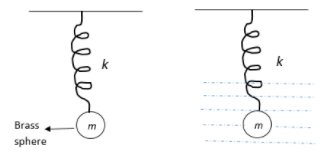
A heavy brass Sphere is hung from a light spring and set in a vertical oscillation with time period T. Therefore, the time period of spring pendulum of mass m and Spring Constant k is given by
\[T=2\pi \sqrt{\dfrac{m}{k}}\]
Hence, we can say that the time period of spring pendulum depends upon the mass m and the spring constant (k) of the spring.
Now, let the density of the sphere be \[\rho \]. Therefore, the density of the non-viscous liquid will be, \[\dfrac{\rho }{10}\]. But we need to calculate a time period which does not depend on density. Hence, density of the non-viscous liquid will not affect the time period in any way.
Hence, the correct option is (D).
Note:
We should not get confused between the time period of a simple pendulum and a spring pendulum. The time period of a simple pendulum is given by,
\[T=2\pi \sqrt{\dfrac{l}{g}}\]
where l is the length of string and g is acceleration due to gravitation.
However, for a spring pendulum, that is, a mass m attached to a spring with a spring constant k, the time period is given as,
\[T=2\pi \sqrt{\dfrac{m}{k}}\]
Complete answer:
A diagram can be illustrated as follows:
A heavy brass Sphere is hung from a light spring and set in a vertical oscillation with time period T. Therefore, the time period of spring pendulum of mass m and Spring Constant k is given by
\[T=2\pi \sqrt{\dfrac{m}{k}}\]
Hence, we can say that the time period of spring pendulum depends upon the mass m and the spring constant (k) of the spring.
Now, let the density of the sphere be \[\rho \]. Therefore, the density of the non-viscous liquid will be, \[\dfrac{\rho }{10}\]. But we need to calculate a time period which does not depend on density. Hence, density of the non-viscous liquid will not affect the time period in any way.
Hence, the correct option is (D).
Note:
We should not get confused between the time period of a simple pendulum and a spring pendulum. The time period of a simple pendulum is given by,
\[T=2\pi \sqrt{\dfrac{l}{g}}\]
where l is the length of string and g is acceleration due to gravitation.
However, for a spring pendulum, that is, a mass m attached to a spring with a spring constant k, the time period is given as,
\[T=2\pi \sqrt{\dfrac{m}{k}}\]
Recently Updated Pages
Master Class 11 English: Engaging Questions & Answers for Success

Master Class 11 Social Science: Engaging Questions & Answers for Success
Master Class 11 Maths: Engaging Questions & Answers for Success
Master Class 11 Biology: Engaging Questions & Answers for Success
Master Class 11 Physics: Engaging Questions & Answers for Success
Master Class 11 Chemistry: Engaging Questions & Answers for Success
Trending doubts
One Metric ton is equal to kg A 10000 B 1000 C 100 class 11 physics CBSE
Difference Between Prokaryotic Cells and Eukaryotic Cells
Find the value of the expression given below sin 30circ class 11 maths CBSE
Difference between physical and chemical change class 11 chemistry CBSE
Two of the body parts which do not appear in MRI are class 11 biology CBSE
Draw a diagram of a plant cell and label at least eight class 11 biology CBSE